
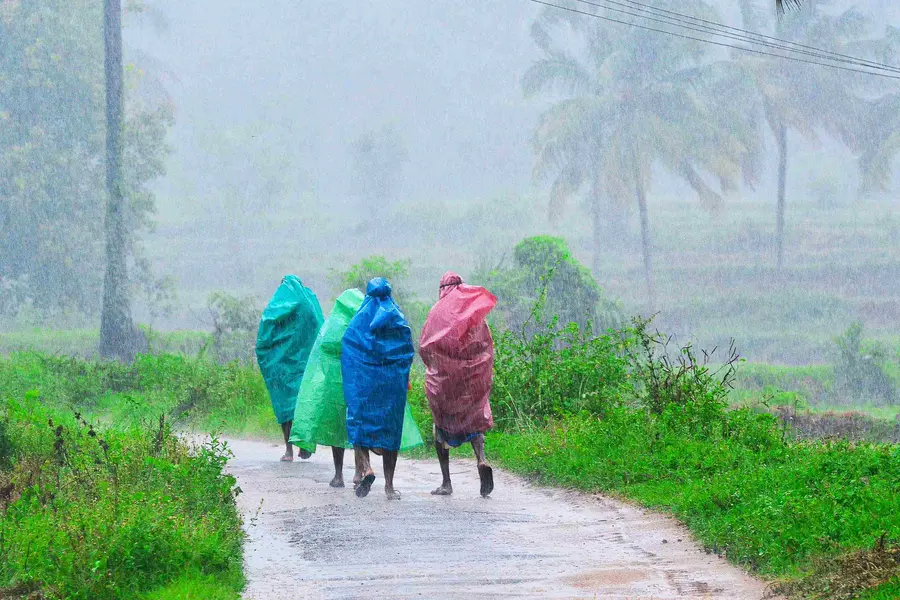
New Delhi: India experienced its wettest monsoon season in four years, receiving about 108 per cent of the long-period average rainfall, which amounted to 934.8 mm, according to data from the India Meteorological Department (IMD). The monsoon this year reached Kerala on May 30, 2024, a day earlier than the usual onset date of June 1. The early arrival of monsoon in Kerala paved the way for timely rains across the country. The long-period average rainfall in India is 868.6 mm.
In its pre-monsoon forecast, IMD had predicted above-normal rainfall across the country at 106 per cent of the long-period average.
The above-normal rainfall has benefited farmers, enabling more sowing during this Kharif season and supporting the broader agriculture sector, which remains a key source of livelihood for millions of Indians. The increased rainfall is likely to boost the gross value added (GVA) in agriculture.
A report from Bank of Baroda indicated that not only has Kharif sowing benefitted from the above-normal rainfall, but the upcoming Rabi sowing is also expected to fare well.
While Indian agriculture, particularly the Kharif season, has traditionally been highly reliant on monsoon rains, expanding irrigation facilities have gradually reduced this dependency.
Regionally, monsoon rainfall across Northwest India, Central India, South Peninsula, and Northeast India was 107 per cent, 119 per cent, 114 per cent, and 86 per cent of their respective long-period averages.
Among the 36 meteorological subdivisions, two subdivisions received large excess rainfall (covering 9 pc of India's total area), ten received excess rainfall (covering 26 pc), 21 received normal rainfall (covering 54 pc), and three subdivisions (Arunachal Pradesh, Punjab, J-K, and Ladakh), accounting for 11 pc, received deficient rainfall.
Monsoon rains began on a weaker note in June, registering 89 per cent of the long-period average. However, rainfall increased in subsequent months—July, August, and September saw 109 per cent, 115 per cent, and 112 per cent of the average, respectively.
This year, the Southwest monsoon current advanced over the south Andaman Sea and Nicobar Islands on schedule (May 19, 2024), almost two days before the usual date. It covered the entire country by July 2, 2024, six days ahead of the usual July 8 date.
The IMD highlighted that the forecast for the onset of monsoon over Kerala was accurate, marking the 19th consecutive year of successful forecasting, with the only exception being 2015.
The withdrawal of the monsoon began on September 23 from west Rajasthan, six days later than its usual date of September 17.
Kharif Crop Sowing:
India's Kharif crop sowing has shown strong performance this season, with planting across 1,108.57 lakh hectares so far, compared to 1,088.25 lakh hectares in the same period last year—a 1.9 per cent year-on-year increase, according to data from the Agriculture Ministry. This exceeds the average cultivated area (1,096 lakh hectares) from 2018-19 to 2022-23.
India has three cropping seasons: Summer, Kharif, and Rabi. Kharif crops are sown during June-July and are dependent on monsoon rains, with harvesting in October-November. Rabi crops are sown in October-November and harvested from January onwards, while Summer crops are grown between the Rabi and Kharif seasons.
Sowing has increased year-on-year for paddy, pulses, oilseeds, millets, and sugarcane, while it remains lower for cotton and jute/mesta. The area under paddy cultivation increased by 2.5 per cent, leading to the easing of some rice export restrictions by the government, including the removal of the minimum export price on basmati rice, permission for non-basmati white rice export subject to a minimum price of USD 490 per tonne, and halving the export duty on parboiled rice to 10 per cent.
Within the pulse category, all major pulses except urad bean—such as arhar, moong, kulthi, and moth bean—reported positive growth. As a major consumer and producer of pulses, India supplements domestic consumption with imports. Key pulses consumed in India include chana, masur, urad, kabuli, and tur. The government has been promoting pulse cultivation and procurement at Minimum Support Price (MSP).
Rahul Chauhan, director of IGrain India, noted that while some Kharif crops in the Bundelkhand region were damaged due to excessive rains, the overall higher rainfall is expected to benefit Rabi sowing. (Agencies)
Published: 02 Oct 2024, 03:18 pm IST
Related Topics
Disclaimer: Kindly avoid objectionable, derogatory, unlawful and lewd comments, while responding to reports. Such comments are punishable under cyber laws. Please keep away from personal attacks. The opinions expressed here are the personal opinions of readers and not that of Mathrubhumi.
