
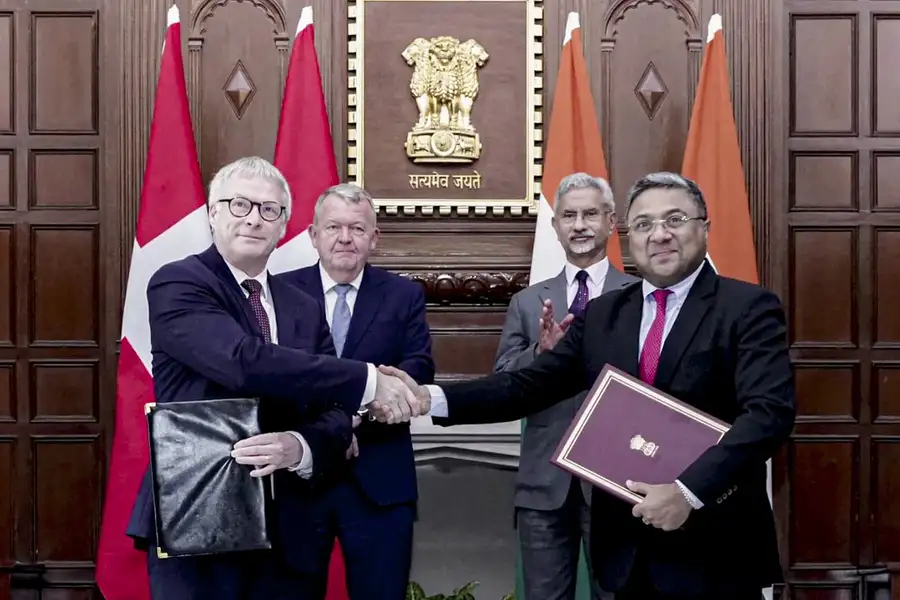
New Delhi: India and Denmark on Saturday firmed up a five-year action plan to significantly expand overall bilateral ties and resolved to extend cooperation in defence and security, emerging technologies, maritime affairs, health and agriculture as External Affairs Minister S Jaishankar held wide-ranging talks with his Danish counterpart Lars Lokke Rasmussen against the backdrop of a fractured geopolitical environment.
The two sides also signed five agreements to provide for deeper engagement in sectors such as financial services, education and skill development besides discussing ways to expand trade and investment relations.
Foreign Minister Rasmussen also met National Security Advisor Ajit Doval and discussed the expansion of cooperation into new strategic areas, as well as on global "geopolitical developments" of mutual concern.
The Danish minister also met Commerce Minister Piyush Goyal and discussed the European Union-India free trade deal and emerging commercial opportunities for Danish companies in India.
Denmark is a key partner country of India in Europe and the relations between the two sides have witnessed significant upswing in areas of trade and investment, green technologies and research and innovation after they elevated the relationship to a Green Strategic Partnership (GSP) in 2020.
"India is a great power, whose rise we will continue to witness in the coming years, both economically and geopolitically. In a world where the international rules of the game are under pressure, Denmark and Europe must reach out and build a stronger partnership with India," Rasmussen said.
"We have achieved significant progress in our bilateral cooperation since the establishment of the Green Strategic Partnership."
"I am here to further strengthen and expand that cooperation. I was particularly pleased that we agreed today on a new joint action plan for an elevated and comprehensive partnership for the coming years," he said, according to a Danish readout.
The Ministry of External Affairs (MEA) said Jaishankar and Rasmussen adopted the Joint Action Plan for 2027-31 to guide the next phase of bilateral cooperation and looked forward for the formal announcement of an elevated comprehensive GSP at the prime ministerial level at a later stage.
Rasmussen landed in New Delhi this morning after concluding his visit to Bengaluru.
In their talks at the fifth India-Denmark joint commission meeting, the two foreign ministers carried out a comprehensive review of implementation of GSP, which Jaishankar said has given the relationship a "very distinctive character".
"It brings together Danish capabilities and India's scale and developmen," he said.
The MEA said the two sides agreed to explore further cooperation in defence and security and and discussed strengthening cooperation in renewable energy, clean technologies, water management, maritime affairs, health, agriculture, food processing, research and innovation, and mobility.
"They also agreed to deepen collaboration in emerging technologies, including artificial intelligence, quantum computing and cyber security, and explore opportunities in space and Arctic cooperation," it said.
The two sides discussed expanding trade and investment. Denmark reiterated its support for the early signing of the India-EU Free Trade Agreement (FTA), the MEA said.
Jaishankar and Rasmussen also reviewed implementation of the Migration and Mobility Partnership Agreement signed in 2024.
In his remarks, Jaishankar highlighted the significance of the new India-Denmark joint action plan for 2026-31 in the larger context of New Delhi's deepening ties with the European Union.
"We very much appreciate the support that Denmark has given to the deepening of that partnership and particularly to the conclusion of the India-EU Free Trade agreement," he said.
The external affairs minister also listed how cooperation between India and Denmark expanded in sectors such as health, food processing, agriculture and science and technology under the framework of the GSP.
"What I do want to emphasise is as we work towards a goal of Viksit Bharat, that is developed India by 2047, we do envisage Denmark as a very important partner in that effort, and that is reflected in the fact that we work with you on many of our national missions," he said.
"We particularly value the contribution of Danish companies in India and welcome a larger business presence and activities in both directions."
The two ministers also deliberated on further expanding engagements in defence and security, emerging technologies, space, education, skills, and mobility.
Besides the agreement on the joint action plan, the other pacts inked were in the fields of skills development, sustainable water management, financial services and cultural exchanges.
The Memorandum of Understanding (MoU) on skill development will facilitate establishing a framework for closer cooperation on vocational education and training, including green, digital and care-related skills.
In Bengaluru, Rasmussen visited Hindustan Aeronautics Ltd (HAL), where components from the Danish company HBK are used in the Advanced Light Helicopter (Dhruv) and Light Combat Helicopter. He also visited the R&D testing facility for Tejas fighter jet.
The minister interacted with senior ISRO officials and discussed cooperation in the space sector.
He also visited the Centre for Cellular and Molecular Platforms (C-CAMP) and QpiAI, which focuses on integrating AI and quantum technologies, to explore two-way collaboration.
In Bengaluru, Rasmussen also met Karnataka IT Minister Priyank Kharge and officials of the Danish companies operating in the state to discuss the role of Global Capability Centres and India's large technology talent pool.
(Except for the headline, this story has not been edited by Mathrubhumi and is published from a syndicated feed.)
Published: 28 Nov 2026, 09:15 pm IST


Disclaimer: Kindly avoid objectionable, derogatory, unlawful and lewd comments, while responding to reports. Such comments are punishable under cyber laws. Please keep away from personal attacks. The opinions expressed here are the personal opinions of readers and not that of Mathrubhumi.
