
India and Belgium unveiled 10 key outcomes during Belgian Prime Minister Bart De Wever's visit, reinforcing bilateral cooperation across trade, technology and talent.
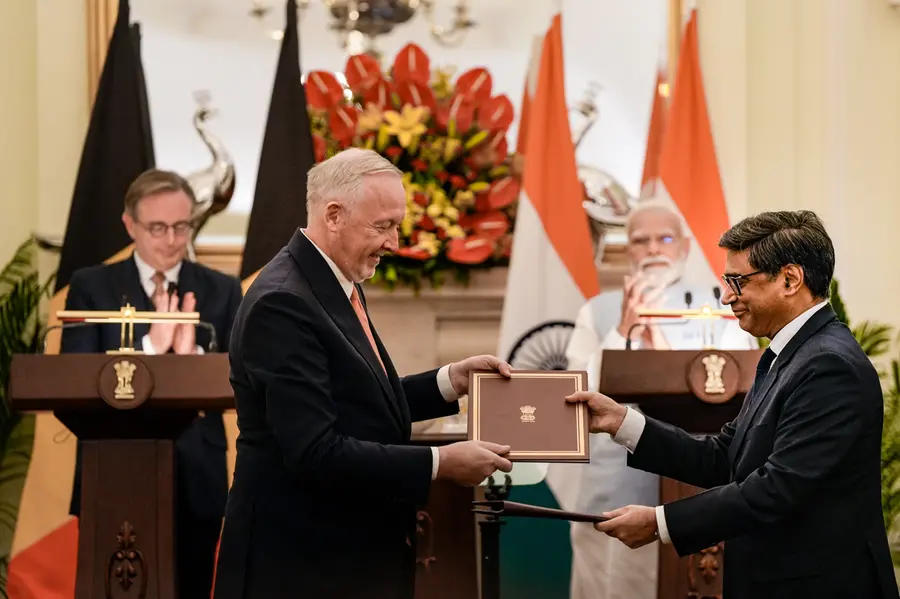
New Delhi: India and Belgium on Thursday revealed 10 landmark outcomes during Belgian Prime Minister Bart De Wever’s three-day diplomatic trip to India, marking a major step forward in bilateral ties spanning commercial trade, investments, national defence, clean energy, national security and cultural exchanges.
Addressing reporters after De Wever met with Prime Minister Narendra Modi, Ministry of External Affairs (MEA) Secretary (West) Sibi George highlighted that the partnership is anchored around “3Ts” – trade, technology and talent.
“In a nutshell, there is a clear focus on three Ts: Trade, Technology and Talent in this relationship,” George said.
De Wever landed in India on September 2 for his three-day visit following an invitation from PM Modi. Their bilateral discussions were structured to solidify ties and broaden joint ventures across trade, defence capabilities, technology transfer and infrastructure connectivity.
Strategic defence ties and new Attache
Among the major deliverables, both nations inked a Letter of Intent on Defence Cooperation along with an MoU linking the Belgian Security and Defence Industry Association (BDSI) with the Society of Indian Defence Manufacturers (SIDM).
George noted that the Letter of Intent provides “a formal institutional basis to our growing defence relationship”, alongside several finalised industrial and military partnerships.
India also confirmed the placement of a resident Defence Attache at the Indian Embassy in Brussels. According to George, this step will accelerate progress in security engagements, combining “Belgian technology together with India’s skill and scale”.
Boosting trade target to $26 billion
Regarding trade and investment, both nations established a target to double two-way trade over the next five years, up from its current level of approximately $13 billion.
To streamline business efforts, both governments agreed to establish an investment fast-track channel to encourage Belgian ventures in India, while also formalising routine commercial interactions via the India-Belgium Business Forum.
The bilateral talks further touched upon ongoing collaboration between Belgium's sovereign wealth fund and India's National Investment and Infrastructure Fund (NIIF), as well as financial technology partnerships.
Collaboration in green energy and critical minerals
In the green energy domain, an MoU was signed to boost cooperation in green hydrogen, green ammonia, solar power, energy storage, offshore wind, bioenergy, small hydropower projects, and pumped storage facilities.
George added that technological cooperation is expanding into the mining domain, including critical mineral extraction, refining, and processing.
“Cooperation in technology also covers the mining sector, critical minerals extraction, refining, processing, etc,” he said.
Maritime logistics via Port of Antwerp
Discussions also focused on maritime logistics tied to the Port of Antwerp. George described the hub as one of India's main entry points for trade into Europe, stating, “India and Belgium actively cooperate on maritime logistics centred around the Port of Antwerp, which is among India's primary cargo gateways to Europe. Cooperation in the port sector is in full swing.”
Mobility, healthcare and academic exchange
On human capital and mobility, George stressed that facilitating smoother movement for skilled professionals, students, researchers, and corporate travelers is essential to strengthening ties.
The leadership welcomed active health sector arrangements, including schemes enabling qualified Indian nurses to work in Belgium. Additionally, PM Modi extended an invitation to top Belgian universities and academic bodies to open satellite campuses in India.
Joint efforts on cybercrime and security
Addressing national security, India's Central Bureau of Investigation (CBI) and the Belgian Federal Police signed an MoU to jointly combat transnational organized crime and cyber threats.
The nations agreed to initiate a regular Consular Dialogue and completed an agreement on diplomatic training between the Sushma Swaraj Institute of Foreign Service and Belgium’s FPS Foreign Affairs.
George stated that talks extended into the green transition, emerging tech, critical mineral processing, healthcare, pharmaceuticals, biotechnology, food processing, and linking startup hubs in both countries.
Both sides reviewed microelectronics collaborations, including semiconductor manufacturers, and emphasised the growing influence of artificial intelligence and innovation.
Broader India-EU strategic ties
The heads of government evaluated the broader India-EU framework, acknowledging the successful completion of India-EU free trade agreement negotiations and advocating for its prompt execution.
They also observed that the India-EU Security and Defence Partnership will enhance strategic synergy across maritime safety, defence tech, cyber resilience, hybrid threats, space, and counterterrorism.
Unified stance against global terrorism
On counterterrorism, Belgium expressed firm condemnation of the terror attack on civilians in Pahalgam, Jammu and Kashmir, in April of last year.
“Both leaders underscored their commitment to a comprehensive global approach to counterterrorism and affirmed that terrorism in any form and manifestation and anywhere could never be justified,” George said.
Both leaders demanded that perpetrators be brought to justice under international law and stressed that the global community must act decisively against terror networks, their financing, safe havens and individuals listed under the UN Security Council 1267 sanctions list.
The 10 deliverables finalised during the visit span defence cooperation, industrial tie-ups, renewable energy, security, diplomatic instruction, defence representation, investment facilitation, trade growth, corporate interaction and consular ties.
ANI
Published: 04 Sept 2026, 06:53 am IST
ABOUT THE AUTHOR

Related Topics
Disclaimer: Kindly avoid objectionable, derogatory, unlawful and lewd comments, while responding to reports. Such comments are punishable under cyber laws. Please keep away from personal attacks. The opinions expressed here are the personal opinions of readers and not that of Mathrubhumi.