
India’s first indigenously engineered hydrogen fuel cell train has debuted on the Jind–Sonipat route, delivering zero-emission transit with advanced multi-layer safety systems.
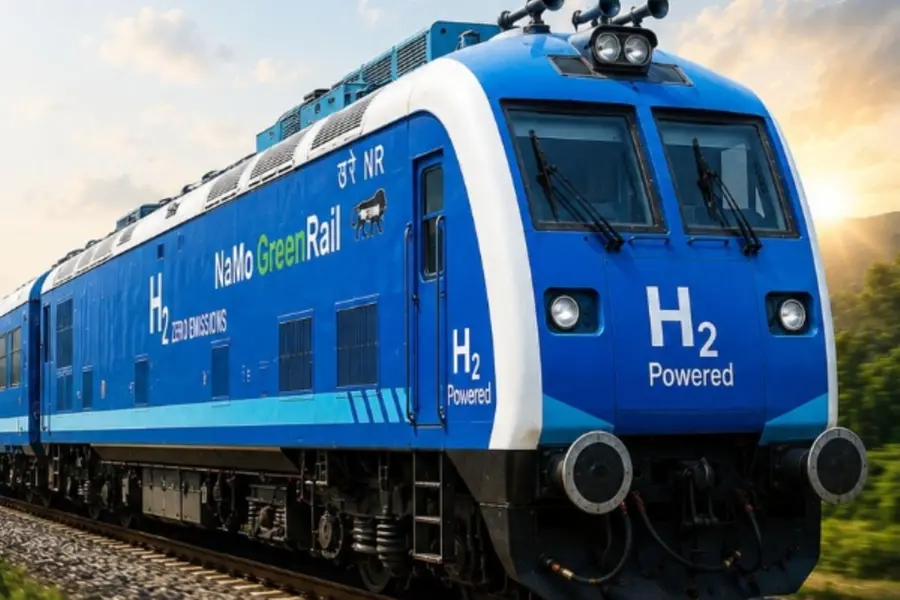
New Delhi: Marking a landmark milestone in the country's push towards clean mobility and sustainable infrastructure, India’s first indigenously built Hydrogen Fuel Cell Train has officially hit the tracks. Operating on the 89-km Jind–Sonipat corridor in Haryana, the revolutionary 10-coach train set generates its own zero-emission power onboard, emitting nothing but clean water vapour and heat as by-products.
Engineered under the Atmanirbhar Bharat initiative and aligned with the National Green Hydrogen Mission, the 2,400 kW (approx. 3,200 HP) train set stands out as one of the largest and most powerful passenger hydrogen trains operating globally.
How the clean technology works
Unlike conventional diesel locomotives or standard electric trains that draw electricity from overhead catenary wires, the hydrogen train functions as a self-sustaining mobile power plant.
- Proton Exchange Membrane (PEM) fuel cells: Onboard cylinders feed compressed hydrogen into PEM fuel cells, where it reacts with ambient oxygen to generate electricity through an electrochemical process—completely eliminating fuel combustion.
- Hybrid battery system: The propulsion setup pairs the fuel cells with high-capacity Lithium Iron Phosphate (LFP) batteries. The batteries supply extra surge power during acceleration and store energy captured during regenerative braking.
- High payload capacity: The 10-coach formation (comprising two driving power cars and eight trailer coaches) can accommodate nearly 2,600 passengers per trip, achieving a design speed of 110 kmph and an operational service speed of up to 75 kmph.
Inside the loco pilot’s cabin and dual-HMI control desk
The modernised pilot cabin features a dual Human-Machine Interface (HMI) digital control desk that provides real-time telemetry. Loco pilots can continuously monitor critical metrics, including
- Hydrogen cylinder pressure levels and fuel supply status.
- Real-time power balance between the fuel cell stacks and the LFP battery bank.
- Live system diagnostic alerts and continuous ventilation management.
Round-the-clock multi-layer safety architecture
Given the flammable nature of hydrogen, Indian Railways implemented strict, multi-layered safety and detection systems.
Onboard safety matrix
- 15 Hydrogen leak detectors placed strategically near storage tanks and piping networks.
- 7 heat detectors continuously monitoring thermal thresholds.
- 4 smoke detectors covering electrical and battery compartments.
- 3 flame detectors providing instant fire hazard warnings.
In the event of an abnormal reading, the continuous ventilation setup is complemented by an automated safety system that instantly shuts off the onboard hydrogen supply.
In addition, the loco pilot’s control desk is equipped with an emergency override mode allowing the train to be safely brought to a halt.
Supported by India’s largest Hydrogen ecosystem
To support continuous operations, Indian Railways constructed a dedicated, state-of-the-art hydrogen storage and refuelling facility in Jind.
- 3,000 kg storage capacity: The facility stores up to 3,000 kg of compressed hydrogen at a time to support dual round-trips daily.
- Simultaneous refuelling: Outfitted with high-pressure compression systems, the facility can dispense fuel to both driving power cars simultaneously.
With successful trials logged on the Jind–Sonipat section, Indian Railways plans to scale hydrogen propulsion technology across select heritage and hill routes, reducing reliance on diesel while paving the way for a greener, zero-carbon future.
Published: 21 Jul 2026, 08:13 pm IST
Related Topics
Disclaimer: Kindly avoid objectionable, derogatory, unlawful and lewd comments, while responding to reports. Such comments are punishable under cyber laws. Please keep away from personal attacks. The opinions expressed here are the personal opinions of readers and not that of Mathrubhumi.
