
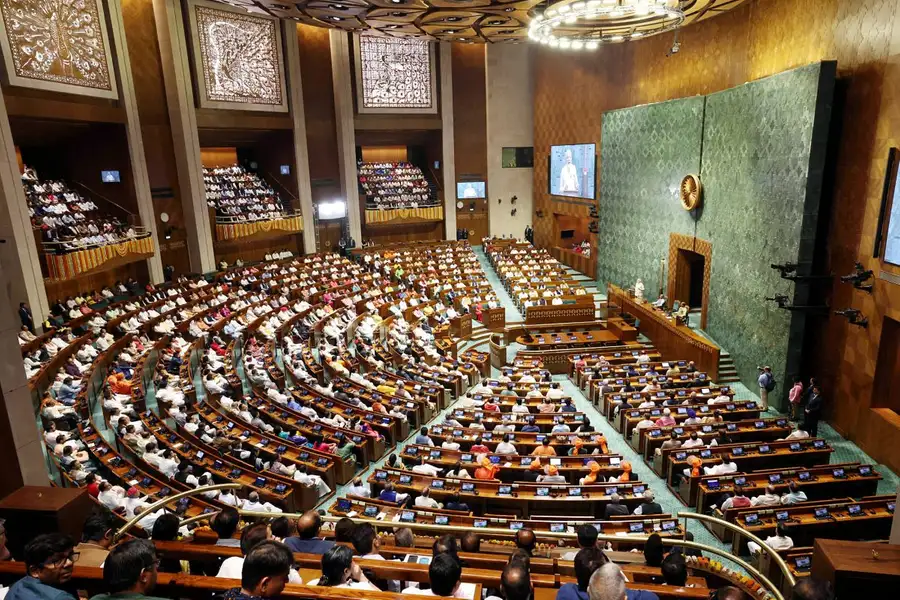
New Delhi: Constitutional amendment bills in India have a chequered history with many of them either facing defeat, lapsing or being withdrawn due to a variety of reasons, including lack of numbers.
Based on a book authored by former Lok Sabha secretary general and constitutional expert P D T Achary and some official online resources, here is an account of some of the draft laws that were defeated after the government could not stack up numbers.
1. Constitution (Seventh Amendment) Bill, 1955
The Bill sought to amend the provisions of Article 3 of the Constitution to empower the President to prescribe a time limit within which state legislatures must communicate their views on proposals concerning the formation of new states or changes in the areas, boundaries or names of the existing states.
The motion for reference of the Bill to a Select Committee lost in the Lok Sabha as it did not obtain the support of the requisite majority.
2. Constitution (Seventeenth Amendment) Bill, 1963
The Bill sought to strengthen the constitutional protection available to land reform legislation, particularly laws relating to the abolition of intermediary land tenures and redistribution of agricultural land.
It was defeated in the Lok Sabha in April 1964 after failing to secure the requisite special majority.
3. Constitution (Nineteenth Amendment) Bill, 1966
The Bill sought to clarify Parliament's powers under Article 3 of the Constitution concerning the formation of new states and Union territories and the reorganisation of existing territories. The Bill was defeated in the Lok Sabha on May 16, 1966, after it failed to secure the requisite majority.
4. Constitution (Twenty-fourth Amendment) Bill, 1970
The Bill sought to abolish the privy purses and special privileges enjoyed by the former rulers of princely states that had acceded to or merged with the Indian Union after Independence.
The Bill was passed by the Lok Sabha but defeated in the Rajya Sabha in September 1970 as it failed to secure the requisite majority.
5. Constitution (Forty-sixth Amendment) Bill, 1978
The Bill sought to accord constitutional status to two important statutory bodies: the Commission for Scheduled Castes and Scheduled Tribes and the Minorities Commission. The Bill was defeated in the Lok Sabha in May 1979 after failing to secure the requisite majority.
6. Constitution (Forty-seventh Amendment) Bill, 1982
The Bill sought to provide constitutional safeguards for Scheduled Tribes in the northeastern states by reserving seats for them in the Lok Sabha and certain state legislative assemblies.
The motion for consideration of the Bill was defeated in the Lok Sabha on August 22, 1984, as it failed to secure the special majority.
7. Constitution (Sixty-fourth Amendment) Bill, 1989
The Bill sought to give constitutional status to Panchayati Raj institutions and establish a stronger, uniform and democratic system of rural local self-government across India.
Introduced by then prime minister Rajiv Gandhi in the Lok Sabha on May 15, 1989, the Bill failed to secure the requisite special majority in the Rajya Sabha on October 13, 1989.
8. Constitution (Sixty-fifth Amendment) Bill, 1989
The Bill was introduced in the Lok Sabha on August 7, 1989, seeking to give constitutional recognition and protection to urban local self-government institutions, including nagar panchayats, municipal councils and municipal corporations.
The Bill was passed in the Lok Sabha on August 10, 1989, but defeated in the Rajya Sabha on October 13 as it failed to secure the requisite majority.
9. Constitution (Sixty-fourth Amendment) Bill, 1990
The Bill was introduced in the Rajya Sabha on March 27, 1990, seeking to extend the period of President's Rule in Punjab by six months -- from three years to three years and six months.
The Bill was considered by the Rajya Sabha on March 27 and 28, 1990, and passed on 28 March 1990. However, in the Lok Sabha, the motion for consideration of the Bill, as passed by the Rajya Sabha, was not carried on March 30, 1990, in accordance with Rule 157.
10. Constitution (Seventy-fifth Amendment) Bill, 1990
The Bill was introduced in the Lok Sabha seeking to extend the maximum permissible period of President's Rule in Punjab from three years and six months to four years. It was considered by the Lok Sabha on the same day. But the motion for consideration of the Bill lost as it was not carried in the Lok Sabha in accordance with Rule 157.
11. Constitution (One Hundred and Sixteenth Amendment) Bill, 2011
The Bill sought to give constitutional status to the Lokpal at the Centre and Lokayuktas in the states, making them autonomous and independent anti-corruption institutions. It proposed independent anti-corruption institutions with powers to oversee preliminary inquiries, investigations and prosecution of complaints, and provided for their composition, appointment and tenure to be regulated by law.
The Bill was defeated in the Lok Sabha in December 2011 after failing to secure the requisite special majority.
12. Constitution (One Hundred Thirty First Amendment) Bill, 2026
The Bill was introduced in the Lok Sabha in April this year to facilitate the implementation of 33 per cent women's reservation in the Lower House and state legislative assemblies, enable delimitation based on the latest published Census and increase the maximum strength of the Lok Sabha from 543 to a maximum of 850.
The Bill was defeated due to lack of numbers.
(This story has not been edited by Mathrubhumi and is published from a syndicated feed.)
Published: 28 Nov 2026, 12:22 pm IST


Related Topics
Disclaimer: Kindly avoid objectionable, derogatory, unlawful and lewd comments, while responding to reports. Such comments are punishable under cyber laws. Please keep away from personal attacks. The opinions expressed here are the personal opinions of readers and not that of Mathrubhumi.
