
The Cockroach Janta Party (CJP) has threatened legal action if its leaders Saurav Das and Ashutosh Ranka are not released, as their five-day judicial custody period nears its end amid protests over voter-roll revision.
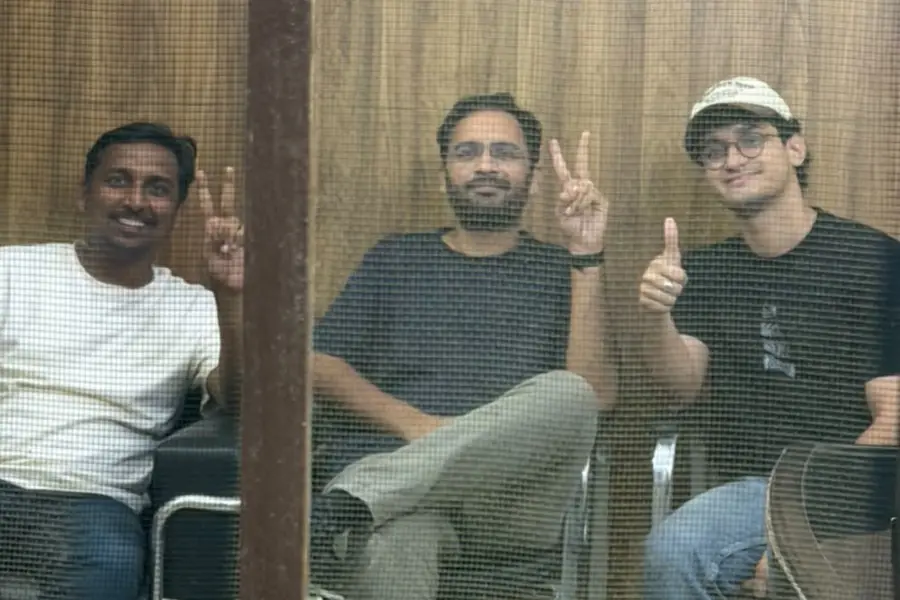
The Cockroach Janta Party (CJP) has warned that it will pursue legal action if its leaders Saurav Das and Ashutosh Ranka are not released on Sunday, October 18, amid continuing protests over the revision of electoral rolls.
The two leaders were sent to five days of judicial custody on October 14 after Delhi Police accused them of entering the restricted Jantar Mantar area and violating conditions linked to earlier peace bonds. They had protested against alleged irregularities in the Special Intensive Revision (SIR) of electoral rolls and demanded the resignation of Chief Election Commissioner Gyanesh Kumar. Police said Jantar Mantar was no longer a designated protest site.
CJP says release formalities are complete
CJP's legal team has approached the Special Executive Magistrate seeking the release of Das and Ranka. According to India Today, the party submitted surety documents, and police were verifying them. A decision on their release was expected by Sunday afternoon.
The party said it had consulted senior advocate Kapil Sibal and would take legal action if the two leaders were not released by the end of Sunday.
However, their release had not been confirmed in the reports available at the time of writing. The magistrate's original order listed October 19 for further proceedings, so the end of the stated five-day custody period does not, by itself, establish that they would be released on October 18.
The detentions have become a focal point of demonstrations against the Election Commission's electoral-roll revision exercise. Opposition parties and protest groups have raised concerns about voters being excluded, while the Election Commission has rejected allegations of wrongdoing.
The dispute has also drawn attention to restrictions on demonstrations at Jantar Mantar, a prominent protest location in the national capital. Police have cited alleged trespass and violations of earlier undertakings in explaining the action against the CJP leaders.
Demonstrations reported in London
Protests have also taken place overseas. According to the report provided, YouTuber Dhruv Rathee addressed a gathering at Parliament Square in London on Saturday. A separate demonstration was held outside the Indian High Commission, where local media reported a counter-protest by supporters of Prime Minister Narendra Modi.
Further demonstrations have been announced in India. The Samyukt Kisan Morcha has called for district- and sub-district-level protests on October 23, while the Congress has received permission to hold a rally in Delhi on November 1, according to the report provided.
The Election Commission has made changes to some aspects of the voter-verification process following criticism. According to the report, these include easing certain verification requirements, extending deadlines for voters to challenge exclusions in Delhi and Maharashtra, and setting up a panel to review voter-registration software.
The commission has also agreed to publish meeting minutes following reports of internal disagreements over the exercise. It has maintained that people whose names are missing from electoral rolls can apply for inclusion through the continuous updating process.
Why the custody dispute matters
The case involving Das and Ranka has become part of a broader political dispute over electoral-roll revision, protest rights and police restrictions on demonstrations.
The immediate legal question is whether the requirements for their release have been met and when the relevant authority will issue its decision. Although CJP says it has completed the necessary formalities, police verification and formal approval remain important to establishing whether release can proceed.
The wider controversy concerns the accuracy and transparency of electoral rolls. Excluding eligible voters can affect their ability to participate in elections, while authorities say verification is necessary to maintain reliable voter lists. Independent scrutiny, clear procedures and accessible appeals are important to resolving such disputes.
The CJP case also illustrates why reporting must distinguish between a party's demand for release, an expected decision and a confirmed release. As of the reports cited above, a decision was expected on Sunday, but the leaders' release had not been independently confirmed.
Published: 18 Oct 2026, 12:12 pm IST
ABOUT THE AUTHOR

Disclaimer: Kindly avoid objectionable, derogatory, unlawful and lewd comments, while responding to reports. Such comments are punishable under cyber laws. Please keep away from personal attacks. The opinions expressed here are the personal opinions of readers and not that of Mathrubhumi.