
The BJP and SAD have officially reunited ahead of the 2027 Punjab Assembly elections, ending a six-year split caused by the 2020 farm laws.
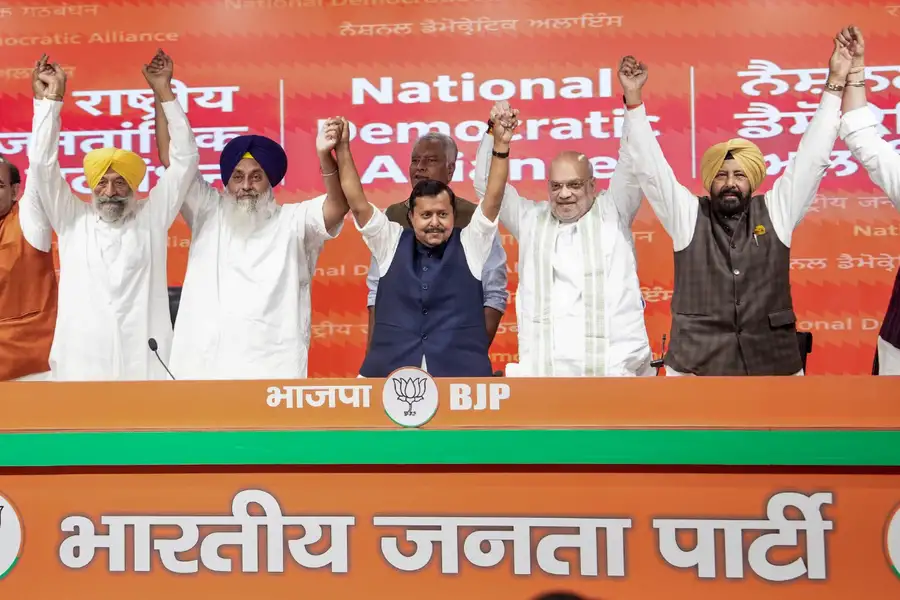
The Bharatiya Janata Party (BJP) and the Shiromani Akali Dal (SAD) formally revived their political alliance on Tuesday ahead of the 2027 Punjab Assembly elections, bringing an end to a six-year separation triggered by the Centre’s now-repealed agricultural laws. Announced at a joint press briefing at the BJP headquarters in New Delhi, the pact was unveiled by Union Home Minister Amit Shah, BJP national president Nitin Nabin, and SAD president Sukhbir Singh Badal.
Coinciding with Gurpurab, the birth anniversary of Guru Nanak Dev, the announcement concluded months of quiet negotiations between two parties weakened by consecutive electoral defeats in Punjab. Welcoming the return of the National Democratic Alliance’s (NDA) "oldest ally", Shah affirmed that both parties will jointly contest all 117 Assembly constituencies. Clarifying leadership terms, Shah stated that the Akali Dal will assume the role of "elder brother" and claim the Chief Minister's post if the combine secures power. Sukhbir Singh Badal described the partnership as an emotional bond, invoking his late father Parkash Singh Badal’s celebrated phrase "nau-maas da rishta" (the bond between the nail and the flesh) to symbolise Hindu-Sikh fraternity.
ALSO READ: 'Our alliance is with Punjab's people': Kejriwal
Origins of a Partnership Rooted in Punjabiyat
The political association between the two formations predates the BJP's founding in 1980, stretching back to coalition ministries formed in 1967 and 1969 alongside the BJP’s forerunner, the Bharatiya Jana Sangh, following Punjab’s linguistic reorganisation. Their modern alliance crystallised in 1996 when the SAD, through its Moga Declaration, sought to expand beyond its traditional Panthic base by championing the inclusive ethos of "Punjab, Punjabi and Punjabiyat".
Emerging in the aftermath of militancy in the border state, the coalition bridged Punjab’s primary social divide by uniting the Akalis’ predominantly rural Sikh electorate with the BJP’s largely urban Hindu support base. Under their longstanding seat-sharing formula, the SAD contested 94 of the 117 Assembly seats and the BJP 23, whilst parliamentary contests followed a 10-to-three distribution. That synergy produced immediate electoral dividends, sweeping 93 seats in the 1997 Assembly polls—75 for the SAD and 18 for the BJP.
Decade of Governance Followed by Steep Decline
After losing office to the Indian National Congress in 2002, the SAD-BJP combine returned to power in 2007 with 68 seats and retained office in 2012 with an identical tally, bucking Punjab’s entrenched anti-incumbency trend. However, ten years of uninterrupted governance left the coalition vulnerable to mounting public discontent over sacrilege incidents, agrarian distress, and the state’s drug crisis. In the 2017 Assembly elections, the emergence of the Aam Aadmi Party (AAP) alongside a resurgent Congress reduced the SAD to 15 seats and the BJP to just three.
The 2020 Farm Laws Rupture and Solo Setbacks
Tensions between the allies reached a breaking point in September 2020 during widespread farmers’ demonstrations against three federal agricultural reform laws. On September 17, 2020, Harsimrat Kaur Badal resigned as Union Minister for Food Processing Industries, and nine days later, the SAD formally severed its 24-year electoral partnership with the BJP. Sukhbir Singh Badal accused the BJP of sidelining allies on major legislative decisions, whilst subsequent years saw Akali leaders allege interference in Sikh religious institutions alongside a wave of high-profile defections to the saffron party.
Concurrently, sections of the Punjab BJP welcomed the split as an opportunity to shed their junior-partner status and build an independent rural footprint. Even after Parliament repealed the farm laws in November 2021, electoral arithmetic proved unforgiving for both camps when contesting apart.
| Election Cycle | SAD Performance | BJP Performance | Combined Vote Share & Context |
| 2017 Assembly | 15 seats (25.24% vote share) | 3 seats (5.39% vote share) | Contested together; lost to Congress |
| 2019 Lok Sabha | 2 seats (27.45% vote share) | 2 seats (9.63% vote share) | 37.08% combined vote share |
| 2022 Assembly | 3 seats (18.38% vote share) | 2 seats (6.60% vote share) | Contested separately; AAP swept 92 seats |
| 2024 Lok Sabha | 1 seat (13.42% vote share) | 0 seats (18.56% vote share) | ~31.98% combined vote share across all 13 seats |
Electoral Arithmetic Forces Strategic Rapprochement
As documented in Election Commission of India records, the 2022 Assembly elections pushed both parties to the political margins as the AAP swept 92 seats. Efforts to revive the pact ahead of the 2024 Lok Sabha elections collapsed amid renewed agrarian protests. Yet the parliamentary results highlighted a compelling reality: while the BJP failed to win a seat across all 13 constituencies, its vote share nearly doubled to 18.56 per cent, whereas the SAD slipped to 13.42 per cent while retaining only Bathinda. Together, their combined vote share of nearly 32 per cent exceeded the individual tallies of both the Congress and the AAP, strengthening proponents of reunification within both leaderships.
Road to Reconciliation Ahead of 2027
Momentum toward a formal truce accelerated markedly during the second half of 2026. On August 7, Sukhbir Singh Badal met Prime Minister Narendra Modi at Parliament House, reigniting intense political speculation. Senior SAD figures—including Harsimrat Kaur Badal, who highlighted infrastructure progress achieved during the coalition’s tenure, and Bikram Singh Majithia—publicly endorsed restoring ties. Following repeated predictions by Amit Shah in October and early November that an NDA government would assume office in Punjab in 2027, Tuesday’s formal ceremony sealed the reunion. As both parties prepare to confront an incumbent AAP administration and a divided Congress, the revived alliance aims to translate combined vote arithmetic into a decisive governing coalition.
Published: 24 Nov 2026, 03:43 pm IST


ABOUT THE AUTHOR

Related Topics
Disclaimer: Kindly avoid objectionable, derogatory, unlawful and lewd comments, while responding to reports. Such comments are punishable under cyber laws. Please keep away from personal attacks. The opinions expressed here are the personal opinions of readers and not that of Mathrubhumi.