
Ravinder Govinda, a member of the Hindu Raksha Dal arrested over the assault of students during the Cockroach Janta Party (CJP) protest in Delhi, was welcomed with garlands after his release on bail on Tuesday, October 13. Govinda and three associates were arrested on October 10 after a video showing members of the group assaulting protesters near DDU Marg circulated widely on social media.
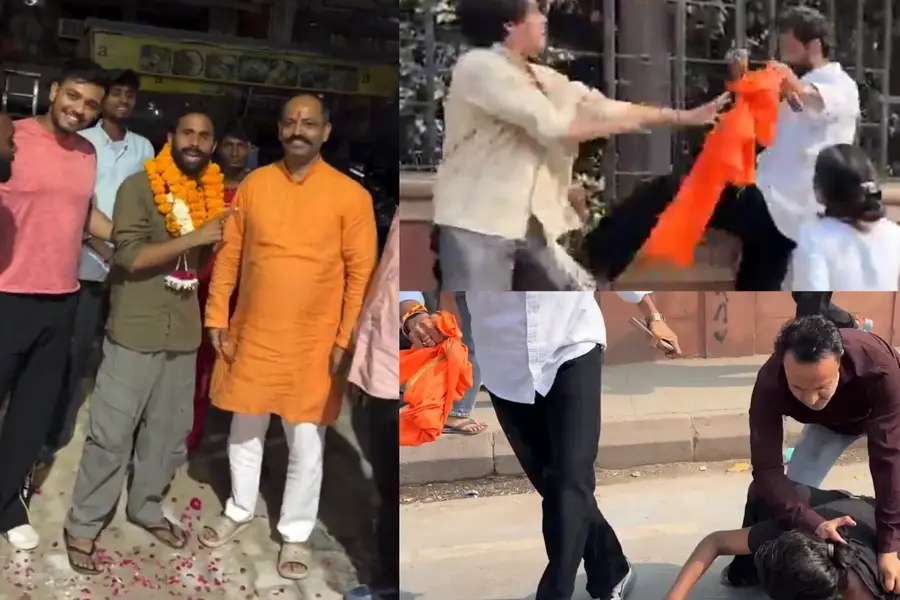
New Delhi: A Hindu Raksha Dal member arrested over the alleged assault of students and women during the Cockroach Janta Party (CJP) protest in Delhi was welcomed with garlands after securing bail, barely two days after his arrest. The reception for Ravinder Govinda has drawn attention to the stark contrast between the disturbing footage of the October 10 confrontation and the public celebration that followed his release.
Govinda and three associates were arrested after a video circulated widely on social media showing members of the group assaulting young protesters near DDU Marg in central Delhi. The footage showed protesters being hit and women being pushed and struck, triggering outrage and political reactions.
The police took action following the incident, arresting the four men. However, Govinda's welcome with garlands after his release has raised questions about the public celebration of a person arrested over alleged violence against protesters.
The incident has also renewed scrutiny of the conduct of right-wing groups that invoke religious or ideological identities while becoming embroiled in allegations of violence. The contrast between the stated values such groups claim to uphold and the conduct captured in footage of the confrontation has become a central point of criticism.
Viral video showed protesters being assaulted
The confrontation took place on October 10 as CJP demonstrators attempted to march towards Jantar Mantar to protest against Chief Election Commissioner Gyanesh Kumar over alleged irregularities in the Special Intensive Revision (SIR) of electoral rolls.
The march took place amid a heavy security deployment and extensive barricading in the national capital. During the confrontation near DDU Marg, members of the Hindu Raksha Dal were filmed allegedly assaulting protesters.
The footage was circulated by the Indian Youth Congress, the All India Students' Association (AISA) and CJP. Congress MP Rahul Gandhi also shared a photograph of a protester wearing a black T-shirt being assaulted, accusing the Delhi Police of allowing violence against young people and women.
The incident prompted police action, with Govinda and three associates arrested on October 10. Their arrests followed the circulation of footage that brought the alleged assault into public view.
From arrest to garlands: the controversy over Govinda's release
Govinda was granted bail in less than 48 hours, according to the report, and was subsequently welcomed with garlands by members of the Hindu Raksha Dal. A video of the reception circulated on social media on October 13.
The sequence has created a sharp contrast: footage of protesters allegedly being assaulted led to arrests, while the release of one of the accused was followed by a public display of support.
Bail is a judicial decision concerning a person's release from custody while legal proceedings continue. It does not establish innocence, erase the allegations or amount to a finding that the conduct shown in the video was justified.
The garlanding itself is not proof of criminal wrongdoing by those who participated in the reception. Nevertheless, the public celebration of a person arrested in connection with an alleged assault raises broader questions about how political and ideological loyalties can shape responses to violence.
The criticism is particularly pointed when the footage appears to show people being physically attacked during a political demonstration. The right to express support for an accused person does not change the need for allegations of assault to be examined through the legal process.
Govinda claims self-defence, disputes interpretation of video
Govinda has maintained that he and his associates acted in self-defence. Speaking to India Today, he claimed that he was travelling with his aides towards Jhandewalan Temple when their vehicle was surrounded by CJP members near Connaught Place.
He alleged that protesters kicked their car and abused them. He also suggested that the saffron flag on the vehicle and the slogan 'Jai Shri Ram' written on it may have triggered the confrontation.
Govinda claimed that he feared he and his associates could be lynched if they stepped out of the vehicle and said they left it only after police personnel arrived.
Although he acknowledged that he and his associates assaulted the protesters, he maintained that their actions were defensive. He also argued that the viral footage did not show the entire incident and claimed to have shared additional footage with Delhi Police showing his group being surrounded.
These claims represent Govinda's account of the confrontation and have not, on the information available, been independently established. His assertion of self-defence does not by itself settle whether the force used was justified; that question depends on the evidence and applicable law.
Rahul Gandhi accuses Delhi Police of allowing violence
The incident drew a reaction from Rahul Gandhi, who shared an image of the assault and accused the Delhi Police of enabling violence against protesters.
In his social media post, Gandhi alleged that the police were giving members of the RSS-BJP ecosystem a free hand to target young people and women. His remarks added to the political confrontation surrounding the CJP demonstration.
The identity of the person wearing the black T-shirt also became a point of dispute. While some social media accounts claimed the person was a woman, Govinda told India Today that the individual was a man and accused Gandhi of spreading misinformation.
The disagreement over the person's identity does not, in itself, resolve the central issue raised by the footage: whether protesters were unlawfully assaulted and whether those responsible should be held accountable.
Protest against CEC Gyanesh Kumar amid wider Delhi crackdown
The confrontation occurred during the CJP's 'Jantar Mantar 2.0' protest against Chief Election Commissioner Gyanesh Kumar over alleged irregularities in the SIR of electoral rolls.
The demonstration was accompanied by a major security operation in Delhi. The report said more than 3,000 people were detained during the police operation, significantly disrupting the protest.
The wider crackdown has prompted separate concerns over the treatment of demonstrators, restrictions on public movement and allegations of police excesses. These issues form part of separate legal proceedings and should be distinguished from the case concerning the alleged assault by Hindu Raksha Dal members.
The episode has placed two questions in sharp focus: how the authorities respond when protesters are allegedly attacked, and whether political or ideological affiliations influence the public response to such incidents.
For now, Govinda's release on bail does not conclude the case. The allegations surrounding the confrontation remain subject to the legal process, while the footage and the subsequent garlanding have made the incident a wider point of public and political debate.
Published: 13 Oct 2026, 03:02 pm IST
ABOUT THE AUTHOR

Disclaimer: Kindly avoid objectionable, derogatory, unlawful and lewd comments, while responding to reports. Such comments are punishable under cyber laws. Please keep away from personal attacks. The opinions expressed here are the personal opinions of readers and not that of Mathrubhumi.