
In conversation with Ajmal Aboobackar, who worked with VFX artists from DNEG and Prime Focus on Ramayana Part 1
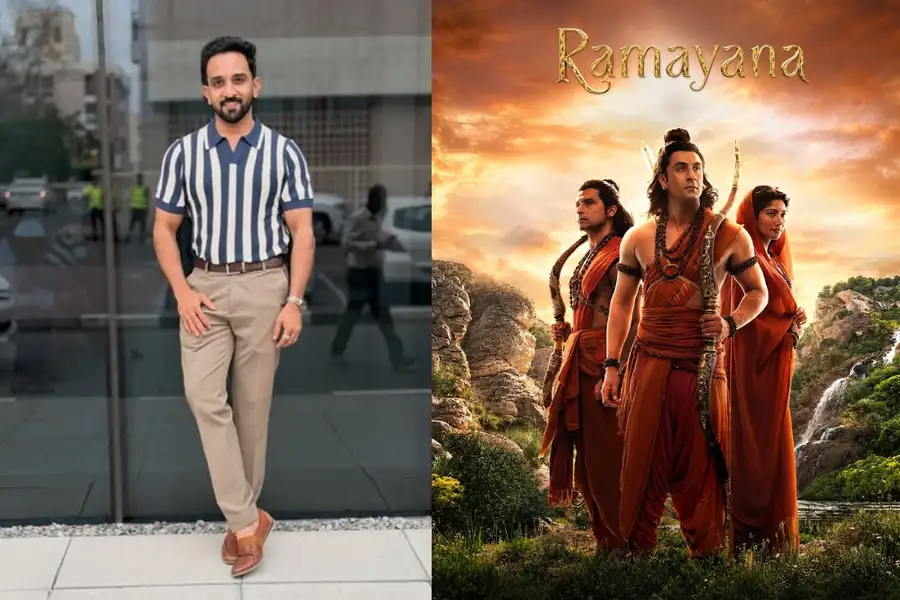
A documentary shot in Munnar led to an unexpected call. A few months later, Ajmal Aboobackar was walking deep inside the Periyar Tiger Reserve with a team of VFX artists. He did not know then that the forest would end up on screen in one of the biggest films ever made in India. Here he talks about how it began, what those five days were like and what does it feel like to be a part of ‘Ramayana’
A storyteller on the move
Ajmal is a storyteller, filmmaker and traveller who has always had one foot in the creative world. Through his company, I'm Social Global, he creates content for corporates, but travel stories and podcasts are what he is particularly drawn to. His podcasts revolve around personal stories, while micro dramas are now among the projects he is actively exploring.
His connection with the film industry goes back to his early days in Bombay. He has worked on a few film projects, events and music concerts there and, over the years, has built friendships with several people in the industry.
How did you get involved with Ramayana?
“Even in the beginning, I did not know that I was getting associated with such a massive project.
I had made a documentary called When We Travel, which was shot in Munnar. One of my friends, a former MTV producer, saw it and contacted me. He told me there was a requirement. He had a VFX team that wanted to collect assets, and they had been collecting them from all over India. I think they had explored almost eight forests in India, and Cambodia too. Now they were looking for a specific kind of forest in Kerala. He shared a few images and their research material and asked whether we could explore forests like that.
They also suggested Periyar. That is where I came in. As a traveler, I have always wanted to go inside a forest and stay there, which is not always possible for everyone. You cannot do it every time. So my immediate thought was that being part of this project would let me explore the forest. That got me excited, and I jumped in.”
What was your first reaction when you learned it was part of ‘Ramayana’?
“Shooting inside a tiger reserve is not easy. Getting permission is a process, you cannot carry big equipment, and you have to be very careful about how you move around. I have a friend in the CRPF, so I reached out to him, and he put me in touch with a couple of IAS officers. That is how we got the permission quickly. Otherwise you may get it, but it takes its own time.
When we went inside, the team told me it was about an epic, and that they also worked on games and similar projects. They did not reveal the project at first, and I think they did not want that attention so early. This was in November 2024. Eventually the poster of ‘Ramayana’ was released with the DNEG name on it. I checked with the team who had come, asking whether this was the project we had worked on, and they said yes. I was very excited.
I mean, we all know the scale at which ‘Ramayana’ is being produced, with Ranbir in the lead and everything else around it. But I did not know it was going to be this big.”
Take us back to those five days. What were you doing there?
“It was really fun. As I said, I love exploring forests. We would start early in the morning, with a group of 10 to 12 people, fully equipped and carrying our gear. From five in the morning until sunset in the evening, we would be inside the forest.
We never knew exactly what we were going to encounter. The team had scenes in their minds, but even they did not know exactly what they would find. There are millions of trees in a forest, so what do you pick as a hero tree? As we walked deeper into the forest, we were in areas where other people are normally not allowed.
In the beginning the forest officials thought we wanted to shoot animals, but we told them we needed trees. A couple of forest guards and some local boys who knew the forest well helped us. Once we explained exactly what we wanted, they took us to the right patches. It was a lot of walking.
In between, we would stop somewhere for lunch. Sometimes we would run into elephants passing by, and we had to wait one or two hours for them to move on. We also saw bison, and sometimes tiger footprints. I was getting lost in the whole experience, at the same time trying to understand what these people were doing. They had scales and color palettes. They would measure a tree, hold the scale against it and take pictures.
For five days, we were looking for trees and atmosphere. We were looking for a particular patch of forest, a water body, a certain section of the forest. They also looked at textures, at interesting surfaces. If you have seen the movie, you know how detailed those things are. They were studying all those tiny details.
They would say for example, they needed a hero tree, or a water body. We would walk for eight hours and I used to wonder why they were shooting only one tree. It was also my first exposure to LiDAR technology, to how they capture images inside the forest and scan the whole atmosphere in 3D. This particular group works on atmosphere VFX, which means they are the ones who create the atmosphere you see on screen.”
Do you know a lot about trees now?
“I would not say I know trees in depth. I did not study them or learn categories. But a few things stayed with me.
One was about parasites. Some of what looks like a tree is actually a parasite. It climbs onto a tree and slowly eats it away until the whole thing looks like a tree with its own branches. But those are not branches at all.
The head of the department on the team was very into photography and wildlife, and he explained this to us.
The other thing is tiger marks. Before hunting, or after eating, a tiger scratches a tree to sharpen its nails. Now when I look at a tree and see long marks on it, I know tigers are around. If the marks look fresh, they are in and around the area. These are the few things I picked up during this project.”
What was it like to watch the film in a theatre after working on it?
“It was great. I was watching it with my wife, trying to work out where they had used our material. In the exile part, when Rama goes into the forest, I kept telling her, "We shot this in Periyar." You could see that some part of the forest was there, the colours were there, and this must have been taken from that patch.
I had taken photographs during the project, and after watching the movie, I put them online because I wanted to share them. I felt like a tiny part of this big project, and I really loved the movie. The next morning, when I woke up, a lot of people were sharing and commenting on the post. Everybody knew about it, and they were asking me when it was shot and how. They were all excited and happy.
Are there particular scenes in Ramayana where you can recognise the forest?
“A lot of it is mixed and matched. In the exile part, where the three brothers are walking, and in the scenes where Rama is running during the fight, there are tree trunks and atmosphere from our work.
The forests of Kerala, and this southern belt in general, have a certain kind of vegetation, which may be why they came here. They also wanted a pine forest, so we shot in Thekkady and collected some pine forest material that I have not seen anywhere yet. Perhaps it is meant for the second part. As for why Kerala, there may be a historical reason connected to the route in the story. In much of the exile part, the vegetation, the look and feel, and the water body where he performs the last rites for his father are bits and pieces of our Periyar forest.”
Do you think Kerala's forests and national reserves have the potential to get featured in large-scale or international films?
“Absolutely. But more than featuring in films, I would like more people to go and explore the forest. A few comments on my Instagram post came from people across India. One lady wrote that she had explored a lot of forests and had been to Periyar Reservoir too, and that it was completely mesmerising and magical. It really is magical once you get inside.
I am sure real artists who want inspiration, especially for colour, go to forests. Fashion designers do too, to explore textures. If you go inside Periyar Tiger Reserve, the colours, the different shades of green and the patterns are very inspirational.
Of course, when a place features in a film, it becomes destination marketing. The Jatayu statue, for example, must be drawing a lot of travelers after the film's release, which is good for the tourism industry in that matter. But beyond that, I believe everyone should explore the forest. It is beautiful, and Malayalis especially are very close to it. You can plan a trip, and there are one-day or two-day options. Not a safari exactly, but you can trek inside the forest in certain areas. That is something I would suggest to everyone. We should explore our forests.”
Can we expect more of Periyar in Ramayana Part 2?
“I hope so. The next part is going to be about the war, with a lot of Lanka in it. So far I think they have not explored any other part of the south, and going by the story, there will be a lot of forest again, and a lot of the south like Sri Lanka, will be there in the next part too.”
Published: 12 Nov 2026, 05:16 pm IST


ABOUT THE AUTHOR

Disclaimer: Kindly avoid objectionable, derogatory, unlawful and lewd comments, while responding to reports. Such comments are punishable under cyber laws. Please keep away from personal attacks. The opinions expressed here are the personal opinions of readers and not that of Mathrubhumi.