
AR Rahman's latest composition 'Mangal Rang' from 'Ramayana' has divided netizens over its alleged Sufi and qawwali influences.
Oscar-winning composer AR Rahman has once again found himself at the centre of an online controversy, this time over 'Mangal Rang', the latest song from Nitesh Tiwari's upcoming mythological epic 'Ramayana'. The track, featuring the voices of Arijit Singh and Shreya Ghoshal, has divided social media users, with some questioning its alleged resemblance to Sufi and qawwali music.
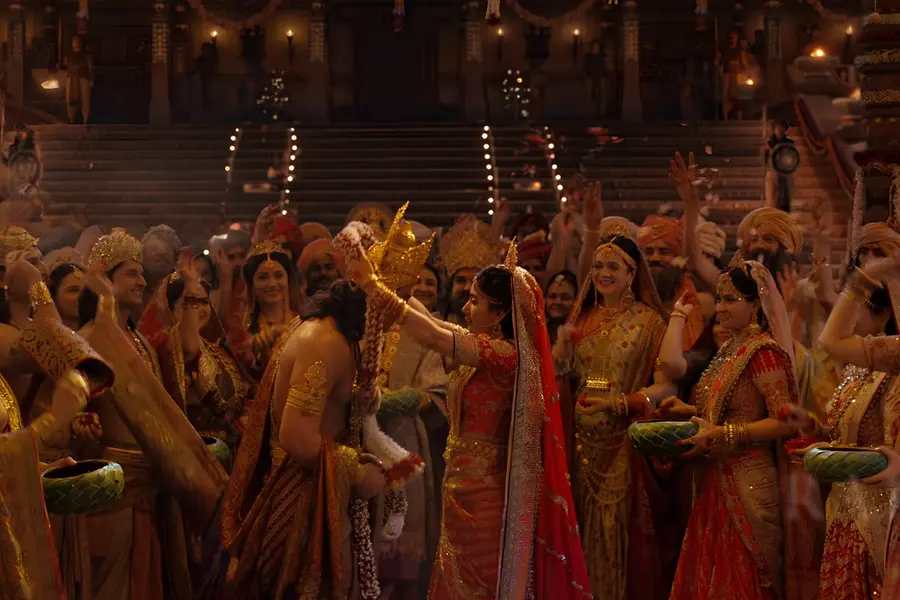
Released on Sunday, the song captures the wedding celebrations of Lord Ram and Goddess Sita, played by Ranbir Kapoor and Sai Pallavi, respectively. While its grand visuals and musical arrangements have attracted attention, a section of the internet has criticised Rahman for incorporating musical elements they believe are unsuitable for a film rooted in Hindu mythology.
The controversy has also extended beyond the music, with viewers questioning a wedding ritual depicted in the song. Meanwhile, Rahman, who has faced criticism over the film's earlier tracks, has addressed the growing backlash surrounding his compositions and explained why he prefers not to dwell on public reactions.
Netizens question Sufi and qawwali influences in 'Mangal Rang'
Soon after the song's release, several social media users began drawing comparisons between 'Mangal Rang' and Rahman's earlier compositions, particularly those influenced by Sufi musical traditions.
Some argued that the track's chorus, vocal arrangements and overall musical structure resembled qawwali, questioning whether such a style was appropriate for a film based on the Ramayana.
One user wrote on X, "Mangal Rang is an obviously qawwali-coded song in Ramayana - the chorus, the "rang" metaphor (most famously used in Aaj Rang Hai), and the guitar which evokes bulbul tarang. Aside: self-inspired from Enna Solla Pogirai."
Another user compared the song to Rahman's popular composition 'Kun Faya Kun', writing, "Mangal Rang from "Ramayana" has clear similarities to A.R. Rahman’s "Kun Faya Kun" the chorus, the singing style, the spiritual lift, the overall architecture. Imagine a Sufi style song attached to Bhagavan Ram and Sita Maa... Is it a deliberate callback? Or an older formula given new packaging?"
A third commented, "It is not qawwali but it is a Sufi song. And it does not fit for this movie at all. Only Shreya's part is good. Rest is totally misfit."
Other critics felt that the makers should have relied more heavily on Sanskrit compositions and traditional Indian musical arrangements to reflect the cultural setting of the epic. Some also accused Rahman of repeating familiar musical patterns rather than creating something distinctive for the film.
However, not everyone agreed with the criticism. Several listeners defended the composer, arguing that the song did not follow the conventional structure of qawwali.
"If you think Mangal Rang song is Qawwali then I have a white house in agra to sell it to you. Qawwali means - Usage of dholaks, tablas, harmonium - Group of 4-6 singers singing chorus - Clapping of hands Qawwali mein sargam hota hein kya?lol," a fan wrote.
Wedding ritual in 'Mangal Rang' sparks another debate
Apart from the music, a sequence depicting the wedding festivities of Ram and Sita has also come under scrutiny.
In one scene, women are seen applying ceremonial substances to Ranbir Kapoor's character while Sai Pallavi's Sita stands nearby. Some viewers assumed that the sequence represented a haldi ceremony and questioned why the bride and groom appeared together during the ritual.
However, reports have identified the ceremony as 'Chumawan', a traditional wedding ritual practised in parts of eastern India, particularly the Mithila region, rather than the conventional pre-wedding haldi ceremony.
During Chumawan, five married women from the bride's family offer blessings to the groom using sacred grass, unbroken rice, turmeric and curd. The ritual involves touching different parts of the groom's body, including his feet, knees, shoulders and head. A similar ceremony is performed separately for the bride.
The sequence has consequently prompted discussions about regional wedding customs and their representation in the film.
'Mangal Rang', written by Dr Kumar Vishwas, features several important moments from the Ramayana, including Sita's swayamvar, Ram lifting Lord Shiva's bow, their wedding vows and the couple's arrival in Ayodhya.
AR Rahman responds to criticism of 'Ramayana' songs
The backlash surrounding 'Mangal Rang' follows similar reactions to the film's earlier musical releases, including 'Ravana Tandav'. Rahman has also faced broader criticism from some listeners who believe his recent compositions have not matched the standards of his previous work.
In an interview with Hindustan Times, the composer addressed the online reactions, explaining that the extensive creative process behind his music leaves him with little inclination to follow criticism after a song is released.
“We do so much work, filtration, ideation, and iteration that there’s no energy left to look at feedback! We just put it out because it’s been tried and tested so much. My son keeps telling me, ‘This is what they said yesterday, now they’re apologising…’ I say fine, I’ve done my work sincerely and hope people celebrate it.”
Rahman also spoke about the pressure to recreate the success of his earlier compositions, saying he believes artistic growth requires experimentation rather than repeatedly returning to familiar sounds.
“After the first 10 years, people said, ‘Oh, you should do what you did in those first 10 years.’ But I can’t stay on old glory like Rockstar or Slumdog Millionaire. You can’t stagnate yourself — you have to be like a flowing river. Now Ramayana has come, and these songs are in five different languages. It’s an epic story almost every Indian knows. It’s such a great honour to do those songs and be part of that celebration with India and the world,” he said.
Despite the criticism, the film's music has drawn considerable attention online. According to reported viewership figures, 'Mangal Rang' registered 19 million views within a day of its release, while 'Ravana Tandav' recorded 21 million views.
AR Rahman opens up about working with Hans Zimmer
For 'Ramayana', Rahman has joined forces with acclaimed Hollywood composer Hans Zimmer, marking a major international collaboration for the Indian music maestro.
Speaking about the partnership, Rahman described Zimmer's involvement as an advantage for the film's global reach. He suggested that the Hollywood composer's association could encourage international audiences to take greater interest in the Indian mythological production.
According to Rahman, even a large-scale Indian film might struggle to attract attention beyond its traditional audience. However, having a globally recognised composer such as Zimmer on board could help change that perception.
"It is a great move by the producer," Rahman said, praising the decision to bring Zimmer into the project.
'Ramayana' gears up for November 5 release
Produced by Namit Malhotra and directed by Nitesh Tiwari, 'Ramayana' is being developed as a two-part cinematic adaptation of the Hindu epic.
The first instalment is scheduled for a worldwide theatrical release on November 5, 2026, during Diwali week, with the second part expected to arrive in 2027.
The film features Ranbir Kapoor as Lord Ram, Sai Pallavi as Sita, Yash as Ravana, Ravi Dubey as Lakshman and Sunny Deol as Hanuman. Arun Govil is also part of the ensemble cast.
Published: 28 Oct 2026, 01:21 pm IST
ABOUT THE AUTHOR

Related Topics
Disclaimer: Kindly avoid objectionable, derogatory, unlawful and lewd comments, while responding to reports. Such comments are punishable under cyber laws. Please keep away from personal attacks. The opinions expressed here are the personal opinions of readers and not that of Mathrubhumi.