
In a stone hall in southwestern Turkey, the whirling never stops and neither does the search for transcendence.
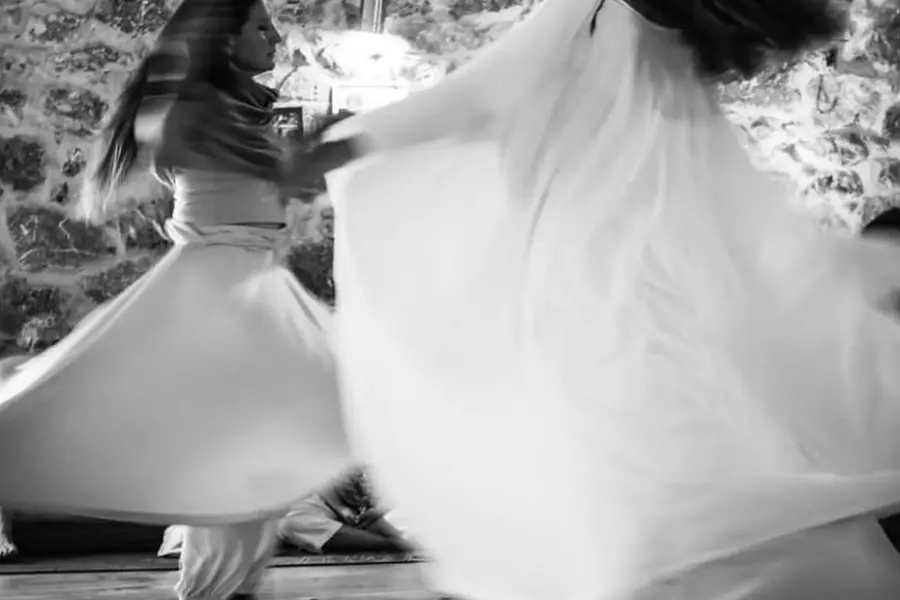
For seven days and nights, at least two people remained in motion at all times inside a stone-walled hall, part of a gathering built around sema, the whirling practice tied to the 13th-century Sufi poet Rumi.
What sema actually is
Sema is a form of moving meditation rooted in Sufi Islam. For many visitors, sema is most familiar as a polished, ticketed performance for tourists, men in tall wool caps and white robes turning in precise unison.
Attendees traveled in from Turkey, France, Italy, Bulgaria, Iran, the United States, and beyond. Many came to the retreat with an interest in spirituality that extended beyond sema, including yoga, Buddhism, and other traditions.
Instead of traditional robes, people whirled in jeans, T-shirts, sundresses, and embroidered tops, choosing whatever felt comfortable for the practice.
Voices from the circle
The retreat had the feel of a folk music festival mixed with a rustic spiritual gathering. Bungalows and glamping tents were available, but most people camped.
Attendance was free, though guests were asked to help fund the event's running costs and pitch in on daily chores, including preparing three vegetarian meals a day for the crowd.
House rules were simple, no drugs or alcohol, and modest dress in public spaces.
A live band, made up of drums, stringed instruments, and a reed flute, played in rotating shifts around the clock, allowing the whirling hall to remain active throughout the week.
The people who showed up
The gathering was organised by Tumata, a band and Sufi music collective founded in the 1970s by the scholar Rahmi Oruc Guvenc, now led by his two daughters. Musician Kanikey Guvenc Akcay described the group's aim as staying true to the emotional core of the practice rather than its formal choreography.
Participants' backgrounds varied widely. A chiropractor from Australia spoke about feeling nervous at first about losing her balance in front of experienced whirlers. She experienced nausea during her first attempt, followed by a sense of connection after pushing through it.
A former data scientist from Istanbul said his path to the retreat followed a pandemic spent living in a tent, travels through India, Thailand, and Nepal, and an eventual career change into plant-based cooking.
Also Read: The art of seeing Thailand in 10 days
A 59-year-old from Bulgaria said she'd been attending similar gatherings for 17 years, ever since finding the group on YouTube, and said she valued the sense that the experience was something participants had to earn through practice and commitment.
Practice with a complicated history
Sema has roots stretching back through the Ottoman era, but it was banned outright after modern Turkey's secular government shut down Sufi lodges in the 1920s.
Restrictions eased only decades later, and in 2008 UNESCO added the sema ceremony to its list of intangible cultural heritage.
This retreat demands stamina, humility, and a willingness to volunteer alongside strangers from a dozen countries.
Also Read: Travel podcasts that will make you want to pack your bags
But for those drawn to Sufi music, communal living, or simply an unusual physical and spiritual challenge, it offers an unscripted, living tradition still practiced by the people who inherited it.
Published: 08 Aug 2026, 06:04 pm IST
ABOUT THE AUTHOR

Disclaimer: Kindly avoid objectionable, derogatory, unlawful and lewd comments, while responding to reports. Such comments are punishable under cyber laws. Please keep away from personal attacks. The opinions expressed here are the personal opinions of readers and not that of Mathrubhumi.