
A century-old design just got a very modern reason to matter again.
In 1913, wristwatches hadn't yet caught on with most men that change wouldn't happen until the First World War pushed pocket watches out of practicality.
But in Japan, Seiko founder Kintaro Hattori was moving in that direction, his company released the Laurel, Japan's first wristwatch with a white enamel dial, slender blue hands, and a red numeral 12 sitting at the top.
More than a century later, Seiko has revisited that design as a modern interpretation.
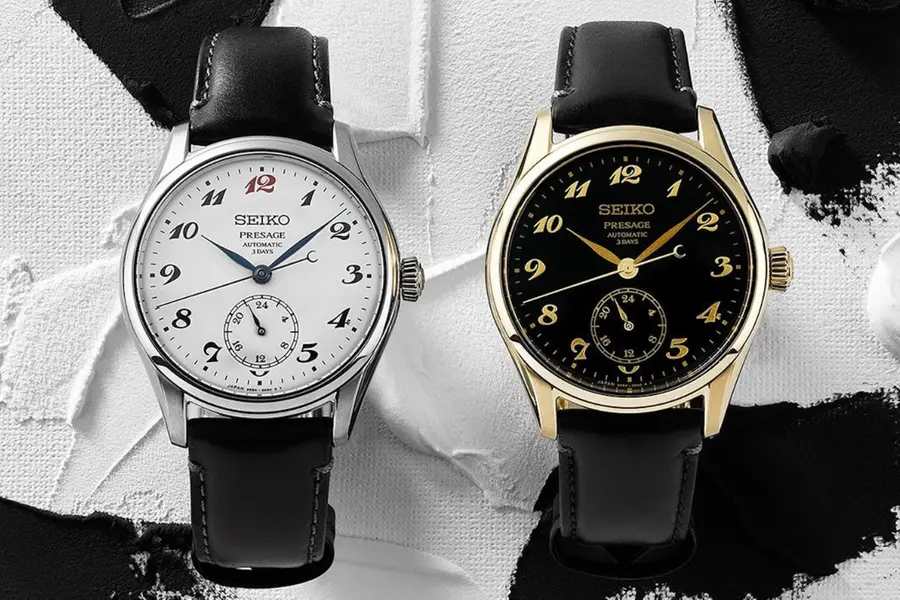
It came with two new additions to the Presage Classic Series "Craftsmanship" line: the Enamel (HCC005) and the Urushi Lacquer (HCC006), priced at ₹1,33,950 INR and ₹1,81,643 INR respectively.
Two takes on one origin
The HCC005 sticks closest to the 1913 original. Its white enamel dial carries over the blue hands, Arabic numerals, and the red 12 that marked the Laurel.
The HCC006 takes a different path, a black urushi lacquer dial paired with gold accents and a yellow-gold-toned case, giving it a dressier presence than its sibling.
Both dials involve techniques that take years to master. The white dial is enamel, fired at high temperature to get its glossy finish.
The black dial uses urushi, a traditional Japanese lacquer that's applied and polished entirely by hand. Seiko has craftsmen who've spent decades refining both processes overseeing the work on each watch.
What's different from 1913?
Unsurprisingly, the mechanics inside are a long way from the original. Both watches come in at 39.6mm and run on Seiko's automatic 6R5H movement, which holds a 72-hour power reserve.
On top is a dual-curved sapphire crystal, the case back is an exhibition window showing the movement, and each watch ships on an oil-tanned leather strap.
The sub-dial at six o'clock looks like it should be tracking seconds, but it's actually a 24-hour indicator tied to the main time display, a way of showing whether it's day or night.
Neither the HCC005 nor the HCC006 is a limited edition, so there's no ballot process or resale scramble involved in getting one, a contrast to how a lot of heritage reissues are typically handled.
Whether or not a design holds up is hard to judge. A watch still looking coherent 113 years after it was first made is one way of answering that question.
Published: 18 Aug 2026, 05:14 pm IST
ABOUT THE AUTHOR

Disclaimer: Kindly avoid objectionable, derogatory, unlawful and lewd comments, while responding to reports. Such comments are punishable under cyber laws. Please keep away from personal attacks. The opinions expressed here are the personal opinions of readers and not that of Mathrubhumi.