
India is considering integrating Russia's long-range RVV-BD air-to-air missile with Su-30MKI fighters, potentially extending its aerial strike reach.
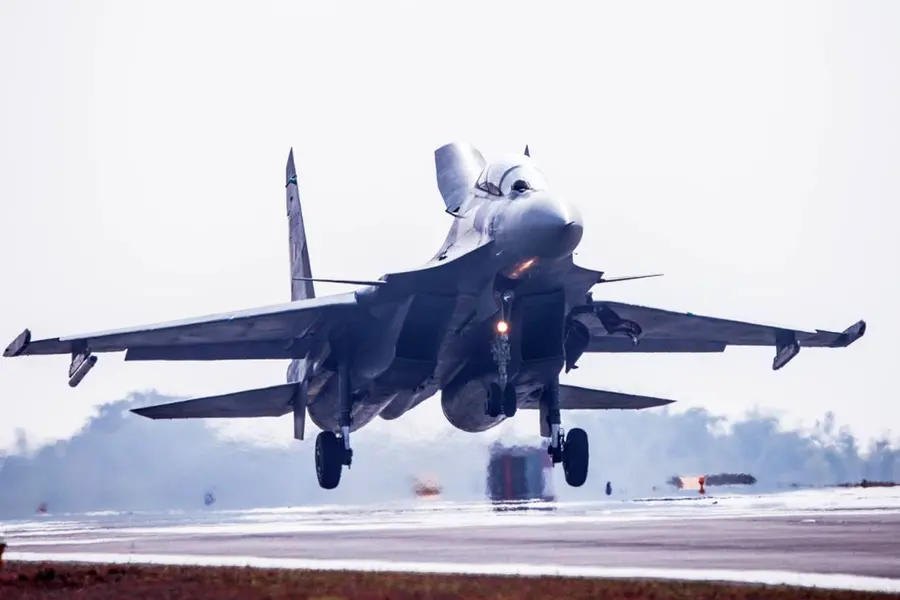
Somewhere in the Defence Ministry today, a file is moving that could quietly alter the arithmetic of the skies over the subcontinent. The Defence Acquisition Council, the ministry's apex clearance body chaired by Rajnath Singh, is expected to take up a proposal to modify the Indian Air Force's Su-30MKI fighters so they can carry the Russian RVV-BD, a very-long-range air-to-air missile built to strike an enemy aircraft from distances at which the enemy cannot yet strike back.
The timing is not accidental. President Vladimir Putin is due in India within days for the BRICS meeting, and a clutch of defence agreements is expected to be discussed while he is here. Files like this one tend to ripen just before such visits.
Also Read: Decoding why India is selling space technology too cheaply
To understand why this matters, picture how modern air combat actually works. Fighter jets rarely circle each other in dogfights the way old films show. They depend on a flying nerve centre, an Airborne Early Warning and Control aircraft, that hovers far behind the front and tells friendly pilots where the enemy is. Jamming aircraft blind opposing radars. Reconnaissance aircraft photograph and listen. Remove those, and an entire air force goes deaf and half-blind. The RVV-BD exists precisely for that task, reaching past the enemy's fighters to hit what is standing behind them.
The range figure deserves careful reading, because it is quoted differently in different places, and all the numbers are honest in their own context. The official export specification for the RVV-BD lists a maximum reach of up to 200 kilometres. Its Russian parent, the R-37M, is frequently cited at 300 to 400 kilometres in ideal high-altitude shots. Indian briefings around this proposal are using a figure of about 300 kilometres after integration, comparable to the road distance between Delhi and Jaipur. All of these can be true together, because a missile's reach is never a fixed guarantee. It depends on the altitude and speed at which it is released, and on the nature of the target. A slow, heavy aircraft flying straight is a very different problem from a fast fighter that turns away the moment it is warned.
Also Read: India’s space dream needs more than rockets
The missile itself is substantial. It weighs up to 510 kilograms at launch and carries a 60-kilogram warhead. It flies at around Mach 6, six times the speed of sound, which places it in the hypersonic band. That figure describes the missile alone, not the aircraft that releases it, which remains a conventional supersonic fighter.
Guidance works in two stages, rather like a courier given directions along the way who then finds the doorbell himself. Early in the flight, the missile navigates by inertial reference with radio corrections sent from the launching aircraft. In the final phase, its own active radar switches on and homes in independently, allowing the pilot to turn away, which is what "fire-and-forget" means. It can engage targets moving at speeds of up to 2,500 kilometres per hour, at altitudes from roughly 15 metres above ground to 25 kilometres up. It is designed to work by day or night, from any angle, over land or water, and through deliberate electronic jamming. Multi-channel firing means a single fighter can send separate missiles against separate targets in the same engagement, not that one missile destroys several aircraft. Detonation is handled by an active radar proximity sensor backed by a contact sensor. The RVV-BD family also exists in more than one version.
Also Read: ISRO restricts resignations of scientists on flagship missions
Behind these numbers sits a broader national effort. The Defence Research and Development Organisation is accelerating current and future variants of the indigenous Astra missile, aiming for reach beyond 300 kilometres, while large orders for the French Meteor have already been placed. No single supplier should hold the key to India's skies.
The Su-30MKI remains the sturdy spine of that force, with more than 260 aircraft in service. Two separate modernisation tracks are under way to give the fleet sharper sensors and longer sight, though they run on their own timelines rather than as part of this single sitting. Separately, the Council is examining an overhaul programme for the aircraft and their AL-31 engines, along with other fleet and helicopter proposals involving work at Hindustan Aeronautics Limited.
Also Read: ‘Inadequate funding slowed India's space tech adoption’
These machines have already been tested in anger. During Operation Sindoor, Su-30MKI crews carried the air-launched BrahMos and the Rampage missile deep into hostile airspace and dismantled several Pakistani air bases.
Every specification listed above finally reduces to something simpler: a pilot in a cockpit, a family waiting at an air force station, and the quiet expectation that the aircraft will come home.
The author is an award-winning science communicator and a defence, aerospace & geopolitical analyst.
Published: 07 Sept 2026, 03:03 pm IST
ABOUT THE AUTHOR

Related Topics
Disclaimer: Kindly avoid objectionable, derogatory, unlawful and lewd comments, while responding to reports. Such comments are punishable under cyber laws. Please keep away from personal attacks. The opinions expressed here are the personal opinions of readers and not that of Mathrubhumi.