
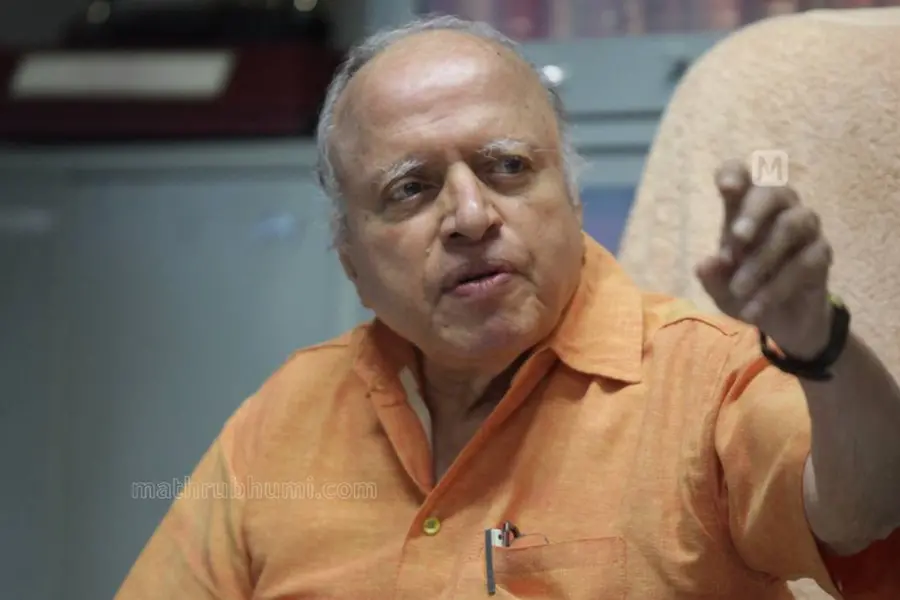
Can Mankombu Sambasivan Swaminathan, who passed away the other day, be considered the greatest Keralite ever?
There would undoubtedly be many who differ. Some may even feel scandalized, especially within Kerala. But if one goes by the international accolades the "Father of India’s Green Revolution" has received, he could indeed aspire to the honour.
The Washington Post newspaper said in an obit, “There was perhaps no one in India- no politician, no business leader, no philanthropist- who did more to help feed the teeming country than Dr. Swaminathan.”
Some time ago, Time magazine named him among the twenty Asians and the three Indians who influenced the world most during the 20th century. The only other Indians were Gandhi and Tagore.
There could also be questions about whether Swaminathan be even called a Keralite. He may not be a Malayali because his mother tongue is Tamil. He was not confident enough to speak Malayalam as he had never lived in Kerala except for two years when he studied at the University College in Thiruvananthapuram after matriculation.

Neither was he born in Kerala. How could a person born in Kumbakonam be called a Keralite? But can being born in the USA to Indian parents disqualify one from being called an Indian? Swaminathan’s parents, though they were second-generation descendants of migrants from Thanjavur, were natives of Mankombu, Alappuzha. Besides carrying Mankombu in his name, the illustrious scientist always proudly said he was the son of Kuttanad, Kerala’s rice bowl. The game-changing Kuttanad Package he authored to salvage his native village from the ecological morass into which it sank also bore a personal imprimatur from Swaminathan. It's another familiar story that Kerala collectively failed to implement the project.
Now, about his credentials to be called the greatest. How can someone personally instrumental in saving millions of people from starvation be denied the honour? How many Indians can be credited with such a feat, achieved in so little time?
Notwithstanding the euphoria over the newly won freedom after centuries of foreign hegemony, independent India was born amidst starvation and deprivation. Barely four years earlier, when Gandhi led India to its final leap towards freedom through the Quit India movement, three million people were dying of starvation in the Great Bengal Famine of 1943. This threw the newly independent India into a new dependency on the USA for cheap food grain imports under the PLO 480, meant for the poorest countries. Many pictured the newborn with a begging bowl, eking out a “ship-to-mouth” existence. Many warned India would sink into a devastating famine by the 1970s, hit by agricultural stagnation and a growing population.
This led many young Indians, inspired by the dawn of independence and rearing to build a new India, to be deeply embarrassed. One of them was the 22-year-old Swaminathan, who changed his plans to follow his late father’s footsteps to become a doctor and instead study agriculture. Later, he also dropped selection to the coveted Indian Police Service to go for a UNESCO fellowship at the Wageningen Agricultural University’s Institute of Genetics in the Netherlands. The year India became independent, MS graduated from the University of Madras in Agricultural Sciences and joined the prestigious Indian Agricultural Research Institute (IARI), New Delhi, for post-graduation in cytogenetics.
Following doctoral studies at Cambridge and post-doctoral research at the University of Wisconsin, Swaminathan returned to India in 1954, rejecting many lucrative offers in USA. First, he joined the Indian Rice Research Institute in Cuttack and later the IARI. He pledged to end India's dependence on America for food despite its great farming tradition and having more than half its population as farmers. Swaminathan keenly followed the quantum jump in wheat production brought about by the famed American agronomist Norman Borlaug in Mexico by the 1950s through high-yielding variety (HYV) seeds combined with modern technology.
On 24 January 1966, another Indian of Swaminathan’s generation, equally ashamed of the country’s dependence on the West for food, took over as the nation’s third Prime Minister. She was Indira Gandhi. One day, Swaminathan, then Director of IARI, accompanied the Prime Minister to an official function in her car. On the way, she asked him about chances to increase India’s agricultural production. Swaminathan replied in the affirmative and cited Borlaug’s incredible achievements. Then Indira asked Swaminathan, wrote his associate Davinder Sharma, “But can you give me a commitment that you will give me a surplus of 10 million tons in a couple of years from now because I want the bloody Americans off my back?”. Swaminathan said yes without batting an eyelid, and thus began India’s Green Revolution.
Backed by C Subramaniam, Union Minister for Food and Agriculture, Swaminathan went about in right earnest. He brought Borlaug to India and led the introduction of the new HYV dwarf wheat seeds combined with new pesticides, fertilizers, and modern farming technologies in Punjab, Haryana, and Uttar Pradesh. The results were quick and dramatic. India’s annual wheat production leapfrogged from 10 million tons in 1964 to 17 million in 1968. In Punjab alone, production zoomed five fold from 1.91 million tons in 1965-66 to 5.15 million in 1970-71.
Swaminathan was crowned the Father of India’s Green Revolution. The magic continued to work without a break, and today, India is not just self-reliant in food grain production but is a net exporter. India’s wheat production has multiplied ten times since 1965 to touch a record 112 million tonnes in 2022. Rice production also rose from 40 million tonnes in 1965 to 130 million tonnes by 2023, although some of the imported HYV rice seeds (IR8, which was common in Kerala and TN1) proved unsuccessful. Today, India is the world’s second-largest producer and exporter of both wheat and rice.
However, the intensive-farming-based Green Revolution had serious flipsides, which began to show within a few years. The worst was its disastrous environmental effects. The widespread use of toxic pesticides and fertilizers contaminated the soil and water, posing grave health risks to humans in the regions where the revolution occurred. Newly mutated pests immune to the pesticides rose in abundance. High water consumption by the HYV seeds caused Punjab to face acute groundwater depletion, drinking water scarcity, and desertification. Agriculture turned capital-intensive, environmentally unsustainable, and unaffordable for the poor and marginal farmers. Another serious catastrophe was the vanishing of hundreds of India’s traditional wheat and rice seeds, replaced by the imported HYV, which brought in quicker revenue. Environmentalists from all over the world rose in revolt against the Green Revolution and its architects like Swaminathan.
Yet, none could take away Swaminathan’s contribution in feeding the starving millions of India, averting famines that were recurrent until the 1960s, and making the country self-reliant in food. Significantly, Swaminathan was the first in India to point out all the possible consequences of indiscriminate intensive cultivation. Even as early as 1968, Swaminathan wrote, “Intensive cultivation of land without conservation of soil fertility and soil structure would ultimately spring up desserts. Indiscriminate use of pesticides, fungicides, and herbicides could cause adverse changes in the incidence of cancer and other diseases through toxic residues present in the grains or other edible parts.”
However, just as he should be credited for the positives of the Green Revolution, Swaminathan could not be exempted from its negatives either. Perhaps, in an act of reparation, he spent the rest of his life highlighting the negative consequences of intensive and industrial farming, the importance of conservation, biodiversity, gene protection, and the cause of poor farmers, especially women. According to P. Sainath, Swaminathan will be remembered mainly in the hearts of millions of peasants for the Report of the National Commission for Farmers that he authored. This report recommended that the Minimum Support Price for farming products should include the comprehensive cost of production plus 50%. Unfortunately, no central government chose to implement it even 20 years after its submission.
Swaminathan openly stated that the Green Revolution was unsustainable because it soon turned into a Greed Revolution. Instead, he called for the "Evergreen Revolution," with environmental sustainability at its core, and held that only holistic farming could mitigate the agrarian crisis. He campaigned for the protection and revival of traditional seeds and organic farming. I last interviewed him at the organic Navara rice farm in Chittur, run by my friend Narayanan Unny. MS was a constant backer of the medicinal traditional rice variety endemic to Kerala.
He was also at the forefront of questioning the ecological sustainability of Genetically Modified crops and seeds propagated by corporate majors. In the last controversy he was involved in, Swaminathan co-authored a paper with top geneticist P C Kesavan in 2018 in the journal Current Science, in which they questioned the need for GM crops like Bt Cotton. This kicked up a row with Prime Minister Narendra Modi’s principal Scientific Officer, K. Vijay Raghavan, calling the paper “pseudoscientific.” The massive outburst made the journal remove the article. It even prompted Swaminathan to clarify that he was not opposed to GM crops but that their negative aspects must be considered before they are introduced.
There could be arguments over Swaminathan being called the greatest Keralite. But no other person from the state seems to have influenced Indian life more than he has.
Published: 01 Oct 2023, 09:02 am IST
Disclaimer: Kindly avoid objectionable, derogatory, unlawful and lewd comments, while responding to reports. Such comments are punishable under cyber laws. Please keep away from personal attacks. The opinions expressed here are the personal opinions of readers and not that of Mathrubhumi.