What's this? NASA’s Curiosity spots massive honeycomb landscape on Mars
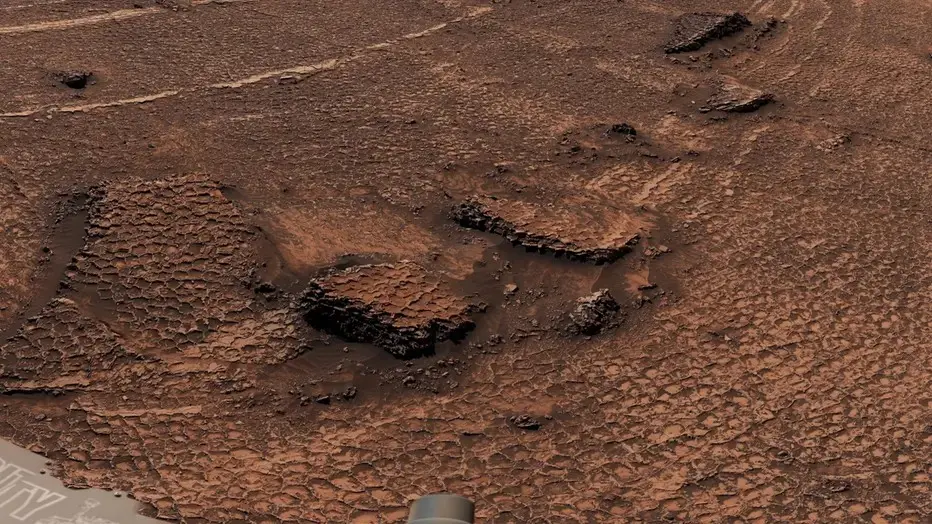
NASA's Curiosity rover has captured striking new images of an enormous field of honeycomb-like geological formations spread across the surface of Mars, offering scientists a rare glimpse into one of the Red Planet's most intriguing landscapes.
The images were taken as Curiosity climbed through a Martian valley known as Valle Grande, where mission scientists say they encountered the largest concentration of polygon-shaped rock fractures the rover has ever observed.
The polygonal fractures, measuring roughly 4-8 centimetres (1.5-3 inches) across, extend in every direction across the valley floor. While Curiosity has detected similar formations before, NASA said they have never previously been seen on Mars at such a large scale.
To document the unusual terrain, the rover captured a 360-degree panoramic view on June 19 and 20, 2026, revealing what scientists described as a vast "sea" of polygonal features stretching as far as the cameras could see.
The formations were also spotted climbing the sides of a 6-metre (20-foot) geological feature, or butte, nicknamed "Miraflores."
Scientists believe some polygonal fractures previously observed by Curiosity formed as ancient mud cracks, but the exact origin of the newly discovered formations remains uncertain.
Researchers say several geological processes may have produced the honeycomb-like textures. Possible explanations include repeated cycles of heating and cooling on the Martian surface or compression that squeezed water out of buried sediments over millions of years.
"We’ve seen a lot of fascinating landscapes through Curiosity’s eyes, but this sea of polygons took our breath away," says Curiosity mission project scientist Ashwin Vasavada of NASA’s Jet Propulsion Laboratory, as reported by BBC Sky at Night Magazine.
"We measured their shapes and chemistry carefully and are hopeful there are clues in the data as to how these features formed."
Curiosity, NASA's car-sized Mars rover, has been exploring Gale Crater and Mount Sharp since landing on the Red Planet in August 2012 as part of the Mars Science Laboratory mission.
Originally designed for a two-year mission, the rover has continued operating for more than 13 years, investigating Mars' climate, geology and ancient habitability. Its scientific objectives include determining whether Gale Crater once offered conditions suitable for microbial life and gathering data to support future human exploration.
As of July 30, 2026, Curiosity has remained active on Mars for 4,969 sols, or 5,106 Earth days, continuing to deliver new discoveries from the Red Planet.