What makes cloud droplets bigger? Scientists find clues in atmospheric electricity
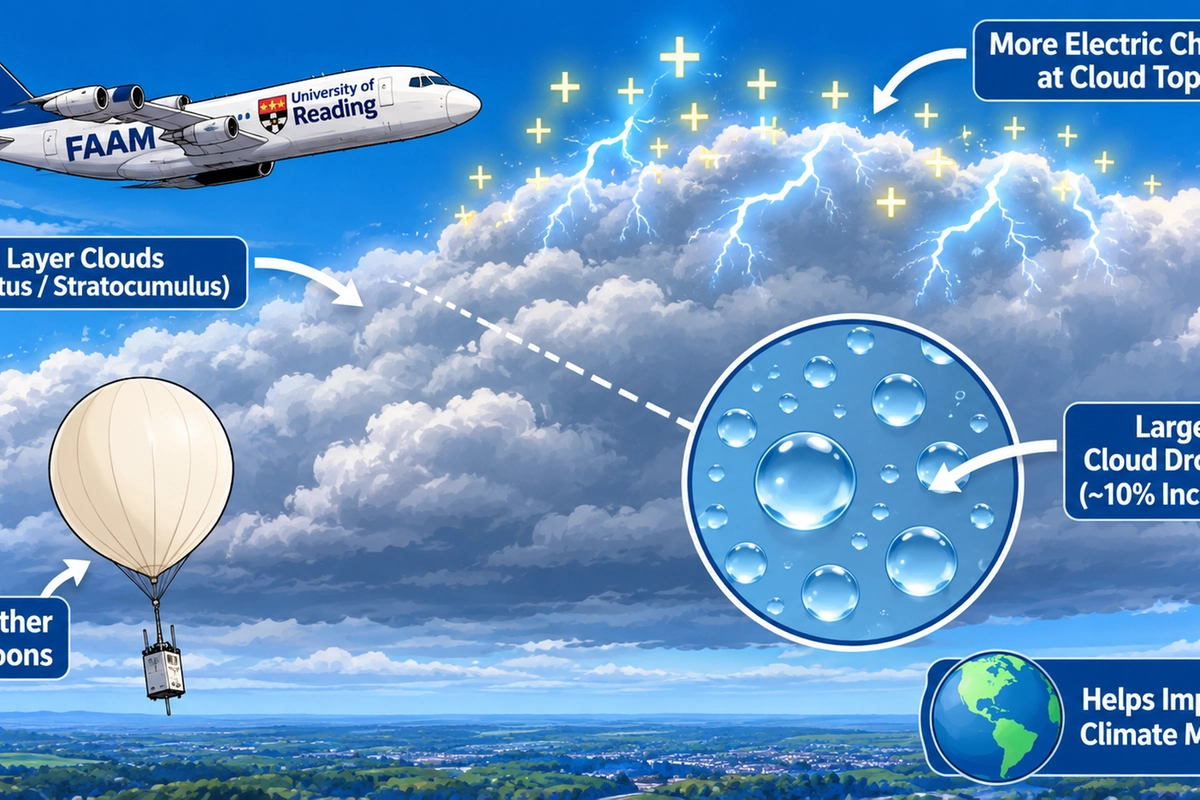
London: Measuring the electric charge in widespread, dull grey clouds could help scientists better understand the droplets within them and how clouds influence the climate, according to a new study by researchers at the University of Reading.
The study found that layer clouds, known to meteorologists as stratus or stratocumulus, tended to contain larger droplets when more electric charge was present at their tops. Droplet sizes increased by around 10 per cent across the range of charges measured.
The findings, published on Friday, November 27, in the journal Geophysical Research Letters, suggest that measuring electrical charge could provide additional information about cloud droplet size beyond conventional cloud measurements.
Droplet size is important because it affects how much sunlight a cloud reflects back into space. A better understanding of these variations could help scientists improve their knowledge of how clouds influence the climate and cool the planet.
Scientists have long suspected that atmospheric electricity could influence layer clouds, but detailed observations have been limited.
Combining aircraft and balloon measurements
For the study, researchers used the FAAM Airborne Laboratory research aircraft, a modified jet equipped with a system to measure atmospheric electricity. It flew over southern England on January 12, 2024.
Research flights over Reading are unusual because the university is located beneath the busy airspace around Heathrow Airport. The flight required close coordination between flight planners, scientists and aircrew as the weather conditions developed.
The aircraft repeatedly flew into and out of the top of an extensive layer of cloud. In one instance, it made 16 consecutive passes, measuring cloud droplets, reflectivity and electric charge at the same time.
As the aircraft passed over the University of Reading's Whiteknights campus, the team launched specially equipped weather balloons into the same cloud. The combination of aircraft and balloon measurements allowed the researchers to cross-check readings from the two platforms.
Dr Claire Ryder, mission scientist for the research flight and co-author of the study, said: “I was responsible for planning the flight and sampling strategy, sitting in the cockpit with the pilots during the flight to make in-flight decisions, and coordinating with the rest of the team operating instruments in the aircraft and on the ground.
“This particular type of flight, where we repeatedly descended and ascended in and out of layer cloud, was not the most popular with those on board. It was a bit like being on a rollercoaster, and adding in some additional light turbulence in the cloud led to a few complaining stomachs.
“Flying past Whiteknights campus was quite exciting, although we couldn’t see the ground at all due to the thick cloud. However, although the FAAM aircraft couldn’t be seen from the ground either, we were told that it could certainly be heard clearly by those on the ground as we flew over.”
Previous studies had generally relied on a single weather balloon passing through a cloud. Repeatedly sampling the same cloud helped the researchers observe variations in its electric charge and compare them directly with droplet measurements taken in the same location.
Professor Giles Harrison, who led the analysis, said: “Combining our specialised radiosondes with the long duration of the FAAM aircraft yielded an unusually detailed set of measurements, capturing the electric charge, droplets and reflectivity of the same cloud at once. It was not the most comfortable of flights and I am fortunate to have intrepid colleagues committed to obtaining these unique observations.”
The researchers said the measurements offer a rare insight into the electrical structure of extensive layer clouds and provide new data to explore how electricity influences them.
A better understanding of these processes could help scientists refine the way clouds are represented in weather and climate models.