Third interstellar visitor confirmed: 3I/Atlas offers rare glimpse into other star systems
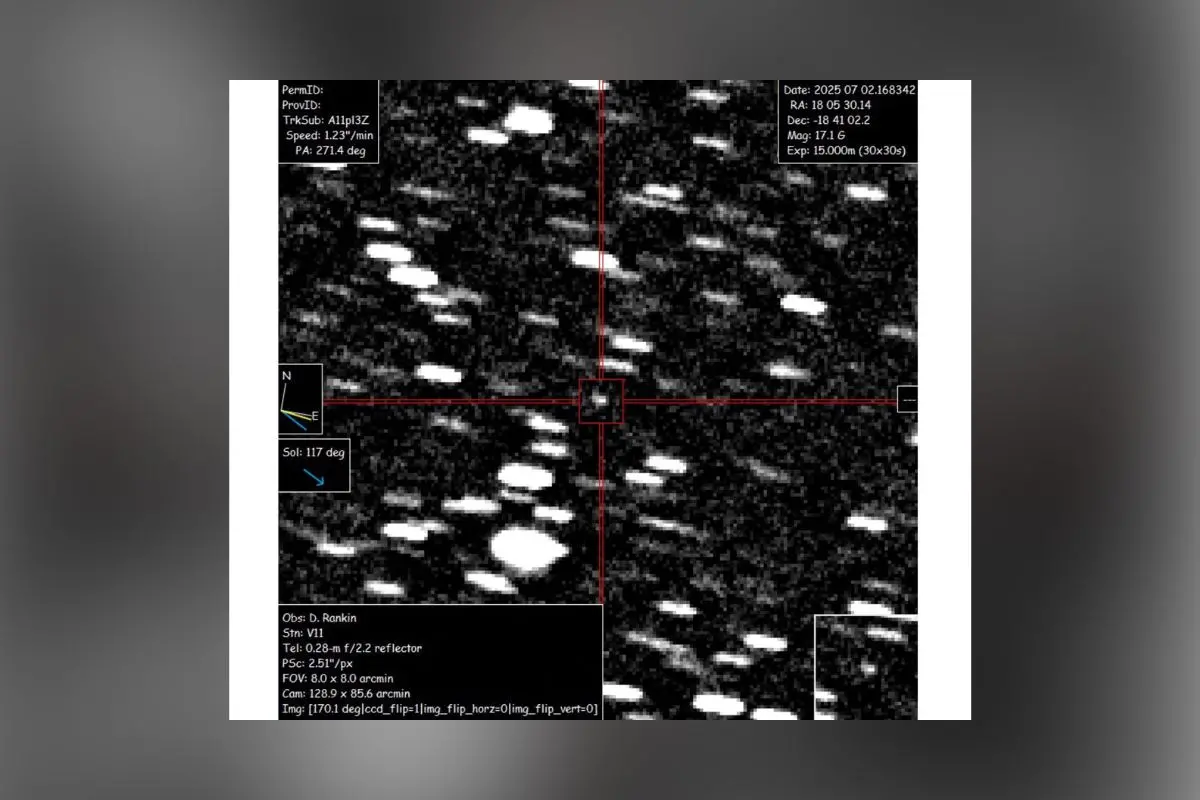
Paris: Astronomers have confirmed the discovery of a new interstellar object, designated 3I/Atlas, currently speeding through our Solar System. This marks only the third such visitor ever detected, and initial estimates suggest it could be the largest, potentially offering scientists a rare glimpse into material from beyond our stellar neighbourhood.
Classified as a comet, 3I/Atlas was first spotted on Tuesday by the NASA-funded ATLAS survey in Hawaii. Subsequent analysis by professional and amateur astronomers allowed its trajectory to be traced back to at least June 14. Its classification as a comet is due to its "fuzziness," which "suggests that it is mostly ice rather than mostly rock," according to Jonathan McDowell, an astronomer at the Harvard-Smithsonian Centre for Astrophysics.
The object, originally known as A11pl3Z, is currently estimated to be roughly 10-20 kilometres wide, though its icy composition could make it appear larger due to reflectivity. Zooming at more than 60 kilometres (37 miles) per second, its trajectory confirms it is not bound by the Sun's gravity but is "coming from interstellar space and flying off to there again," explained Richard Moissl, head of planetary defence at the European Space Agency. Moissl confirmed that 3I/Atlas poses no threat to Earth, as it will pass "just inside the orbit of Mars." It is expected to grow brighter and closer to the Sun until late October, remaining observable by telescope until next year.
This discovery follows two previous interstellar visitors: 'Oumuamua, detected in 2017, and 2I/Borisov, spotted in 2019. Mark Norris, an astronomer at the UK's University of Central Lancashire, noted that the new object appears to be "moving considerably faster than the other two extrasolar objects that we previously discovered." He speculated that such "ice balls" are likely formed in other star systems and then dislodged, wandering through the galaxy.
Scientists are particularly excited by the potential for these interstellar interlopers to provide unique insights into the composition of other star systems. Norris highlighted that detecting precursors of life, such as amino acids, on such an object could significantly boost confidence in the existence of life conditions elsewhere in the universe. While sending a mission to intercept 3I/Atlas is not feasible, the ongoing discoveries suggest a new era of interstellar observation. Modelling estimates that as many as 10,000 interstellar objects could be drifting through our Solar System at any given time, with the newly online Vera C. Rubin Observatory in Chile potentially set to find these dim visitors monthly.