Beyond our galaxy: WOH G64's surprising stellar metamorphosis offers supernova clues
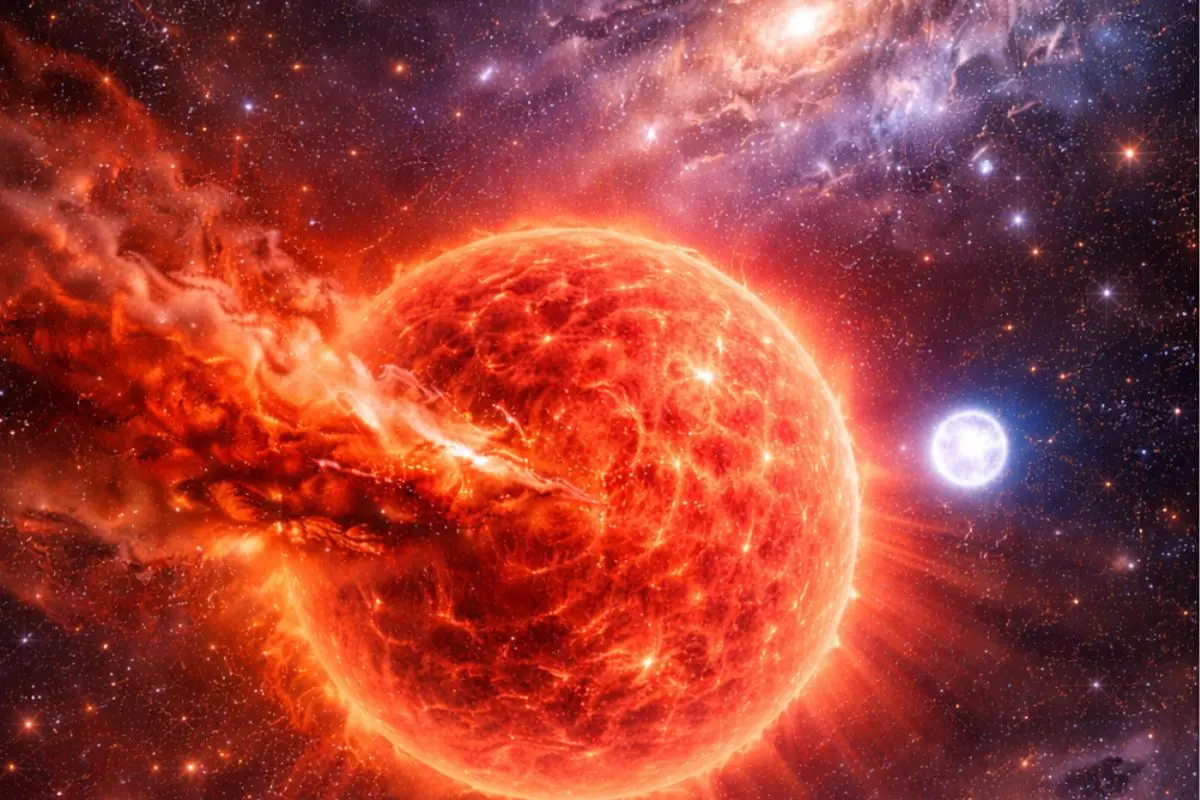
Melbourne: One of the largest known stars in the universe appears to have undergone a dramatic transformation and could be approaching a catastrophic end, according to new research.
A study led by Gonzalo Muñoz-Sánchez at the National Observatory of Athens, published in 'Nature Astronomy', suggests the enormous star WOH G64 has shifted from being a red supergiant to a rare yellow hypergiant — a change that may signal an impending supernova.
Researchers say the findings indicate astronomers could be witnessing, in real time, a massive star shedding its outer layers, contracting as it heats up, and edging closer to the end of its brief but intense life.
A colossal star beyond the Milky Way
WOH G64 was first identified in the 1970s in the Large Magellanic Cloud, a dwarf galaxy that orbits the Milky Way. It soon drew attention for both its extraordinary brightness and its immense size — measuring more than 1,500 times the radius of the Sun, making it one of the largest stars ever discovered.
In 2024, the star became the first beyond our galaxy to be photographed in such detail. Observations by the Very Large Telescope Interferometer revealed a dense, dusty cocoon surrounding the star, confirming that it has been losing mass as it evolves.
From red supergiant to yellow hypergiant
Although colossal, WOH G64 is relatively young in cosmic terms, estimated to be less than five million years old. By comparison, the Sun is around 4.6 billion years old. Massive stars like WOH G64 are known to burn through their nuclear fuel rapidly, living short and volatile lives.
Like other stars, WOH G64 would initially have fused hydrogen in its core. As its hydrogen supply diminished, it expanded and began fusing helium, entering the red supergiant phase.
Not all supergiants evolve into hypergiants. Astronomers believe hypergiants form when extremely massive stars rapidly transition between stages of nuclear burning. During this phase, they shed significant portions of their outer layers while their cores contract.
Once a star reaches the hypergiant stage, it is generally considered to be on a fast track to a supernova — the explosive death of a massive star.
What changed in 2014?
The new study points to a dramatic event around 2014, when a substantial portion of WOH G64’s outer surface appears to have been expelled.
One possible explanation is gravitational interaction with a companion star, whose presence was confirmed through analysis of WOH G64’s light spectrum. Such interactions can destabilise a star’s outer layers, triggering intense mass loss.
Another possibility is that the star has entered a pre-supernova “superwind” phase — a period characterised by powerful internal pulsations as the core rapidly exhausts its fuel. These pulsations can drive extreme stellar winds, stripping away vast amounts of material.
A rare opportunity for astronomers
Most stars endure for tens of millions or even billions of years. Capturing such rapid and dramatic changes — particularly in a star outside our own galaxy — is exceptionally rare.
If WOH G64 does explode within our lifetime, it would offer not only a remarkable cosmic display but also a valuable scientific opportunity. Observing the final stages of such a massive star could help astronomers refine their understanding of how the universe’s most colossal stars live and die.