Indian frogs show never-seen new behaviours – Biting and screaming
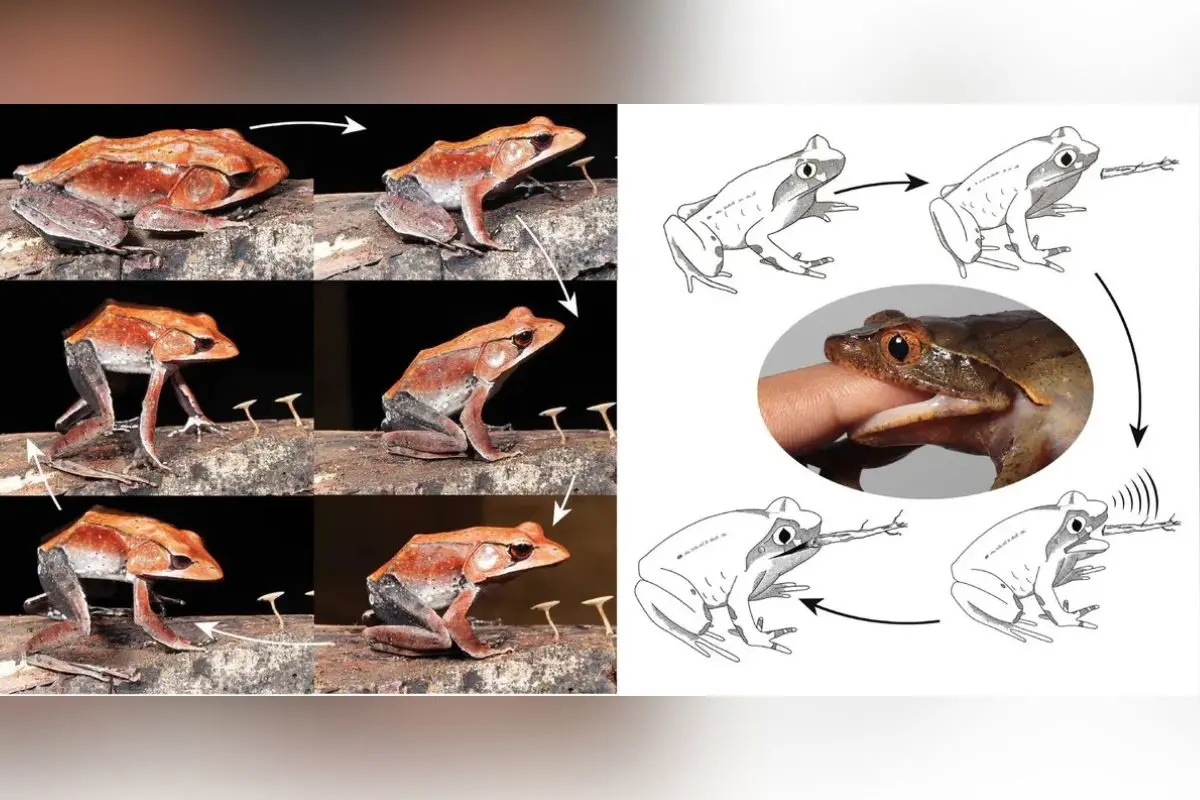
Kozhikode: A frog that bites and screams when threatened, and another that raises its body in a defensive stance, two remarkable behaviours never before observed in Indian frogs, have been documented by a team of amphibian researchers.
The discoveries were made by a Delhi University research group led by renowned Malayali amphibian expert Dr Sathyabhama Das Biju. The findings have been published in the latest issue of the international journal Herpetological Notes.
The Apatani Horned Toad, found only in Arunachal Pradesh, was observed to bite and emit a scream when disturbed. Meanwhile, the bicoloured frog, native to the Western Ghats of Kerala, was seen raising its body to appear larger as a defensive response when threatened.
“Although frogs are known to exhibit a wide range of defensive behaviours, these are often undocumented,” said Dr Biju. “India has 419 known frog species, yet this is the first record of biting and body-raising defence strategies in any Indian frog.”
He added that the findings highlight how much remains to be discovered about the behaviour and natural history of Indian amphibians.
Discovery during Field Photography
The new observations were made during field photography expeditions in Arunachal Pradesh and Kerala.
The Apatani Horned Toad (Xenophrys apatani), a nocturnal species endemic to Arunachal, camouflages itself among leaf litter during the day. When approached or threatened, it inflates its body and lets out a loud scream, and if the threat persists, it bites. Researchers confirmed this behaviour by simulating threatening situations using twigs and other objects.
In Kerala’s Palakkad district, during fieldwork in the Siruvani forest, the team observed the bicoloured frog (Clinotarsus curtipes) exhibiting a unique defensive posture. This diurnal species, which lives among forest leaf litter, has distinct colouration on its dorsal and ventral sides. When disturbed, it stretches its limbs vertically and lifts its body off the ground to appear larger, a clear warning to predators.
Researchers later verified this behaviour through controlled experiments, confirming the frog’s distinctive defensive strategy.
“These observations reveal the astonishing diversity of defence mechanisms even among familiar species,” said Dr Biju. “It’s a reminder that India’s amphibian world still holds many secrets waiting to be uncovered.”