How does your brain know your hand belongs to you? New study reveals the process
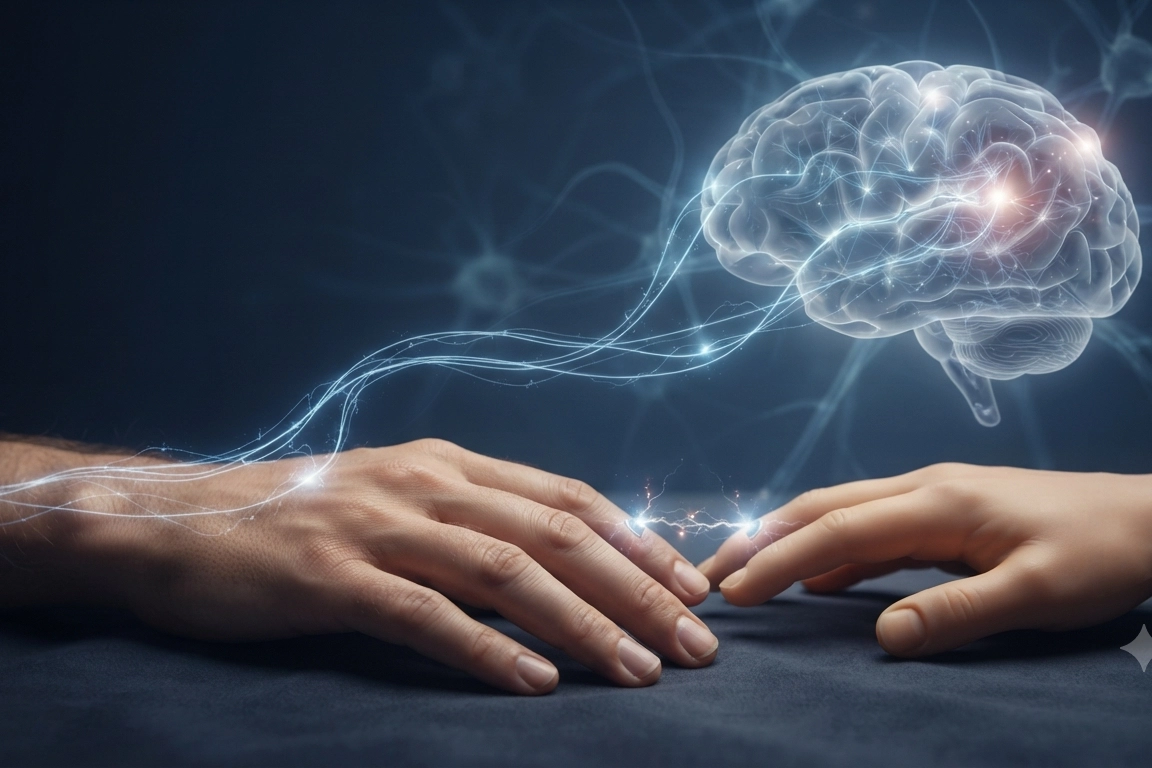
Stockholm: The feeling that a hand belongs to one's body is created through a coordinated sequence of activity across different regions of the brain, with the process beginning even before physical contact takes place, according to a new study by researchers at Karolinska Institutet in Sweden.
Published in the journal Nature Communications on November 23, 2026, the study examined how the brain combines information from different senses to create the experience of body ownership.
Researchers used the well-known rubber hand illusion experiment to investigate the process. The findings provide a more detailed picture of when different brain regions become active and how they interact to make a person perceive a limb as part of their body.
Henrik Ehrsson, professor in the Department of Neuroscience at Karolinska Institutet and the study's lead researcher, said scientists already know several brain regions involved in the sense of body ownership. However, less is known about the timing and sequence of activity across these regions.
The research team mapped these activity patterns over time, tracking changes in brain activity at intervals of four milliseconds.
How did researchers study the brain's sense of body ownership?
The experiment involved 45 healthy volunteers who took part in the rubber hand illusion.
In this experiment, participants are shown a lifelike artificial hand while their real hand remains hidden behind a screen. Two robotic arms then apply brief, light touches simultaneously to the visible artificial hand and the hidden real left hand.
When the touches are synchronised, participants can begin to experience the artificial hand as if it were part of their own body.
Researchers measured participants' brain activity using magnetoencephalography (MEG), a technique that records the magnetic fields generated by electrical activity in the brain.
By changing the timing and manner in which the hands were touched, the researchers compared brain activity under different conditions. These included situations in which participants experienced the illusion, did not experience it, or could see their real hand being touched.
The researchers focused their detailed analysis on 28 participants who clearly experienced the illusion. They examined brain activity across the entire brain at four-millisecond intervals to create a time-based map of the process.
What happens in the brain when a hand feels like your own?
The researchers identified three distinct phases of brain activity associated with the feeling that the artificial hand belonged to the participant.
The first phase began before the hand was touched. This was followed by a rapid sequence of activity in several regions of the brain's right hemisphere, including the frontal and parietal lobes and the cerebellum. The left hemisphere became involved later.
The findings suggest that the brain does not simply register physical contact before deciding whether a limb belongs to the body. Instead, expectations about incoming sensations also appear to contribute to the experience.
Daniel Lundqvist, professor in the Department of Clinical Neuroscience at Karolinska Institutet and a co-author of the study, said the activity beginning before touch indicates a close connection between the brain's expectations of sensations and the conscious experience of body ownership.
The research also demonstrates how different brain regions work in sequence to combine information from multiple senses into a unified perception of the body.
Could the findings help explain body perception problems after a stroke?
The researchers observed that activity during the first two phases occurred almost exclusively in the right hemisphere of the brain.
They said this observation could help explain why some people lose the feeling that their left arm belongs to them after a stroke. Such disturbances in body perception are often associated with damage to the right hemisphere.
However, the researchers have not yet tested this proposed connection in stroke patients.
Ehrsson said future research would compare the brain activity associated with perceptions of the right and left hands. The team also plans to collaborate with stroke researchers to investigate the phenomenon in patients.
The findings could eventually contribute to a better understanding of altered body perception following brain injuries, although further clinical research will be needed.
Study details and funding
The study, titled Spatiotemporal brain dynamics of limb ownership perception, was conducted by Maximilian F. A. Hauser, Sara Coppi, Daniel Lundqvist and H. Henrik Ehrsson.
It was carried out in collaboration with NatMEG, the national infrastructure for magnetoencephalography at Karolinska Institutet, and the Centre for Brain Imaging at Stockholm University.
The research received funding from the Swedish Research Council, the Göran Gustafsson Foundation, the Torsten Söderberg Foundation and the Swedish Brain Foundation. NatMEG also receives support from the Knut and Alice Wallenberg Foundation.
The researchers declared no conflicts of interest.
Why understanding body ownership matters
The sense that a limb belongs to one's body is an important part of how people perceive and interact with their surroundings. The brain continuously combines sensory information, including touch and visual input, to maintain this perception.
The rubber hand illusion provides researchers with a way to study how this process works. When a person sees an artificial hand being touched at the same time as their hidden real hand, the brain can begin to treat the artificial hand as part of the body.
The new study adds a time-based dimension to this understanding by identifying the sequence in which different brain regions become active. The finding that activity begins before touch also highlights the role of the brain's expectations in shaping bodily experience.
Its potential relevance to stroke research is particularly significant. Damage to certain brain regions can affect how patients perceive their limbs, even when those limbs remain physically present. Understanding the brain activity associated with body ownership may help researchers investigate why these disturbances occur.
However, the study involved healthy volunteers and an experimental illusion. It does not establish how body ownership is affected in stroke patients or provide a treatment for such conditions. Further research involving patients will be necessary to explore these possibilities.