Ayodhya is not a milestone, it is a continuum, says Yechury
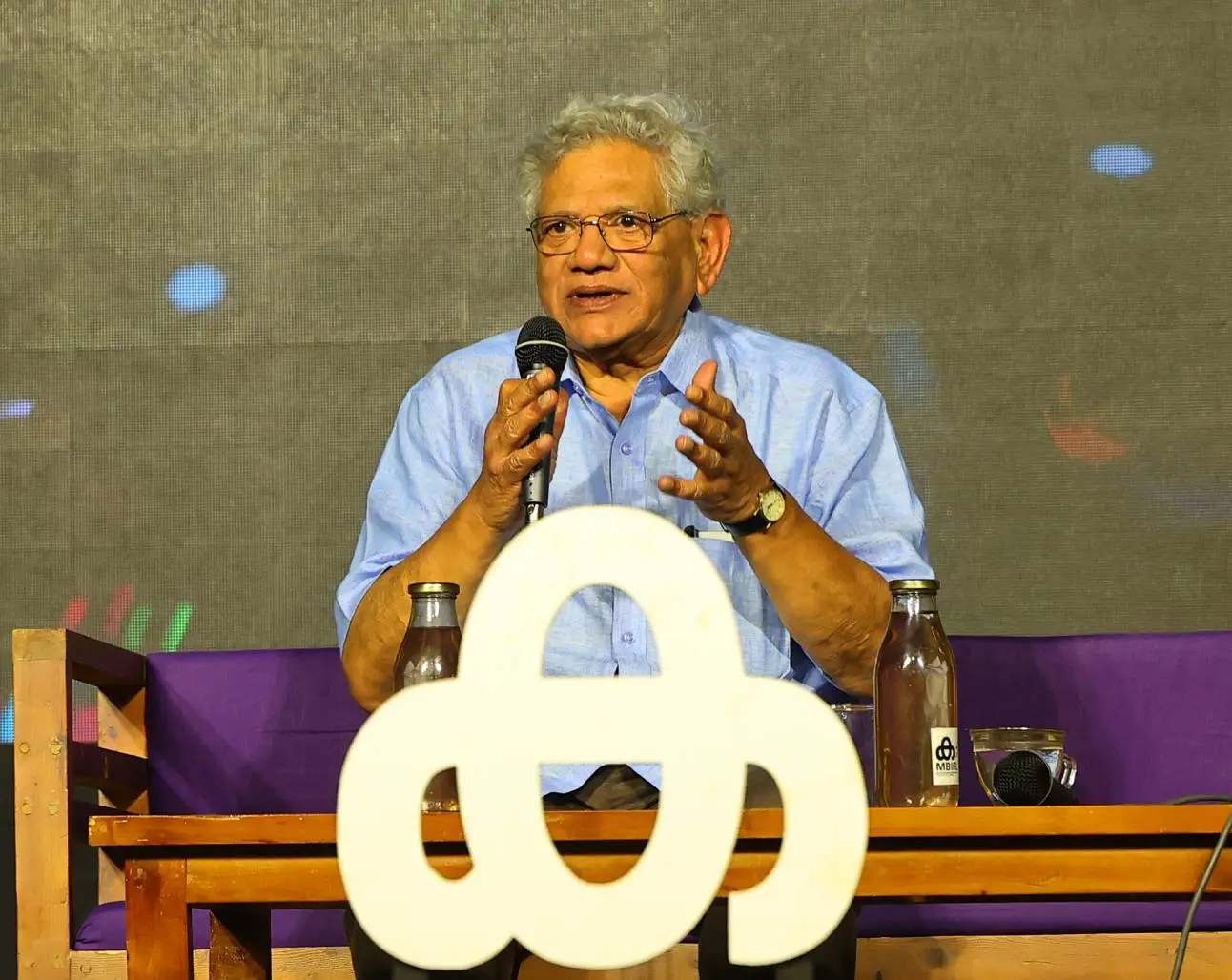
Is Ayodhya a milestone in the political history of India? What is the difference it has brought about in the political landscape of the nation? According to CPM general secretary Sitaram Yechury, Ayodhya is a continuum rather than a milestone.
Addressing the session ‘India After Ayodhya,’ at the fifth edition of the Mathrubhumi International Festival of Letters, he said this is a continuum that has been happening for a century. “It was in 1923 that Veer Savarkar wrote a small pamphlet called ‘Hindutva’ and it meant the people who were here and whose holy places are in this land. This naturally excludes Muslims and Christians whose holy places are outside India,” he said. In 1925, the RSS was formed, he pointed out, underscoring the evolution of a political game plan.
“For Savarkar, Hindutva is a political project that has nothing to with the practice of the Hindu religion,” he pointed out, adding that the project has been continuing for a long time and hence Ayodhya is not a milestone.
Yechury also pointed out that the political agenda of the BJP-RSS combine is to use Ayodhya as a campaign tool again and a motion has been moved in the Lok Sabha and the Rajya Sabha, congratulating the prime minister for building the Ram Temple at Ayodhya with that aim only.
“We respect religion and we respect the right of every human being to choose their religion, but that should be allowed without any interference. Interference is what we are actually suffering today,” said Yechury.
He was critical of the Supreme Court verdict on Ayodhya while expressing that he respected the verdict. “The Supreme Court said the demolition of the masjid was really a violation of the law and handed over the land to the same people (who demolished it) to build the temple,” he said.
Yechury observed that the Trust has to build the temple and the government or the state cannot propagate any one religion. “That is the foundational principle of secularism but that is violated today and that is what we oppose,” he added.
The CPM general secretary was also highly critical of the action of Kerala Governor Arif Mohammed Khan, which is also affecting the functioning of educational institutions. Further, the centre is denying the states their due share of the revenue, especially to states like Kerala, where the BJP is not in power.
Hindutva can be fought by relentless non-compromising upholding of secularism, which is the separation of the religion from politics. He was also highly critical of the soft-Hindutva stand taken by the Congress.
Snubbing the stories of development and progress that India has achieved under the BJP regime, he said the country has the highest unemployment rate. Also, there is the reverse migration and workers are returning back from the cities to their villages for a living, which contradicts the development narrative being created, he pointed out.
Yechury also said the Modi regime wants to convert a secular democratic republic into a Hindutva state and also undermine independent institutions, subtly criticizing the way the judiciary is functioning today, especially in the backdrop of the abolition of Article 370. So, the India after Ayodhya is worse than the India that was before Ayodhya, said the CPM general secretary.