History has excluded women who played crucial roles in Kerala's formation, says K K Shailaja
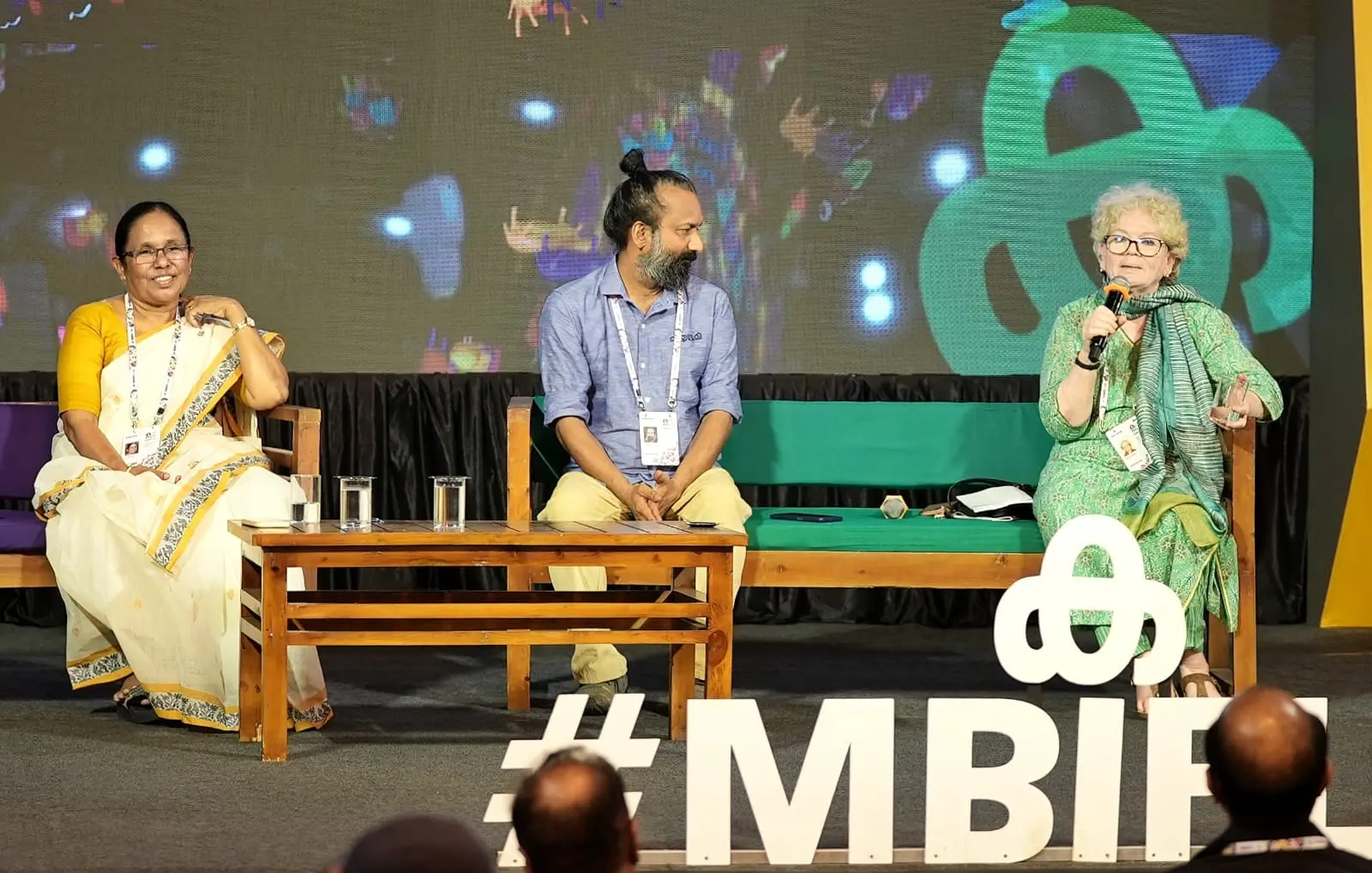
Former minister for health in Kerala, K.K Shailaja, and renowned novelist and torchbearer of the feminist movement in Kerala, Sarah Joseph, came together for dialogue on ‘Kerala created by women’ (Streekal srishticha Keralam) at the Mathrubhumi International Festival of Letters on Friday.
The session, moderated by senior journalist K Madhu, began with the release of ‘Lilliappa’, a children’s book by Sarah Joseph. While introducing the topic for the discussion, K Madhu praised the role of women in pushing the state forward in various fields.
K.K. Shailajah spoke about how her grandmother helped her take her first steps into literature and opined that many women who play drastic roles in the creation of a state are often not mentioned in history. She also explained how reading Sarah Joseph's work growing up influenced her worldview and fostered her reading habit.
Alluding to her fictional character of Budhini, Sarah Joseph said that the character represents the lakhs of dislocated and forgotten people in the name of development. "Indian history has never acknowledged the sacrifices of such people who gave up their livelihoods and homes for the sake of development. Writing about Budhini was like writing about India. That is how it became a pan-Indian work."
“Mahatma Gandhi has told us how a nation can be developed by catering to those that lie at the bottom level of society. On one hand, our Prime Minister Narendra Modi talks about the leaps in rural development, while on the other hand, he goes to the villages and promises toilets. Without caring for the roots, there is no point in tending to the shoots. Thus, when we talk about development, we should talk about these people that are ignored,” she said.
Talking about the politics of freebies, Shailaja said that the development of a nation can only happen when the public's daily needs are met. This requires a Rs 1600 pension, a subsidy, and scholarships. This cannot be considered an offering or a freebie, she added.
Sarah raised the question of the role played by women in designing state developmental policies. Citing an anecdote from the US-Vietnam war, she said that women do not think about bombs but about grains and water. "The basis of development as far as women are concerned is the availability of food, water, and shelter. There are no means for women to develop policies that the nation actually needs. Even 33 per cent of representation for women is not available in actual decision or policy making."
“If we constantly raise such issues and make noise, people on the inside, like Shailaja Teacher, will be able to do something about it. Why are women not given equal rights as per Article 14? There is no need for half the population to demand representation. It should naturally exist. The confidence and comfort that the teacher (Shailaja) gave us during the COVID-19 period is incomparable. Could any of the male leaders have done the same? It’s not that women are not capable. Women have the knowledge, empathy, and ability to make decisions and form policies. They have a vision of the world, the future, and their children. The 33 per cent reservation is merely welfare, it should be 50 per cent if equality is to be maintained,” Sarah opined.
Responding to this, Shailaja listed out the women-oriented policy decisions made by the communist party. She also pointed out a tendency among women to avoid taking up positions of power due to their familial responsibilities. Change needs to come, and that needs to take place at the societal level. Scientific growth needs to be encouraged. But we are now living in times where even scientists are ascribing to superstitious beliefs. Taking up positions of power from the grassroots level is the way to go, Shailaja opined. She also said that processes are ongoing within the communist party to change mindsets and create more spaces for women. She ended her words with the hope that such a change might occur soon.
Political equality may have come but social and economic equality is yet at large. If economic equality had to be ensured, we should have created a society like that. We haven’t been able to create an equal world for women, Sarah Joseph said. She ended her words by saying that she does not believe that the 33 per cent reservation will be a reality in the upcoming elections.