Signs are alarming, we are reminded of Nazis: MT Vasudevan Nair
In the last years of the 20th century, UNESCO carried out a census of the languages of the world. According to this survey, 6,700 languages were in use in the world. Twenty years later, when another census was conducted it was found that 1,700 of these languages were not in use. Along with that, it was said, half of the 6,700 languages were virtually dead. In a later survey it was found that out of 196 Indian languages, most were not in use. Among these were five South Indian languages, mainly from Karnataka. Tulu, Koduva, Coorgi and so on have almost reached the point of extinction. In programs instituted to overcome this situation, it is necessary to take the record of the spoken language before moving on to the task of reviving them. People like Balachander Nemade are involved in this kind of work. He is recording the folklore and ancient tales narrated in local languages. GN Devi is working to retrieve North Eastern languages that have been lost. In such an environment, there is concern in many places about what is happening to languages. We have been thinking about the state of Malayalam for quite some time. Malayalam will not vanish suddenly. It is slowly growing in the live consciousness. Here we have a University dedicated solely to Malayalam. However, we should be thinking about the exclusion of Malayalam from the teaching curricula. I recently examined many text books. There was no dearth of literature. There were many literary works. Old as well as new works were included.
There was a practice of nominating writers to the Rajya Sabha. G Sankara Kurup and later on RK Narayanan became Rajya Sabha members in this way. Only once did Narayanan speak in the Rajya Sabha. He pointed out that our children’s spines are getting bent because they have to carry loads and loads of books and he demanded that experts must study this problem. This is an important matter. I became convinced of this when I picked up the bundle of books carried by the seventh-class girl in my house.
Textbooks do have literature but no one is asked to memorise poetry anymore. Earlier there were conditions that poems had to be memorised and tests would be held to check if it had been. Over time, all has changed and even exams are no longer considered necessary. Now the dominant thought is that everyone must be allowed to pass. What meaning is there in life if there is no healthy competition. We send any child who is ready to run or jump to the Olympics and other games. Anyone who gets the qualifying grade in these spheres can compete. But look at our educational situation. It is absolutely necessary to cultivate in our children the spirit to compete and come out in front. It is an essential requirement in life. We can discard whatever is unhealthy. But competition is necessary for entry into the world of knowledge. A condition in which there is no competition and everyone is allowed to pass is not correct. Children must learn and they should do so while competing a little. In my childhood, at a school function, I received a lot of prizes from Chitran Namboodiripad. For essays, stories, poems. I still remember that function. It was a function that filled me with joy and enthusiasm. We need to encourage children to compete in these ways.
These days you very often hear the question whether it is necessary to teach poetry. Even today the poems by Asan, Ulloor and Vallathol that I read in my childhood remain unerased in my memory. Lines from “Kuchelavritham” remain in my memory. Recollect the picture of Krishna welcoming his comrade. Citing those lines, my Malayalam teacher Kuttiraman Master told me, “Vasudeva, give Abdurehman some more space on the bench. He is tired and sweaty after climbing the hill. Like we just read, he is a comrade”. That was how I learnt the meaning of that word. Our language has picked up words from many other languages also.
Today’s children do not even learn grammar. The earlier generation would find the same thrill in doing grammar problems and Vyakarnam and Alankaaram as today’s generation finds in doing Sudoku. In today’s literary creations, literature itself comes as a topic. An adaptation of one of Shakespeare’s plays with Harvard University as the backdrop has come out. Pablo Neruda is a character in the novel and movie called “In Post”. The writer tried to show in this work that Roopakam (conceptualisation), Alankaram (ornamentation) and so on are not disconnected with life. He did it successfully. When I looked at a seventh-class student’s class-books without his knowing, I found five books. There was one Malayalam notebook. Good handwriting but lots of mistakes. The teacher who assessed his work had not corrected the mistakes. There were three English books and one fifth-class book on computer science.
There are benefits as well as costs to not knowing about computers. Today’s children need calculators to add numbers. It was not needed earlier. With calculators there is no testing of intelligence. Nowadays you give this device as gifts to even small children. In excess, even Amrut is poisonous. To cite the novel Martha as an example. There is a computer expert in it. He builds a computer and teaches it everything. It learnt how to do every job including how to make tea. He also gave it a name—Martha. After some time, he fell in love. After they were married the man told his wife, “You need not do any work. I have made a computer and you can tell it if you need anything. The bride became acquainted with Martha. As Charlie Chaplin depicted in Modern Times, the machine gradually began exercising its brain. It stopped obeying instructions. When it did something it was the opposite of what it was supposed to do. She complained to her husband who examined the machine and said that there was nothing wrong with it. Finally, Martha kills that young woman who had become her enemy. Computers are needed but at the same time there is no need for it to enter into spheres where our own intellects should function.
There is nothing wrong if children memorise poems. I still remember poems I learnt seventy years ago and can recite them flawlessly. An antidote to diseases that affect the memory is the exercise of trying to remember events from long ago. Will there be any child in Tamil Nadu who does not remember four lines from Bharatiyar’s works? In Bengal will there be a child who does not know four lines of Tagore? Our children don’t know the poetry of Asan or Ulloor or Vallathol. This is a pitiable situation in which we do not know the foundations of our language. Poetry is there in the textbooks but it is not being memorised. They need to confront many problems directly throughout their life and learn their lessons. This notion that their entire life is inside the computer needs to be changed. When I went to Manipal University, I saw that they have classes in Medicine, Engineering and so on. Apart from that one day in the week they have the opportunity to read literature. They listen to speeches on literature like they listen to the lectures in their subject. The stories and poems they listen to become part of their lives. We need that in our study programmes. If we want to absorb our language, poetry and novels have to be inside us. Once a group of French writers had come to Delhi. A writer called Mudam Costa was in that group. One of her sons was studying philosophy, while the other was studying engineering. Neither of them could write their exams, without having a foundation in French language and literature. Our own language is part of our life skills. It improves our thinking ability, improves our imagination. All this must be taken into consideration while preparing our study programme. Students must be made to memorise some poetry so that they can be encouraged to venture into the universe of reading. When I was studying, lots of children used to make handlooms. In the same way education must become part of our lives.
You must be aware of the problems India is facing. A writer like Perumal Murugan had to give up writing because of social pressure. Writers and intellectuals are being killed for expressing contrary views. In general intolerance is increasing. Freedom of expression is being threatened.
Matters seem to be heading towards a very dangerous situation. A great sin was committed against Perumal Murugan by the community. As a writer I do not agree with the stance he took. Writers should confront such challenges, in my opinion. That is his duty. He should not remain silent. He should not take a stance that he will not write.
To use power to suppress opposing voices is very wrong. Not just wrong, it reminds you of the time of the Nazis. Lot of people left Germany at that time and went to neighbouring countries. Such a situation should nor develop in India. I don’t think it will happen. There are people here with the strength to resist. People who know the seriousness of these developments will come out into the field. Therefore, I do not think that what happened in Germany will happen here. But we are seeing some signs of it. These should be looked at seriously. Small signs can grow into big problems. This is something we must remember. We must be prepared. Religion is like an opinion. No religion tells people to kill. No religious scholar or prophet calls for attacks and murder. They teach love and friendship. Who is making young people tie bombs to their bodies and become suicide bombers to kill innocent people? Who is teaching them that they will get entry into heaven if they do all this? They are being taught that Houris will serve them Biryani in heaven. This is what they are being taught. True believers should oppose all this. They need to understand this. Everyone must give up the language of violence. All religions have principles in their very nature. They have a philosophy. That is what should be propagated in society.
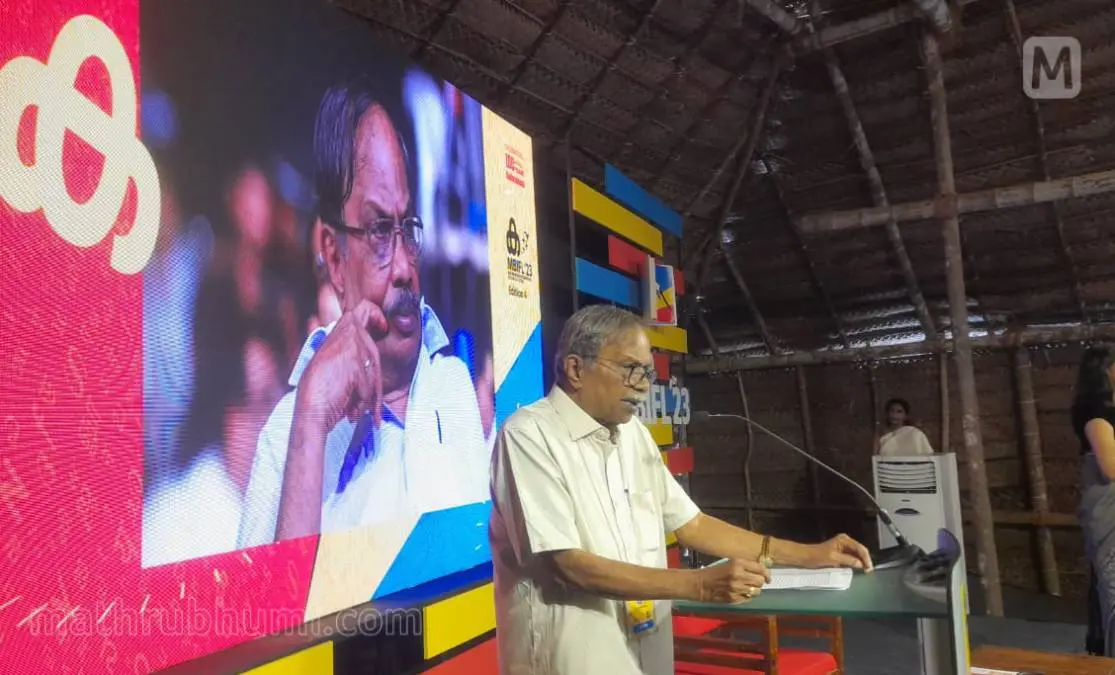
Keynote address delivered by MT Vasudevan Nair at the inaugural session of MBIFL 2023, translated by Uma Satheesan.