US Ambassador Mike Huckabee draws Arab fury with claim on Israel’s right to much of Middle East
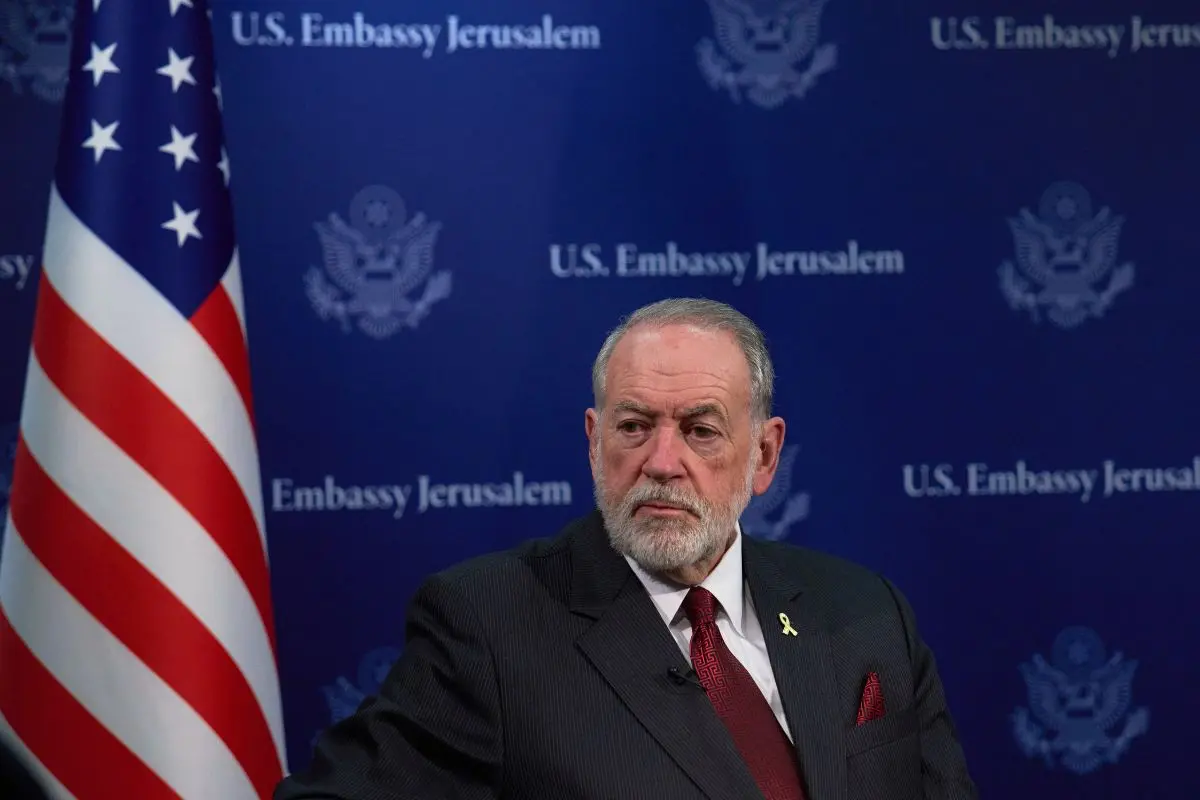
Tel Aviv (Israel): Several Arab and Muslim-majority countries on Saturday criticised remarks by the United States ambassador to Israel, Mike Huckabee, after he suggested that Israel could lay claim to a vast expanse of the Middle East.
Huckabee made the comments during an interview with conservative commentator Tucker Carlson that aired on Friday. Carlson referred to biblical passages stating that the descendants of Abraham were promised land encompassing much of today’s Middle East and asked whether Israel had a right to that territory.
Huckabee responded: "It would be fine if they took it all." He added that Israel was not seeking territorial expansion and emphasised that the country has a right to security in the land it legitimately controls.
Regional condemnation
The remarks prompted swift reactions from Egypt and Jordan, as well as from the Organisation of Islamic Cooperation and the League of Arab States. In separate statements, they described the comments as extremist and provocative, and said they did not reflect official US policy.
Egypt’s foreign ministry termed the remarks a "blatant violation" of international law, asserting that "Israel has no sovereignty over the occupied Palestinian territory or other Arab lands."
The League of Arab States said: "Statements of this nature - extremist and lacking any sound basis - serve only to inflame sentiments and stir religious and national emotions."
There was no immediate response from either Israel or the United States administration.
Historical and political context
Since its founding in 1948, Israel’s borders have evolved through a series of wars, ceasefires and agreements with neighbouring states.
During the 1967 war, Israel took control of the West Bank and east Jerusalem from Jordan, Gaza and the Sinai Peninsula from Egypt, and the Golan Heights from Syria. The Sinai was later returned to Egypt under a peace treaty following the 1973 war. Israel withdrew from Gaza in 2005.
In recent months, Israel has expanded settlement activity in the occupied West Bank, legalised previously unauthorised outposts and introduced administrative changes in the territory. US President Donald Trump has said he would not permit Israel to annex the West Bank and has pledged to block any such move.
Palestinians have long sought an independent state in the West Bank and Gaza, with east Jerusalem as its capital — a position supported by much of the international community.
Huckabee has consistently rejected the two-state solution. In a previous interview, he said he does not accept the term "Palestinians" to describe Arab descendants of people who lived in British-controlled Palestine.
In the latest exchange, Carlson cited verses from the book of Genesis, stating that God promised Abraham land stretching from the Nile to the Euphrates.
"That would be the Levant, so that would be Israel, Jordan, Syria, Lebanon. It would also be big parts of Saudi Arabia and Iraq," Carlson said.
Huckabee replied, "Not sure we'd go that far. I mean, it would be a big piece of land."
Ongoing regional tensions
Israel has also expanded its footprint in certain areas since the start of its war with Hamas in Gaza. Although a current ceasefire has led to troop redeployments into buffer zones, Israeli forces continue to control more than half of the territory. Further withdrawals are expected, though no specific timeline has been outlined.
Following the removal of Syrian President Bashar Assad in late 2024, Israeli forces took control of a demilitarised buffer zone in Syria established under a 1974 ceasefire agreement, describing the move as temporary and aimed at ensuring border security.
Israeli troops also remain stationed at five elevated positions in Lebanese territory after a brief conflict with Hezbollah in 2024.
AP