Putin walks off, Shehbaz Sharif follows: Pakistan PM’s brief interaction draws attention
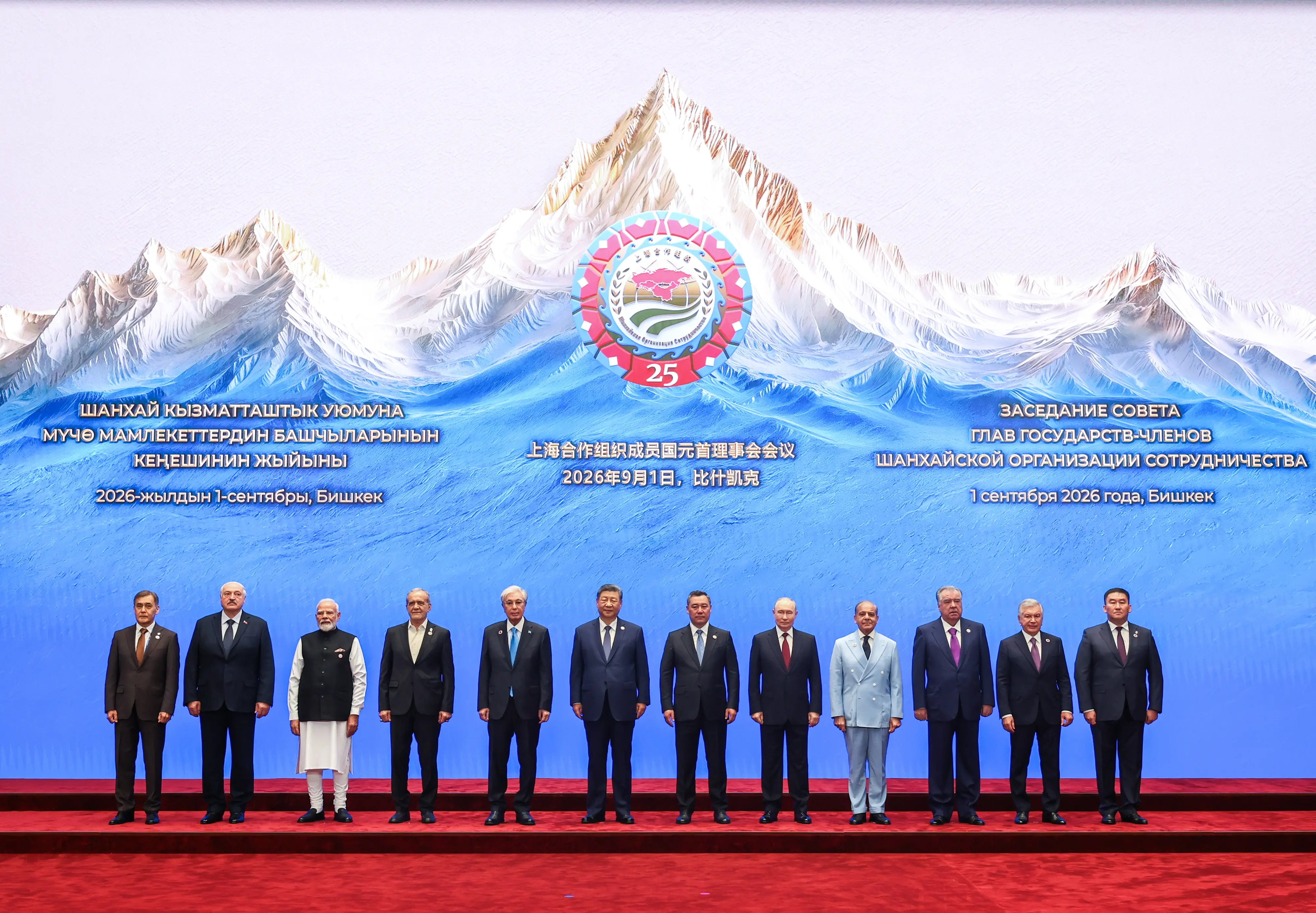
Kyrgyzstan: A brief interaction between Pakistan Prime Minister Shehbaz Sharif and Russian President Vladimir Putin after the SCO group photograph drew attention at the summit in Bishkek, while Prime Minister Narendra Modi used his address to call for stronger action against terrorism and advocate dialogue and diplomacy to resolve conflicts.
Shehbaz Sharif approaches Putin after group photograph
World leaders attending the 26th Shanghai Cooperation Organisation (SCO) Summit in Bishkek, Kyrgyzstan, gathered for the formal group photograph on Tuesday.
After the photograph, Russian President Vladimir Putin began walking away from the podium when Pakistan Prime Minister Shehbaz Sharif approached him. Television footage showed Sharif appearing to stop Putin by taking his hand before speaking with him briefly.
The interaction took place a day after Prime Minister Narendra Modi held a substantive meeting with Putin in Bishkek.
Modi and Putin discuss Ukraine war
During his meeting with Putin, PM Modi reiterated India's position that the Russia-Ukraine conflict should be resolved through peace and dialogue.
"Every day spent on war pushes humanity backwards, whereas every step taken towards peace fills humanity with new hope and enthusiasm," Modi said. He called for moving from what he described as an "endless war" towards an end to the conflict.
Modi and Putin also reviewed bilateral India-Russia relations, including trade and investment, energy security and fertiliser supplies.
The two leaders were also seen travelling together in Putin's limousine to the Nomad Games in Bishkek and arriving together for the inauguration ceremony.
Ahead of the formal group photograph, Modi briefly met Chinese President Xi Jinping, with the two leaders seen exchanging greetings and speaking for a short time.
Modi calls for dismantling terror ecosystem
Addressing the SCO summit, PM Modi described terrorism as a grave challenge and called for dismantling its broader ecosystem.
"We must dismantle the entire ecosystem of terrorism--its financing, recruitment, radicalisation, and safe havens," Modi said.
He also called for an end to "double standards" in dealing with terrorism and said countries that use terrorism as an instrument of policy or provide shelter and support to terrorists should face a strong message from the international community.
Modi identified peace and security as the first pillar of India's SCO vision, alongside connectivity and opportunity.
He also linked peace in Afghanistan to wider Eurasian stability and highlighted India's development and humanitarian assistance to Afghanistan.
India calls for dialogue over West Asia crisis
On the continuing West Asia crisis, Modi said conflicts in one region can have consequences for energy security, maritime trade and global supply chains.
He argued that countries of the Global South bear a significant share of these consequences and reiterated India's position that conflicts cannot be resolved solely on the battlefield.
"The solution to all tensions and wars is not possible on the battlefield, but only through Dialogue and Diplomacy," Modi said.
He also called for stronger SCO cooperation against drug trafficking, organised crime and other security threats.
Iran's Pezeshkian makes US offer
Iranian President Masoud Pezeshkian, addressing the SCO summit, said Tehran would immediately reciprocate if the United States returned to its commitments under a 14-point Memorandum of Understanding.
Pezeshkian accused the US and Israel of carrying out attacks against Iran and described them as violations of international law. He said subsequent negotiations mediated by Pakistan and Qatar resulted in the 14-point MoU.
According to Pezeshkian, US commitments to the document lasted less than two weeks before Washington allegedly began making additional demands and reneging on its commitments.
"If the US returns to its commitments in the aforementioned Memorandum of Understanding, the Islamic Republic of Iran will immediately reciprocate," Pezeshkian said.
He also said Iran did not seek war but would respond to aggression.
SCO leaders sign declaration
PM Modi and other heads of state signed the declaration adopted at the 26th SCO Summit in Bishkek.
The summit is being hosted by Kyrgyzstan President Sadyr Japarov, who is also serving as SCO chair.
The gathering includes leaders from the organisation's 10 member states, along with partner and observer countries. The summit agenda covers regional security, terrorism, connectivity, economic cooperation, Afghanistan and wider geopolitical issues.
What the summit interactions indicate
The interactions at the SCO summit highlight the organisation's role as a forum where India, Pakistan, Russia, China and Iran engage despite differences on major geopolitical issues.
Modi's meetings and remarks emphasised India's established positions on terrorism, the Russia-Ukraine conflict and the West Asia crisis. His call for dialogue and diplomacy also reflects India's broader diplomatic approach of maintaining engagement with competing powers while advocating negotiated solutions.
Sharif's brief post-photograph interaction with Putin occurred against the backdrop of Pakistan's expanding engagement with Russia and its participation in the SCO. However, the footage of the two leaders speaking briefly does not by itself establish the subject or outcome of their conversation.
Pezeshkian's remarks, meanwhile, placed the US-Iran relationship and regional security prominently on the SCO agenda. His reference to a US return to commitments indicates that Tehran continues to leave open a diplomatic pathway while maintaining its stated readiness to respond to further aggression.
The signing of the SCO declaration underscores the bloc's effort to present a common framework for cooperation, even as its members hold differing positions on conflicts and international security issues.