Jordan’s King Abdullah II to visit China from August 18 to 24
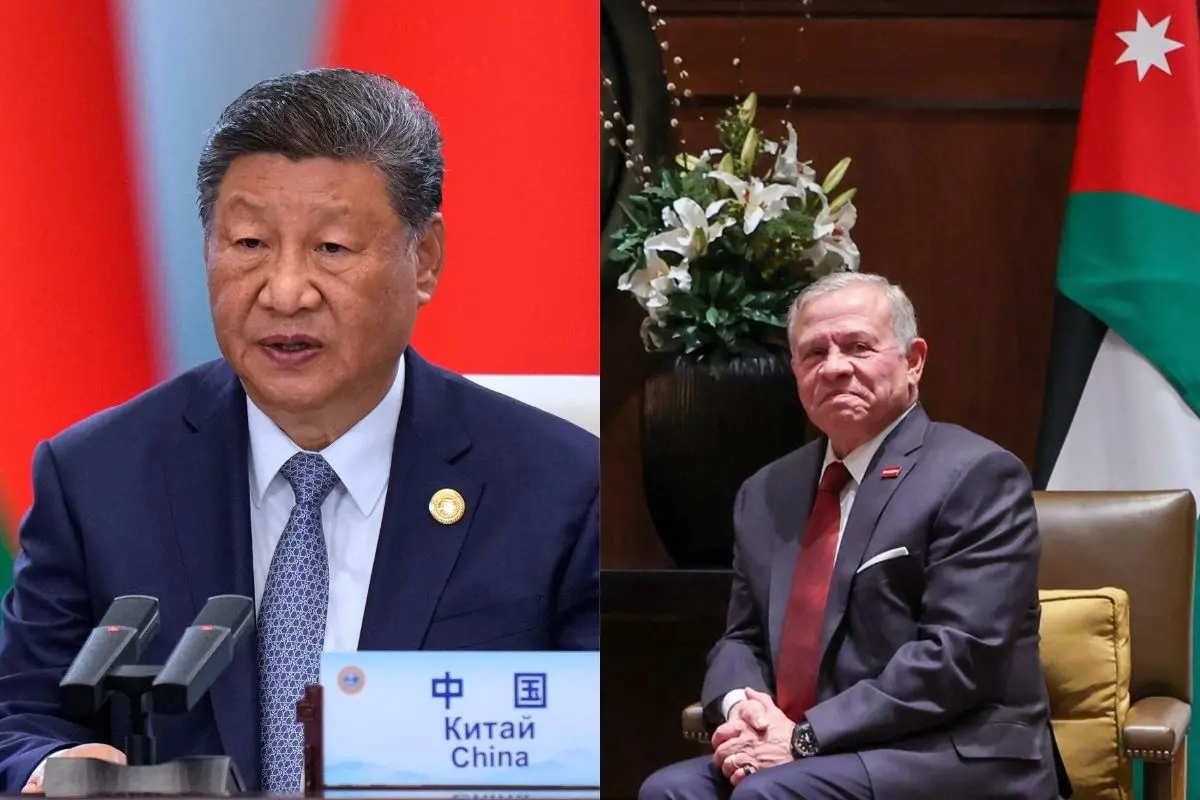
Jordan’s King Abdullah II ibn Al Hussein will pay a state visit to China from August 18 to 24 at the invitation of Chinese President Xi Jinping, with the talks expected to focus on strengthening political ties and expanding economic, investment and development cooperation.
The visit comes as Amman and Beijing seek to give new momentum to their strategic partnership, with discussions likely to cover trade, infrastructure, energy, technology, investment and regional developments.
According to the Royal Hashemite Court, King Abdullah is scheduled to meet President Xi Jinping during the visit. He is also expected to hold talks with Chinese Premier Li Qiang and Zhao Leji, chairman of the Standing Committee of the National People’s Congress.
The Jordanian monarch will be accompanied by an economic ministerial delegation and is scheduled to meet representatives of major Chinese companies. The discussions will explore opportunities to attract investment to Jordan and expand cooperation across several sectors.
ALSO READ: US immigration: Two key forms are changing; what students and visitors need to know
The two governments are also expected to sign cooperation agreements and memorandums of understanding during the visit, although the specific areas and details of the agreements have not yet been disclosed.
Chinese Ambassador to Jordan Guo Wei described the visit as an important opportunity to shape the next phase of bilateral relations. He said the summit could help chart the two countries’ strategic cooperation for the coming decade, particularly as Jordan and China approach the 50th anniversary of diplomatic relations in 2027.
Economic cooperation at the centre
Economic and investment cooperation is expected to be a major focus of the visit. According to Jordanian officials, China became Jordan’s largest trading partner in 2025, with bilateral trade rising by more than 25 per cent to over $6.7 billion.
Jordanian exports to China also increased sharply, rising by around 80 per cent during the first five months of 2026 to nearly $300 million, the Chinese ambassador said. Chinese investments in Jordan have crossed $3 billion and are spread across sectors including engineering, textiles, steel, ceramics, energy, logistics and e-commerce.
Jordan’s Investment Minister Tareq Abu Ghazaleh said China’s industrial, technological and commercial strength made it a key partner in implementing the country’s Economic Modernisation Vision.
ALSO READ: Baloch Liberation Army claims 22 coordinated attacks across Balochistan in major escalation
The second phase of the vision, covering 2026 to 2029, places emphasis on attracting foreign investment, expanding public-private partnerships and developing high-value industries. Areas such as advanced manufacturing, digital transformation, technological innovation and green development are seen as potential avenues for deeper cooperation with Chinese companies.
Abu Ghazaleh said Jordan’s location at the crossroads of Asia, Europe and Africa, along with its skilled workforce, infrastructure and access to multiple markets through free-trade agreements, could help position the kingdom as a regional base for Chinese businesses.
Investment in energy and industry
Chinese companies are already involved in several important areas of Jordan’s economy. Cooperation with the Arab Potash Company has been highlighted as one of the most prominent examples. A Chinese firm is the company’s largest shareholder, and the partnership has contributed to higher production and sales, according to the Jordan News Agency.
Chinese investment has also expanded into renewable energy, logistics and industrial production. The Jinteng Group industrial complex in Al Qatraneh, in Jordan’s Karak Governorate, has been cited by Jordanian officials as an example of investment supporting local supply chains, industrial activity and skills development.
ALSO READ: ‘Don’t send us back’ Why migrants from Morocco and beyond are seeking asylum in Spain
The two sides are expected to examine further opportunities in green energy, minerals, advanced manufacturing, artificial intelligence and the digital economy. These areas were also identified during high-level talks between the two countries in December 2025.
Broader areas of cooperation
China and Jordan have previously discussed cooperation in infrastructure, transport, energy, defence, telecommunications, science and technology. The two sides have also expressed interest in expanding collaboration in artificial intelligence, digital services and green energy.
The December 2025 China-Jordan foreign ministerial talks also covered education, tourism, culture, journalism, student exchanges and cooperation between research institutions and think tanks. Beijing and Amman agreed at the time to improve coordination and implement existing agreements and memorandums of understanding more effectively.
People-to-people links have continued to grow. More than 600 Jordanian students are currently studying Chinese at seven institutions in Jordan, while about 500 Chinese students are studying in Jordan, according to Ambassador Guo. Cultural programmes, language competitions, youth concerts and Chinese artistic performances at the Jerash Festival have also contributed to closer public engagement.
ALSO READ: Iran offers $30,000 bounty for US soldiers, doubles reward for women
Shared views on regional issues
Regional security and the Palestinian question are also likely to feature in the discussions between King Abdullah and President Xi.
Jordan and China have maintained broadly similar positions on the need for a ceasefire in Gaza, expanded humanitarian access and a political settlement leading to the establishment of an independent Palestinian state. In their December 2025 talks, the two sides called for a comprehensive and lasting ceasefire in Gaza and urgent, sustained access for humanitarian aid.
They also backed efforts aimed at establishing a sovereign Palestinian state along the borders that existed before June 4, 1967, with East Jerusalem as its capital, in accordance with relevant United Nations resolutions. China has praised Jordan’s humanitarian role and its efforts to promote regional stability, while Jordan has welcomed China’s initiatives concerning the Palestinian issue.
The two countries have also strengthened their coordination through the China-Arab States Cooperation Forum. Jordan supports China’s hosting of the second China-Arab States Summit in 2026, an event that could provide another platform for discussing trade, investment and regional diplomacy.
ALSO READ: Who is Cami Clark? What Anthropic CEO’s wife discussed with Jeffrey Epstein
A renewed strategic partnership
King Abdullah has visited China several times during his reign. The two countries upgraded their relationship to a strategic partnership during a previous meeting between the king and President Xi, laying the groundwork for closer coordination in political and economic affairs.
The upcoming state visit is expected to build on that relationship by moving cooperation beyond traditional trade and infrastructure projects into technology, investment, renewable energy, advanced industry and digital development.
For Jordan, the visit offers an opportunity to attract capital, expand exports and secure partnerships that support its economic modernisation programme. For China, deeper engagement with Jordan provides access to a strategically located market and a longstanding Arab partner with diplomatic influence in the Middle East.