Iran protesters shout ‘death to the dictator’ as Trump issues fresh warning to Tehran | WATCH
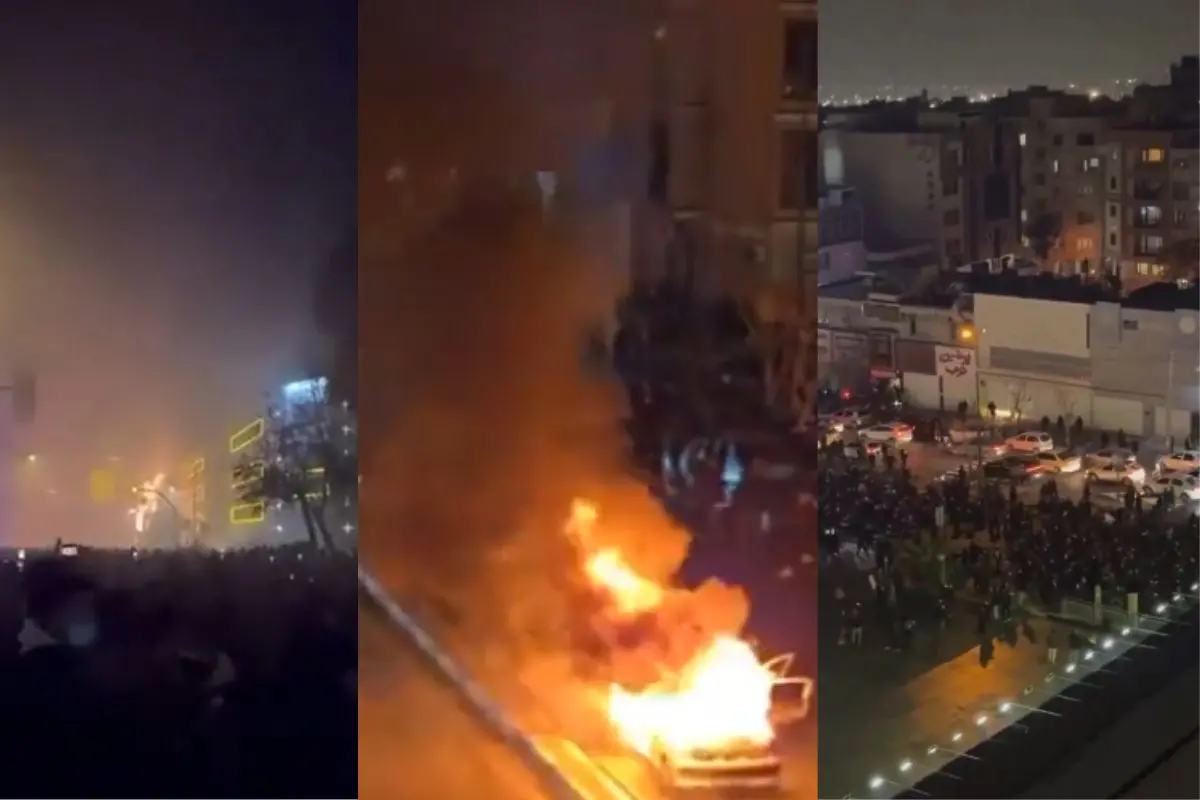
Tehran: Protesters in Iran took to the streets into the early hours of Friday after a call for demonstrations by the country’s exiled crown prince, Reza Pahlavi, defying an extensive communications blackout imposed by the authorities.
Internet monitoring group NetBlocks said early on Friday that the country had “now been offline for 12 hours” in what it described as an effort to curb widespread protests.
Short video clips shared online by activists, before access was cut, appeared to show demonstrators chanting slogans against Iran’s leadership around bonfires, with debris scattered across streets in Tehran and other cities. Videos also showed government buildings being set on fire. The full scale of the protests could not be independently verified as Iran shut down the internet and international telephone calls nationwide.
Despite the shutdown, AFP verified footage showing large crowds gathering on Ayatollah Kashani Boulevard late on Friday, with motorists sounding their horns in support. Other verified videos pointed to significant demonstrations in several cities, including Tabriz in the north, the eastern holy city of Mashhad, and parts of western Iran with large Kurdish populations, notably the regional centre of Kermanshah.
Further footage suggested protesters set fire to the entrance of the regional state television office in the central city of Isfahan. Additional videos showed flames engulfing the governor’s office in Shazand, the capital of Markazi province, after demonstrators assembled outside the building.
Iran state media labels protesters ‘terrorists’
Iranian state media broke its silence on Friday morning, alleging that “terrorist agents” linked to the United States and Israel had set fires and incited violence. It reported that there had been “casualties”, without providing further details.
Economic pressure on Iran intensified following tougher sanctions and the aftermath of a 12-day war with Israel in June. In December, Iran’s currency plunged to around 1.4 million rials to the US dollar, triggering fresh demonstrations.
Protests have grown steadily since December 28 amid mounting anger over Iran’s struggling economy, and now represent the largest demonstrations seen in Iran since the nationwide protests of 2022–23, after the death in custody of Mahsa Amini following her arrest for allegedly breaching the Islamic Republic’s strict dress code.
The unrest also serves as the first major test of Reza Pahlavi’s influence inside Iran. Pahlavi, whose father, the last shah, fled the country shortly before the 1979 Islamic Revolution, called on Iranians to demonstrate on Thursday night and again at 8 pm on Friday.
Chants heard during the protests included “Death to the dictator” and “Death to the Islamic Republic”, referring to Ayatollah Ali Khamenei, who has ruled the Islamic republic since 1989. There were also slogans praising the former monarchy. In the past, such expressions could have carried the death penalty, but they now underscore the depth of public anger. It remains unclear whether the slogans reflect support for Pahlavi himself or a broader longing for life before the revolution.
According to the US-based Human Rights Activists News Agency, at least 42 people have been killed in protest-related violence so far, while more than 2,270 have been detained.
“What turned the tide of the protests was former Crown Prince Reza Pahlavi’s call for Iranians to take to the streets at 8 pm on Thursday and Friday,” said Holly Dagres, a senior fellow at the Washington Institute for Near East Policy. “Per social media posts, it became clear that Iranians had delivered and were taking the call seriously to protest in order to oust the Islamic Republic.”
In a statement issued after the blackout began, Pahlavi said, “Iranians demanded their freedom tonight. In response, the regime has cut all lines of communication. It has shut down the internet and landlines and may even attempt to jam satellite signals.”
He urged European leaders to join US President Donald Trump in holding Iran’s leadership to account and called for international efforts to restore communications so that “the voice and will” of the Iranian people could be heard.
He added that the internet shutdown was designed to prevent the outside world from witnessing the protests and may also have given security forces cover to use lethal force.
Neighbourhoods erupt in chants
Witnesses said that when the clock struck 8 pm on Thursday, neighbourhoods across Tehran erupted in chants. Thousands were reportedly on the streets before communications were severed.
The internet shutdown also appears to have taken several state-run and semi-official news agencies offline. A brief announcement on state television at around 8 am on Friday marked the first official acknowledgment of the protests, claiming that private vehicles, public transport and metro facilities had been set alight.
Trump issues warning to Tehran, says Khamenei might flee
President Trump renewed his warnings to Tehran this week, saying the United States would respond if peaceful protesters were killed. “They’ve been told very strongly that if they do that, they’re going to pay hell,” he said in a radio interview.
Speaking later on US television, Trump suggested that Iran’s Supreme Leader, Ayatollah Ali Khamenei, might be considering leaving the country, adding, “It’s getting very bad.”
Despite the rising tension, Iranian authorities have yet to launch a full-scale crackdown, and with communications largely cut, the situation on the ground remains difficult to assess.
(With AP and AFP inputs)