Why use of Corsair sea drones to target Bandar Abbas marks a dangerous new phase in US-Iran faceoff
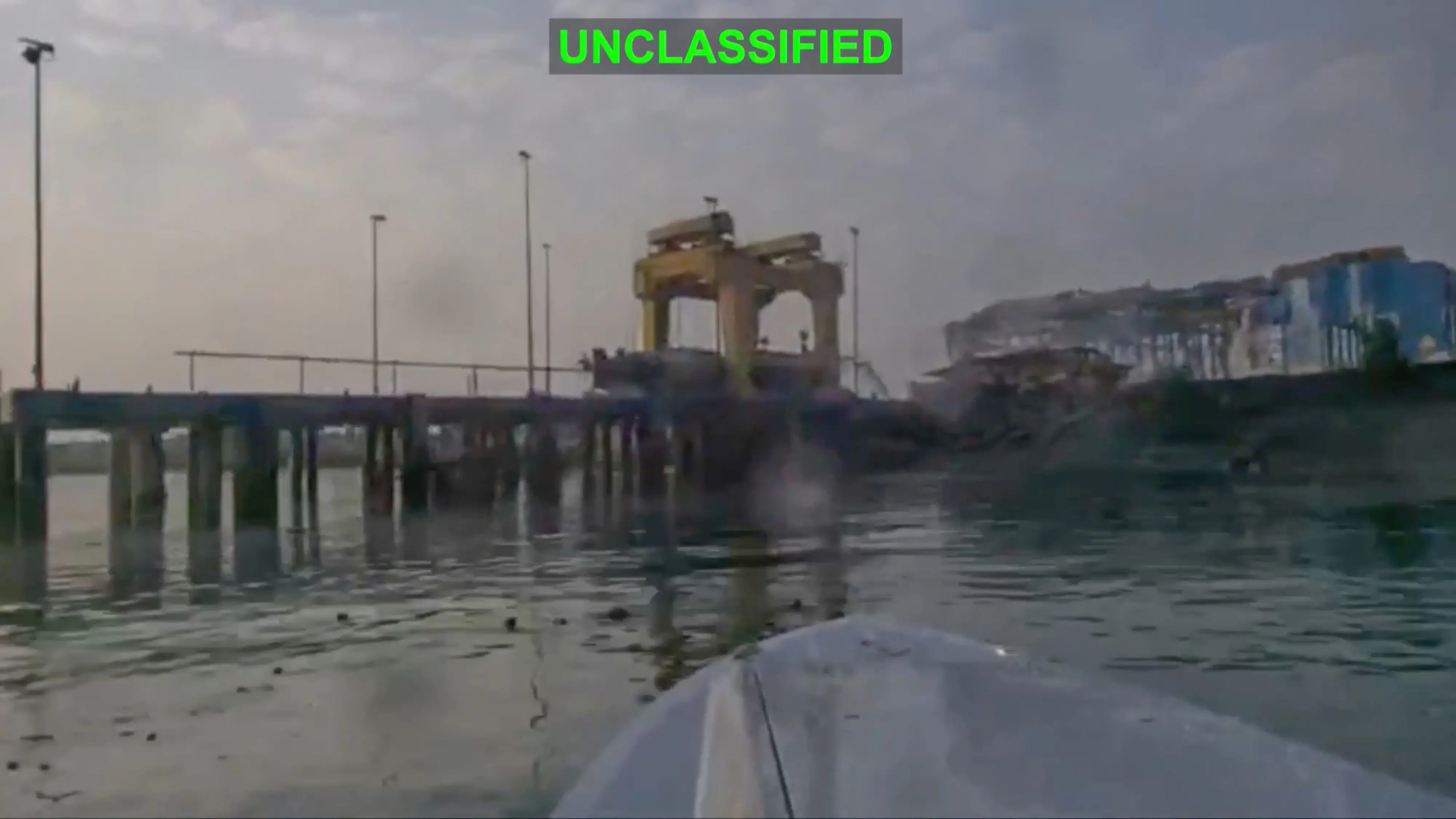
United States armed forces Central Command has confirmed that three Saronic Corsair unmanned surface vehicles (USVs) were used in a coordinated attack on a port complex in Bandar Abbas, in the immediate vicinity of the Strait of Hormuz, marking what appears to be one of the first high‑profile uses of such craft in the Gulf.
The attack, which took place in the early hours of Sunday, targeted storage and logistics facilities at the port, with the USVs reportedly penetrating the outer security perimeter and detonating near fuel depots and container handling areas.
State media said three vessels were hit and disabled, but the port continued to operate with “limited disruption,” while officials warned that the incident could escalate the broader confrontation involving the United States, Iran and regional allies.
What are Saronic Corsair USVs?
The Corsair has emerged in recent months as a relatively new class of unmanned surface craft, developed by the Greek firm Saronic Maritime Technologies under a design that blends civilian‑grade propulsion with military‑grade control and sensor systems.
The platform is marketed as a “multi‑mission” vessel, capable of roles ranging from maritime surveillance and port security to weapons delivery and targeted strikes, depending on the configuration chosen by the customer.
Technical details released by the company and discussed in defence circles indicate that the Corsair is a modular USV, typically 6–8 metres in length, with a maximum range of up to 250 kilometres and a cruising speed of around 20–25 knots in standard configuration.
It can be operated remotely via satellite and terrestrial links, with options for autonomous navigation using pre‑programmed routes and onboard sensors to avoid collisions and threats.
Different versions of the Corsair can be fitted with electronic surveillance suites, communications intercept hardware, or explosive warheads for attack missions.
The variant reportedly used in the Bandar Abbas incident appears to be an attack configuration, with a compact warhead designed to detonate on impact or via remote command.
The Bandar Abbas strike
Three Corsair USVs approached Bandar Abbas from the open sea, navigating under low‑profile conditions and evading radar detection by using the natural terrain of the coastline and the complex geometry of the port infrastructure.
Surveillance footage released by CENTCOM showed low, fast‑moving craft entering the port’s inner waterways before exploding near fuel tanks and storage areas.
Port authorities said the explosion caused damage to a fuel storage facility and a container warehouse, with minor injuries reported among security personnel. According to Iranian officials, emergency teams extinguished the fires and cleared the debris, and that the port remained operational for “non‑sensitive” cargo movements.
The attack follows a pattern of recent maritime incidents in the Gulf, including drone and missile strikes on oil infrastructure, tankers and regional ports, as tensions between the United States and Iran have surged over the Strait of Hormuz, with the US imposing a naval blockade and proposing a 20% fee for protecting commercial shipping.
Iranian officials have described the use of Corsair USVs as an “escalation” of the conflict, accusing Western and possibly third‑party actors of introducing new layers of technology into the region’s maritime warfare.
Why the attack matters
The use of Corsair USVs in a major port such as Bandar Abbas is significant for several reasons. First, it demonstrates that unmanned surface craft are no longer confined to experimental or training roles; they are being used in real‑world, high‑risk operations in contested waters.
Second, the attack shows that relatively small, low‑cost platforms can penetrate sophisticated port security and radar systems, challenging the ability of navies and port authorities to detect and neutralise emerging threats.
Third, the strike highlights the growing role of asymmetry in maritime warfare, where smaller craft, drones and autonomous systems can be deployed to inflict disproportionate damage on high‑value infrastructure such as oil storage, logistics hubs and naval bases.