China’s ‘Luanniao’: Space-based aircraft carrier that could redefine future warfare
Aircraft carriers are designed to rule the seas. But China is now floating an idea that pushes warfare far beyond Earth’s oceans, and into near space.
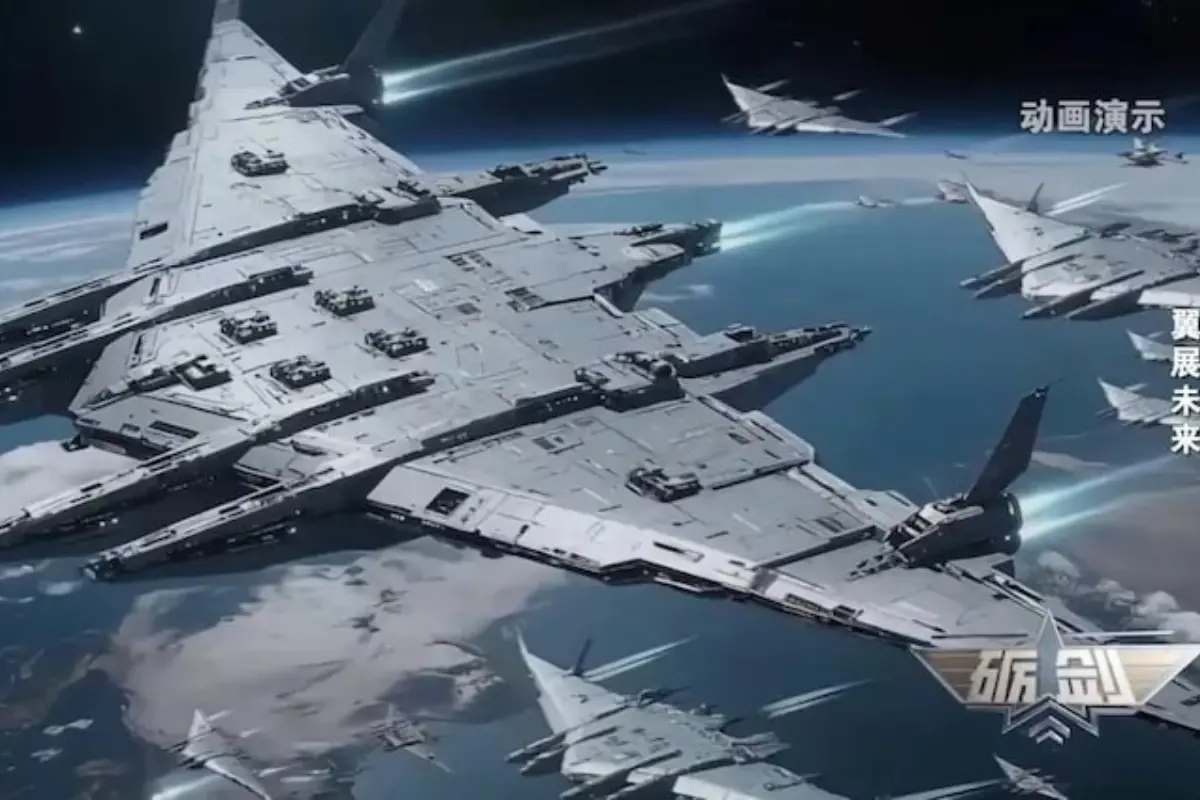
Beijing has unveiled the concept of a massive space-based aircraft carrier, called Luanniao, a colossal triangular warship designed to hover at the edge of space. An aircraft carrier, not on water, not even fully in the atmosphere, but operating in near-space conditions.
As dramatic as it sounds, the Luanniao remains a concept for now. Chinese state media has acknowledged that such a platform could become a reality only after at least two to three decades, given the enormous technological challenges involved.
A ‘Star Wars’-like vision
A recent concept video aired by Chinese state broadcaster China Central Television (CCTV) has brought renewed global attention to the project. The video depicts a giant, grey, triangular craft racing through near space, launching hypersonic missiles and deploying unmanned fighter jets toward targets on Earth.
Visually, the Luanniao looks like something straight out of a Star Wars film, a futuristic warship built not for the seas, but for dominance across air and space. If ever realised, analysts say it could offer China a significant strategic edge in future conflicts and further elevate the relevance of space-based military power.
The Luanniao is part of China’s broader Nantianmen Project, which translates to “South Heavenly Gate.” The initiative aims to build an integrated defence system that operates seamlessly across air and space.
The project first gained public attention in 2017, when the Aviation Industry Corporation of China (AVIC) revealed early ideas. Scale models of the carrier and its associated aircraft later appeared at air shows, including the Zhuhai Airshow in 2018, sparking international curiosity.
The latest CCTV video, aired in late January 2026, has reignited debate by showing the Luanniao firing hypersonic missiles and releasing swarms of unmanned jets during simulated combat missions.
Just how big Is Luanniao?
If the Luanniao ever takes shape, it would be unlike anything the world has seen.
According to concept specifications, the carrier would measure 242 metres in length and an astonishing 684 metres in width, forming a massive triangular platform. That makes it far larger than any existing aircraft carrier, even dwarfing the world’s largest, the USS Gerald R. Ford.
To put it in perspective, Luanniao would be twice as long and nearly three times as wide as the largest aircraft carrier currently in service. Its wingspan would stretch over 2,000 feet, and it could weigh as much as 120,000 tonnes, heavier than many supertankers.
Getting something that massive airborne, let alone into near space, would require propulsion and lift technologies that do not yet exist.
The closest real-world parallel to China’s vision is the Soviet-era KM Ekranoplan, often dubbed the “Caspian Sea Monster.” Built during the Cold War, the massive vehicle skimmed just metres above the sea using ground-effect aerodynamics while carrying heavy payloads.
However, the KM Ekranoplan never truly flew, remained within the atmosphere, and was eventually abandoned due to high costs and safety concerns. At over 500 tonnes, it was impressive — but still tiny compared to what China is proposing.
The Luanniao concept is far more ambitious, aiming to operate in near-space rather than hugging Earth’s surface.
A carrier for unmanned warfare
At the heart of the Luanniao’s design is unmanned combat power. Chinese state media claims the carrier could deploy up to 88 stealth unmanned fighter jets, known as Xuan Nu, meaning “Mysterious Woman.”
These drones would reportedly be capable of launching hypersonic missiles at targets anywhere on the globe, making the platform a mobile launch base with global reach.
If realised, such a system could dramatically shorten response times and blur the lines between air, space and missile warfare.
Despite the hype, Chinese state media has been cautious about timelines. Officials suggest the Luanniao could take 20 to 30 years to materialise, potentially between 2045 and 2055, assuming major breakthroughs in propulsion, materials and energy systems.
Until then, the Luanniao remains a bold vision rather than a deployable weapon. But even as a concept, it signals China’s long-term ambitions to dominate future battlefields that extend far beyond Earth’s surface.
For now, the idea of a space-based aircraft carrier remains firmly in the realm of science fiction. But as China continues to invest heavily in aerospace and military innovation, the world is watching closely — because today’s concepts can become tomorrow’s realities.