MK Prasad: The evangelist of 'Save Silent Valley' campaign
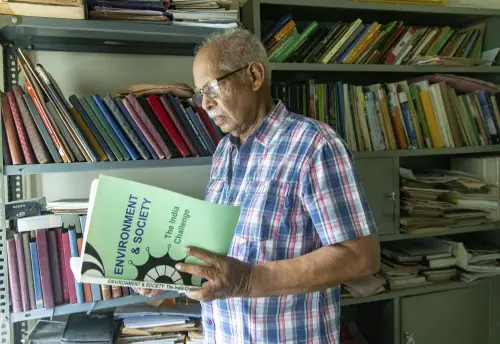
The ‘Save Silent Valley campaign’ was perhaps the most benign yet most effective protest that Kerala has ever witnessed since its formation in 1956. Not only did it save the sub-tropical forest of Silent Valley in Palakkad but it also gave a perpetual meaning to the phrase, ‘What we save, saves us’.
MK Prasad, the zealous advocate of environmental conservation, played a key role in saving the evergreen subtropical forest of Silent Valley from being flooded by a hydroelectric project. As the head of the Kerala Sasthra Sahithya Parishad (KSSP), he rings up the curtain on a protest that saw eminent figures like Sugathakumari, M S Swaminathan, Karthikeya Sarabhai, Bittu Sahgal, Romulas Whitaker, Madhav Gadgil and many others joining hands.
There were many protests in the past aimed at those hydroelectric projects, dams that pushed out tribal communities from their lands. However, the campaign in Silent Valley was against the adverse effects of the proposed project in the 1970s to set up a hydroelectric dam across the Kunthipuzha River that runs through Silent Valley, that will submerge 8.3 sq km of untouched moist evergreen forest.
Though Herpetologist Romulus Whitaker was the first to bring the attention of the authorities to the valley, it took efforts from local communities and MK Prasad to convince the other environment activist about the dangers of the proposed project. He also formed a group, carried out an environmental impact study of the valley and recommended that the area be declared the biosphere reserve. A poem from Sugathakumari, "Marathinu Stuthi" ("Ode to a Tree) became the epitome of the "Save the Silent Valley" campaign.
KSSP was thus able to generate public opinion against the project. As a consequence, in 1979, the Government of Kerala passed a legislation on the ‘Silent Valley Protection Area’ (Protection of Ecological balance Act of 1979) and declared the exclusion of the hydroelectric project area from the proposed national park. In 1983, the Central Government asked the state to abandon the project and declared the valley as a National Park in 1985.