Vice-chancellor or Calcutta killings figure? Kolkata road rename ignites Suhrawardy debate
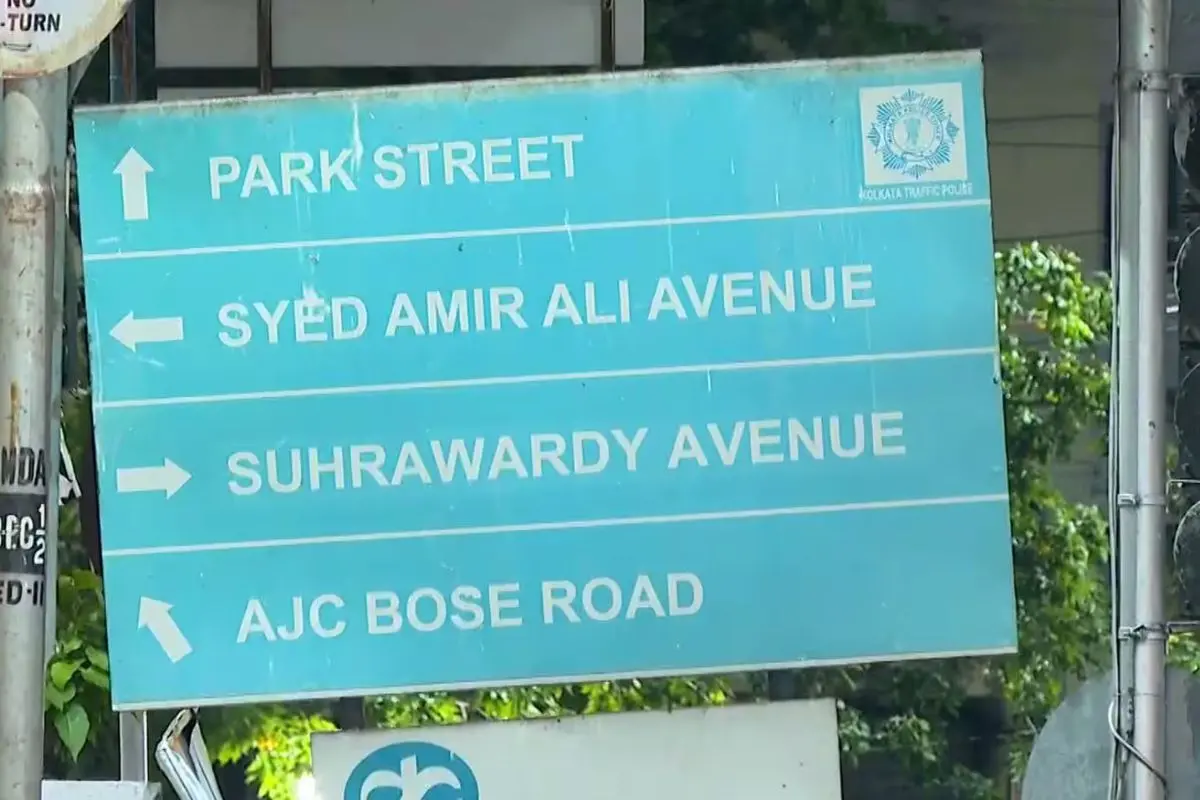
The Kolkata Municipal Corporation's (KMC) decision to rename Suhrawardy Avenue as Gopal Mukherjee Road has triggered a political storm, with the BJP hailing the move as 'historical justice' and opposition leaders accusing the government of confusing two different members of the Suhrawardy family.
The 500-metre stretch connecting Park Circus Seven Point Crossing and Don Bosco Circle will now be named after Gopal Mukherjee, popularly known as Gopal Patha.
The decision, taken on June 20, West Bengal Day, was welcomed by Chief Minister Suvendu Adhikari, who said it corrected a historical wrong.
In a post on X, Adhikari argued that Kolkata should not continue to honour a figure associated with the communal violence of 1946.
He praised Gopal Patha for allegedly helping save thousands of lives during the riots and described the renaming as a step towards restoring historical justice.
However, the move has sparked sharp criticism from Trinamool Congress leaders, historians and fact-checkers, who argue that the avenue was never named after Huseyn Shaheed Suhrawardy, the last Premier of undivided Bengal who is often linked to the 1946 Calcutta killings.
TMC Rajya Sabha MP Sagarika Ghose said the road was named after Sir Hassan Suhrawardy, a renowned physician, former Vice-Chancellor of Calcutta University and Fellow of the Royal College of Surgeons (FRCS), not a politician.
In a strongly worded post, she accused the BJP of failing to distinguish between Hassan Suhrawardy and his nephew Huseyn Shaheed Suhrawardy, saying the party had 'no business lecturing anyone on historical justice.'
TMC MP Mahua Moitra also shared what she described as historical evidence showing that Suhrawardy Avenue was named after Dr Hassan Suhrawardy.
She alleged that the BJP's 'hatred for Muslims' had overshadowed the need for basic historical research.
Echoing the argument, TMC MLA Kunal Ghosh said the party had no objection to naming a road after Gopal Mukherjee but stressed that Hassan Suhrawardy and Huseyn Shaheed Suhrawardy were 'different individuals.'
He urged authorities to verify the historical record before justifying the name change on the grounds of the 1946 riots.
Ghosh further said that if the road had indeed been named after Sir Hassan Suhrawardy, a distinguished physician, educationist and former Vice-Chancellor of Calcutta University, then removing his name because of actions attributed to his nephew would be unfortunate.
He called on the Chief Minister and KMC to re-examine the records.
Alt News co-founder Mohammed Zubair also weighed in on the controversy, noting that Sir Hassan Suhrawardy was a renowned surgeon and academic who served twice as Vice-Chancellor of Calcutta University.
Citing historian P Thankappan Nair's book 'A History of Calcutta's Streets', Zubair said the avenue was named after Hassan Suhrawardy in the 1930s, years before the Calcutta killings of 1946.
The controversy has brought renewed attention to the origins of Suhrawardy Avenue. While some historians maintain that the road honoured Sir Hassan Suhrawardy, others cite alternative records suggesting it may have been named after the educationist Maulana Obaidullah Suhrawardy.
The debate has left one central question unresolved: which Suhrawardy was the avenue actually named after?
As political leaders trade accusations and historians pore over archival records, the renaming of a short Kolkata road has evolved into a wider battle over history, memory and the interpretation of Bengal's past.