How India’s only tiger-reserve nature camps helped Panna win back its people
Madhya Pradesh, the Tiger Capital of the country, is thriving with the increasing population of the big cats. As per the All India Tiger Estimation report 2022, India is home to at least 3,165 tigers, of which 785 are reported to be in MP alone. Though MP has been enjoying its ‘Tiger Capital’ status for the past few years, there was a time when one of its key tiger reserves, Panna Tiger Reserve (PTR), had lost all its tigers.
Then came the year 2009, when one of the biggest conservation projects, the Panna Reintroduction Project, was started by the forest department under R. Sreenivasa Murthy, the then Field Director of PTR. Cut to today — from once zero population, the PTR is home to over 90 tigers now, proving the reintroduction project as a huge success in tiger conservation.
But all was not easy in making PTR regain its glory. One of the most essential elements that proved to be a key factor in bringing the tiger population to rise again was the constant effort that the state forest department put into turning the locals, who once thought tigers were their foes, into friends of the wildlife, especially tigers.
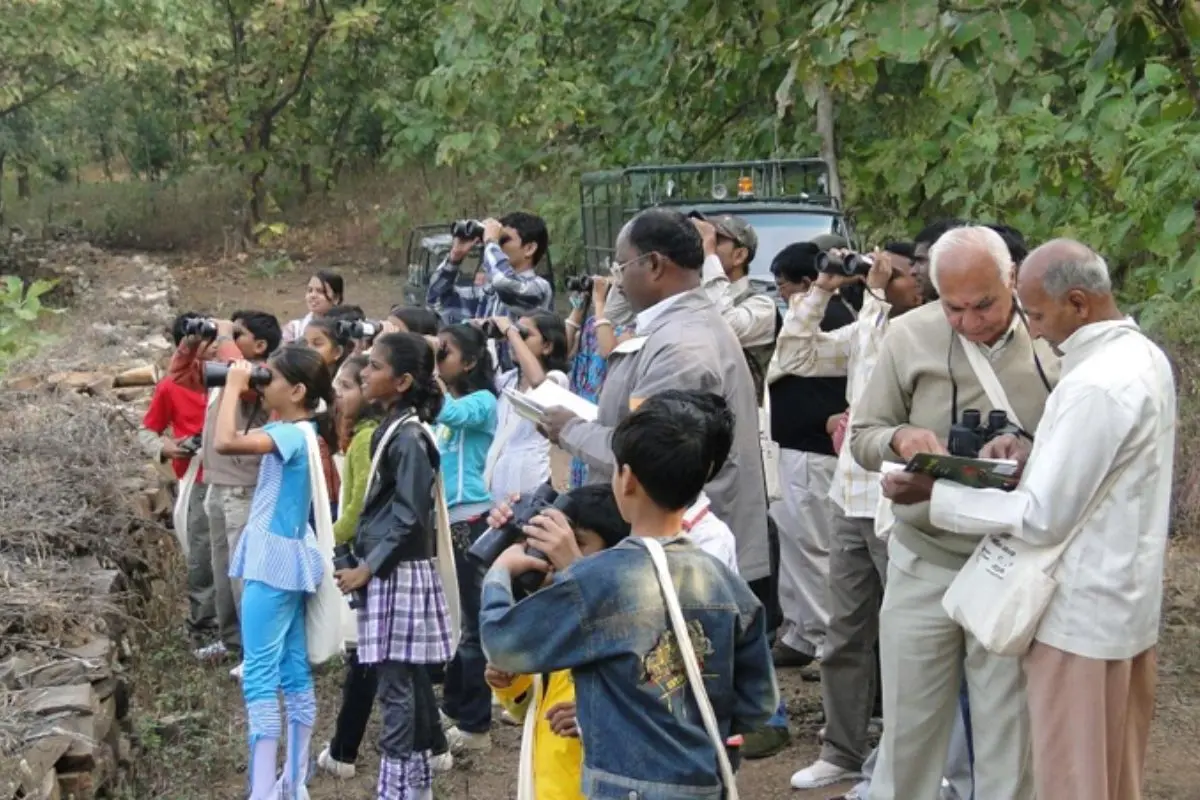
To make this happen, Murthy and his team started a one-of-a-kind conservation project that aimed at bringing locals close to nature and closer to the wildlife. This initiative, called ‘Panna Nature Camps’, was launched in 2010 with the mission of fostering a deep connection between the community and the forests they live around.
As Panna Nature Camps completes 15 years on Saturday, Murthy, now a retired senior forest official, recalls how the initiative came into existence, and the impact it has had on Panna, its jungles, and especially its tigers.
How Panna Nature Camps came into formation
Started in 2010, the purpose of Panna Nature Camps was to involve the locals of the region and instill in them a sense of ownership towards the tiger reserve. Recalling the time when the tiger population had hit zero in the reserve, which spreads over 1,598.1 square kilometers (including core and buffer areas), Murthy said, “These camps were tailor-made for PTR, and it has entered its 15th year on Saturday. This milestone is unknown in the annals of any protected area in India. The need to start these camps came at a time when Panna had lost all its tigers, and the locals were relieved by it. One of the reasons for such high sentiment against the tigers in the minds of the locals was that the locals never got a chance to see and appreciate the park’s ecosystem. At the same time, locals considered the tiger reserve a hindrance to the local developmental projects. Thus, there was neither empathy nor sympathy for losing tigers among the locals in general.”
To address this, Murthy designed a project with the help of Sanjay Thakur from Pune, Maharashtra. Approvals for the camps were sought from Bhopal, while simultaneously, WWF (World Wide Fund for Nature) India was also roped in for the programme. The first inaugural camp was organized on November 1, 2010, coinciding with Madhya Pradesh’s formation day.
What are these camps about?
Panna Nature Camps are day-long programmes held inside the tiger reserve. These camps are typically scheduled prior to Wildlife Week in October each year, followed by registrations. Earlier, the registration fees were kept at ₹100 and ₹200 for children and adults, respectively; these have now been revised to ₹200 and ₹400. Once registrations are complete, participants are selected purely on a first-come-first-serve basis.
On the day of the camp, all registered participants report to the tiger reserve’s office at 5:30 AM for an orientation, where they are briefed about the day’s schedule. After orientation, participants are taken inside the reserve, roughly a 50-kilometre drive from the office, reaching the Hinauta gate. From there, they embark on a nature walk up to the Majhgawn dam area (NMDC).
“Upon reaching, the resource persons of the camps introduce the participants to the flora and fauna of the PTR. They’re also told about animal tracking through pugmarks, scratches, callings, etc. They practically get an insight into the vast world of the jungles,” said Murthy.
After the nature walk and a brief breakfast break in the wild, participants are taken to the Hinauta park interpretation center, where they are further exposed to the park’s ecosystem through acts and storytelling. Post-lunch, the group heads for a park visit, covering areas such as Dhundhwa Seha and Pipartola. At the end of the day, a test is conducted by park officials, and the top three participants are awarded. While the first-year camps were conducted by Murthy himself—who also trained the resource persons—today, Manish Rawat and Bhavanideen Patel are responsible for running the camps.
The impact of these camps on conservation efforts
These nature camps have been a huge success and a major hit among the locals, especially children who are eager for hands-on experience inside the jungle. Speaking about the impact of the programme, Murthy said, “These camps acted as a vehicle to bridge the gap between the tiger reserve and the people. Today, the role of these camps is invaluable. Once the locals who were against the park and tigers are now proud of the same. Children and elders carry the conservation message after a one-day camp, and help us spread the word of conservation. From foes, the locals of Panna have now become the friends and saviours of the tiger reserve.”
Today, PTR has seen a significant increase in tourism, which has directly contributed to the livelihoods of locals. As per official data, over 2.75 lakh tourists visited Panna Tiger Reserve in the year 2024–2025, including 2.6 lakh Indian tourists and 15,300 foreign tourists, with gate receipts amounting to ₹7.42 crore. As far as the camps are concerned, at least 365 sessions have been organized, with over 11,000 participants to date.