From 2020 near tie to 2025 sweep: NDA’s strategy pays off in Bihar
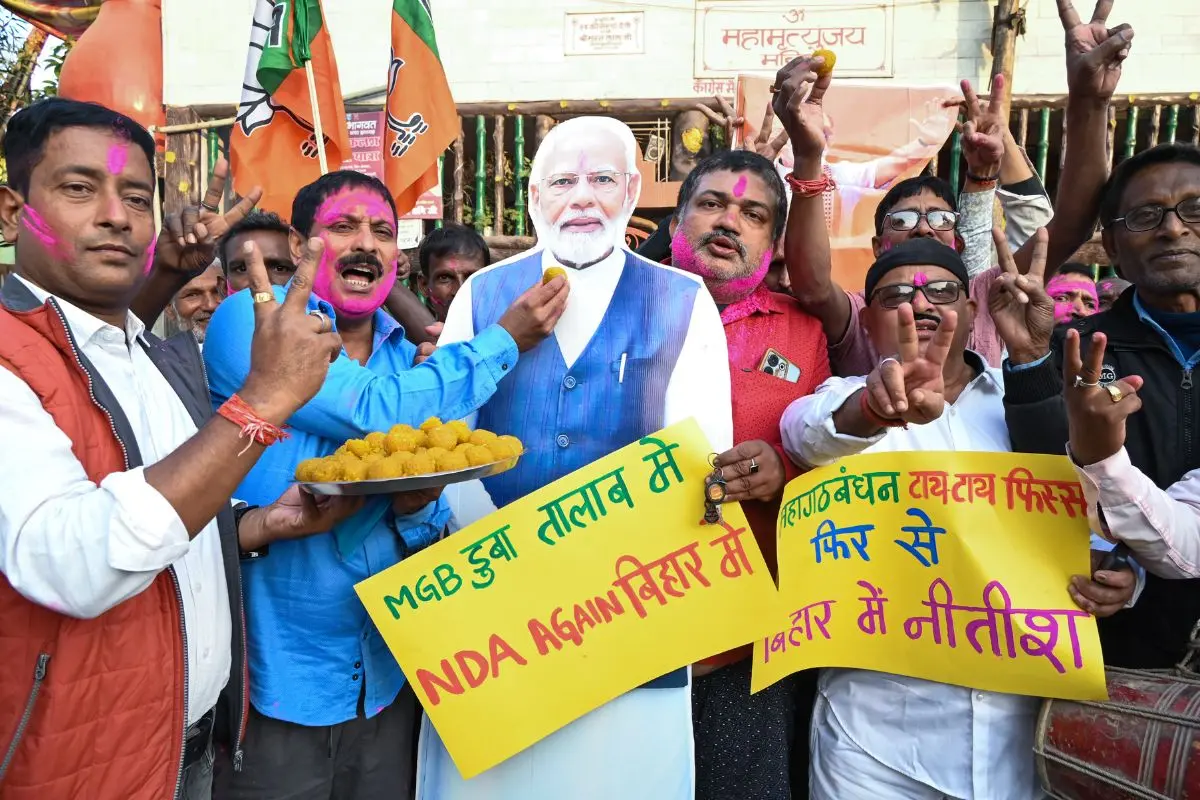
In the 2020 Bihar Legislative Assembly election, the National Democratic Alliance (NDA), led by Nitish Kumar's Janata Dal (United) (JD(U)) and the Bharatiya Janata Party (BJP), secured 125 out of 243 seats with a vote share of 37.26%. In contrast, the Mahagathbandhan (MGB) coalition, primarily composed of the Rashtriya Janata Dal (RJD) and Congress, won 110 seats, with a vote share just slightly behind at 37.23%.
Fast forward to 2025, and the NDA appears to have gained a commanding lead, with early trends indicating the alliance crossing 200 seats, a decisive improvement compared to 2020. The final vote share numbers are still emerging, but it’s clear that the NDA has strengthened its position significantly, both in terms of votes and seats.
What Shifted: Vote Share & Seat Conversion
Vote Share Gains for the NDA
The most significant shift between 2020 and 2025 is the NDA’s increased vote share. In 2020, the margin between the NDA and the MGB was razor-thin, with both coalitions securing almost identical vote shares. However, by 2025, the NDA seems to have expanded its support base significantly, not just among its traditional votebanks but also in constituencies that had previously been strongholds for the opposition.
Stronger Performance in Minority and Reserved Seats
One of the key factors behind the NDA’s success in 2025 is its increased penetration into Muslim-majority and Scheduled Caste (SC) constituencies—areas where it had struggled in 2020. The NDA appears to have made significant gains, particularly in Muslim-majority areas, where the opposition traditionally enjoyed strong support. This shift highlights the NDA’s recalibrated social coalition, which seems to have better mobilized these communities in 2025, despite them being traditionally aligned with the opposition.
Improved Strike Rate for Key Allies
Another factor contributing to the NDA’s success in 2025 is the performance of its allies, especially the Lok Janshakti Party (LJP). While the LJP contested fewer seats in 2025, its strong strike rate and targeted campaigning seem to have played a pivotal role in boosting the overall NDA tally. This points to a more effective alliance strategy, where smaller partners were able to deliver impactful results in carefully chosen constituencies.
Opposition Underperformance
Despite the MGB’s strong presence, its ability to convert votes into seats in 2025 was weaker compared to 2020. The MGB had hoped for breakthroughs in constituencies with a large Muslim population, but these gains did not materialize. The Congress, in particular, struggled to retain its traditional voter base, and the RJD found itself unable to significantly improve on its 2020 performance. As a result, the MGB’s seat count has fallen short, despite a relatively strong vote share.
Key Drivers Behind the NDA’s Stronger Performance
Governance Narrative & Incumbency
The incumbency factor played a major role in the NDA’s victory in 2025. Nitish Kumar, the JD(U) leader and Chief Minister, was able to present himself as a stable, experienced leader, and the NDA’s narrative of good governance resonated strongly with voters. Nitish’s welfare initiatives, especially programs aimed at women and marginalized communities, helped cement his reputation as a leader committed to stability and development.
Social Coalition Recalibration
The NDA’s success in 2025 can be attributed to its successful outreach to traditionally marginalized groups, including Scheduled Castes (SC), Extremely Backward Classes (EBC), and even Muslim voters. The party managed to forge a broader social coalition, disrupting the traditional vote blocs that had historically supported the MGB. This recalibration allowed the NDA to expand its base, particularly in areas where the opposition had previously been dominant.
Effective Voter Mobilization
In 2025, the turnout reached 67%, one of the highest in Bihar’s electoral history. High voter turnout typically benefits the party with the stronger ground presence, and in this case, the NDA’s mobilization efforts were highly effective. The NDA’s ability to energize voters, particularly in rural and underrepresented constituencies, helped boost its overall performance.
Weak Opposition Coordination
The MGB’s organizational capacity and ability to form a coherent counter-narrative were notably weaker in 2025. The coalition was unable to capitalize on its large voter base and failed to translate votes into seats effectively. Part of the reason for this was the disorganization within the opposition and internal disagreements over seat-sharing. Additionally, the failure of some smaller parties to mobilize their voters may have further weakened the opposition’s position.
Challenges Ahead
Despite the NDA’s commanding victory, several questions remain about the sustainability of this new coalition. The distribution of power within the NDA will be an important consideration in the coming months, as each partner will seek to maintain influence over the governance process. Similarly, the social base that has shifted in favor of the NDA is still a subject of debate—whether this support is stable or driven by short-term electoral factors is yet to be seen.
On the opposition side, the MGB will need to reassess its strategies. For one, it will need to rebuild its vote-to-seat conversion strategy, particularly in key constituencies that slipped away from it in 2025. Additionally, the MGB will have to improve internal cohesion and adapt to changing voter preferences if it hopes to mount a serious challenge in the next election cycle.
The 2025 Bihar Legislative Assembly elections marked a decisive shift in the state’s political landscape.