‘What’s wrong with regime change?’ Chidambaram pushes back as BJP targets Opposition
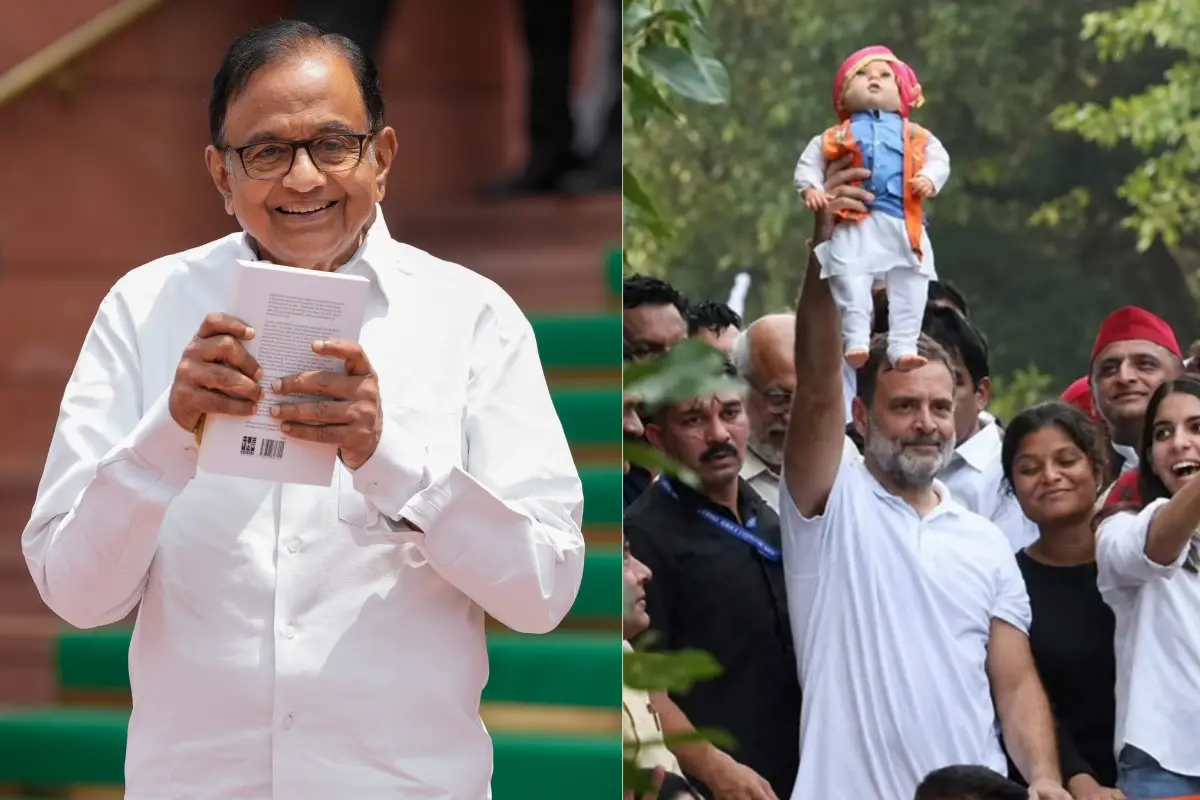
New Delhi: Congress leader P Chidambaram has defended the phrase ‘regime change’, describing it as a normal feature of democracy, as the Bharatiya Janata Party (BJP) intensifies its criticism of Opposition leaders over remarks made during protests concerning electoral democracy.
In a post on X, Chidambaram questioned the BJP's reaction to the expression and outlined what he described as the Opposition's responsibility in a parliamentary democracy.
“‘Regime change’ is normal in a democracy,” Chidambaram wrote, arguing that the Opposition's duty was to “oppose, expose and depose” the government through political opposition, parliamentary scrutiny and elections.
The controversy follows remarks by senior advocate Prashant Bhushan, who described the ongoing campaign concerning electoral democracy as a fight for regime change. The BJP has interpreted such statements as evidence of an attempt to destabilise the Narendra Modi government, an allegation rejected by Opposition figures.
What are the ongoing protests about?
The political controversy is linked to protests concerning electoral rolls, the Special Intensive Revision (SIR) process and demands for the resignation of Chief Election Commissioner Gyanesh Kumar.
Protesters and Opposition-linked groups have raised concerns about electoral transparency, alleged irregularities in voter-list revisions and the accountability of the Election Commission.
Demonstrations in Delhi, including a protest at Connaught Place on October 16, brought together student groups, activists and other participants. Police detained several protesters during the demonstrations.
The Election Commission's voter-list revision exercise has also become a political flashpoint, with critics questioning the process and the potential impact on eligible voters. The Commission has cited reasons including deaths, relocation and voters who could not be traced for removals from electoral rolls.
The protests have consequently developed into a wider political confrontation over electoral integrity, institutional accountability and the right to challenge the government.
What did Prashant Bhushan say?
Senior advocate Prashant Bhushan argued at a press conference in New Delhi that seeking a change of government through democratic means was legitimate.
He said the campaign was aimed at protecting electoral democracy and ensuring that elections were conducted properly. Bhushan also maintained that creating disaffection against a government was not, by itself, an offence.
The BJP objected to his use of the phrase ‘regime change’, particularly in the context of protests and references to Bangladesh's youth-led movement, which contributed to the fall of Sheikh Hasina's government in 2024.
The party has argued that the language suggests an attempt to remove an elected government outside the electoral process. Bhushan and Opposition figures have maintained that their objective is to protect democratic institutions and pursue political change through legitimate means.
What is the BJP saying?
Several BJP leaders have accused the Opposition of attempting to destabilise the Modi government by using protests and public grievances to pursue a broader political objective.
Defence Minister Rajnath Singh alleged that the Opposition was attempting to replicate a Bangladesh-style political upheaval in India. BJP president Nitin Nabin claimed that references to regime change exposed what he described as an agenda to destabilise the country.
Other BJP leaders, including Sudhanshu Trivedi, Dharmendra Pradhan and Devendra Fadnavis, also criticised the Opposition over the remarks.
The BJP has stressed that governments must be changed through elections and the people's mandate. It has questioned whether the protests are limited to electoral reforms or are being used to advance a wider campaign against the government.
These are the BJP's allegations; the statements and protests cited do not, by themselves, establish that the organisers are attempting an unlawful overthrow.
How has Congress responded?
Congress leaders have rejected the BJP's allegations, arguing that opposing the government and seeking to defeat it in elections are central responsibilities of the Opposition.
Chidambaram's post reinforced this position by describing regime change as a normal democratic objective.
Congress spokesperson Pawan Khera also questioned the BJP's reaction, arguing that replacing a government through elections was precisely what an opposition party sought to achieve.
The Opposition has cited the 1977 general election, when the Congress lost power after the Emergency, as an example of a democratic transfer of power.
Its central argument is that seeking a change of government through elections and peaceful political mobilisation is fundamentally different from attempting to overthrow a government outside constitutional processes.
Why is ‘regime change’ controversial?
The phrase can refer broadly to replacing a government, but it is also used in international politics to describe efforts to remove a government outside normal electoral processes, including through external intervention.
In the current dispute, the BJP has linked the phrase to its allegations of attempts to create instability, drawing comparisons with Bangladesh. The Opposition argues that the expression is being used to portray legitimate political opposition as a conspiracy.
The distinction is important: seeking to defeat a ruling party in an election is a normal democratic activity. Whether a particular protest or campaign involves unlawful conduct depends on its actions and evidence, not merely on the terminology used by its participants.
How the protests became a national political controversy
The dispute reflects two competing interpretations of the protests.
For the protesters and Opposition leaders, the central issues are electoral transparency, the voter-list revision process and the accountability of constitutional institutions. They argue that peaceful demonstrations and calls for a change of government are legitimate forms of democratic participation.
The BJP, meanwhile, contends that references to regime change and Bangladesh indicate that the movement may have expanded beyond electoral reform into a broader effort to destabilise the government.
The controversy has therefore shifted attention from the original demands concerning electoral rolls to the intentions of the protest organisers and the political language used by their supporters.
The wider implications concern public confidence in electoral institutions, the right to peaceful protest and the distinction between political opposition and unlawful attempts to remove a government.
As the dispute continues, the key questions are whether the concerns about electoral rolls are adequately addressed, how the authorities respond to demonstrations and whether the competing allegations are supported by evidence.
For now, the BJP and the Opposition remain divided over the meaning of the ‘regime change’ remarks, while the protests have become the immediate backdrop to a wider debate about democracy and political accountability in India.