‘Elder brother’ to ‘Vishnu avatar’: Bhutan PM’s unusual praise for PM Modi
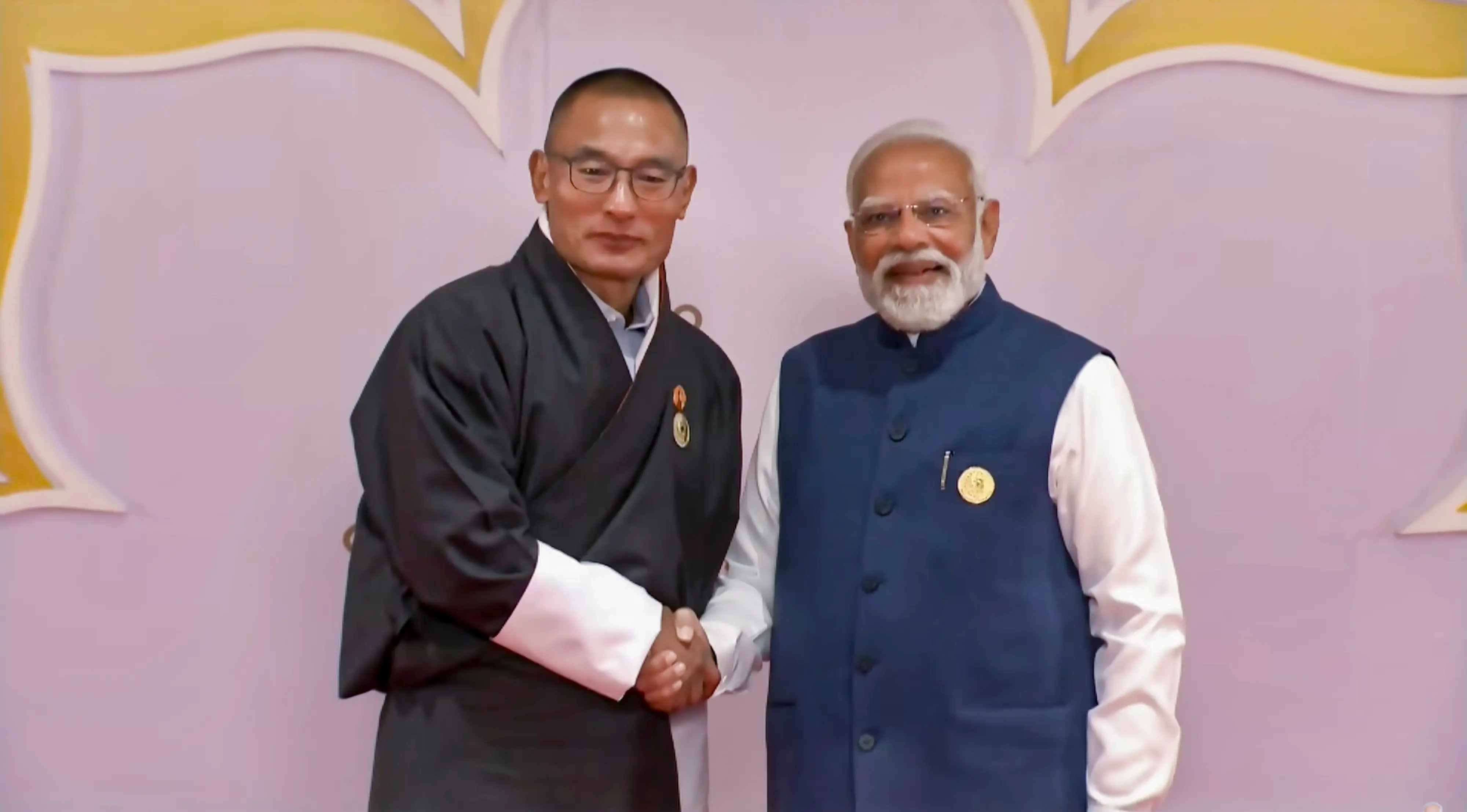
Bhutan Prime Minister Tshering Tobgay's unusually reverential description of Prime Minister Narendra Modi as an “avatar of Vishnu” and later as Kalki has put the spotlight on the personal tone of political diplomacy between the two countries.
Tobgay said he has long regarded Modi as an elder brother and later as a mentor. But his description did not stop there.
Recalling a conversation in 2019, Tobgay said he had told Modi that he viewed him as an avatar of Vishnu. According to Tobgay, he revisited that view before meeting Modi again in 2024 and concluded that he had been right.
He then identified Modi with Kalki, traditionally described in Hindu belief as Vishnu's final avatar associated with restoring dharma and renewal.
For a foreign head of government, describing another country's prime minister in explicitly religious and quasi-divine terms is an unusually personal form of political praise. The comments have therefore attracted attention beyond the substance of India-Bhutan relations.
Praise wrapped in diplomacy
Tobgay's article also reads as an extended appreciation of Modi's leadership and India's role in Bhutan's development.
He praised India's “neighbours first” approach, Modi's role in amplifying the Global South and India's effort to secure permanent G20 membership for the African Union.
He also highlighted India's financial assistance to Bhutan, including support for its Five-Year Plans and an increase in India's support for Bhutan's 13th Plan to Rs 10,000 crore.
“B4B” and the partnership
Tobgay recalled Modi's first foreign visit as prime minister in June 2014, when he travelled to Bhutan. He said Modi described the relationship using the phrase “B4B” — Bharat for Bhutan and Bhutan for Bharat.
Tobgay said the partnership now extends across infrastructure, healthcare, education, hydropower, technology, agriculture and enterprise.
He also pointed to India's support for the Gelephu Mindfulness City project, including cooperation on rail links, border infrastructure and air and digital connectivity.
What stands out
The striking element of the article is not the description of bilateral cooperation but the intensity of the personal praise directed at Modi.
Calling a political leader an “elder brother” can be understood as diplomatic warmth. Calling him an “avatar of Vishnu” and then specifically identifying him with Kalki takes the rhetoric considerably further.
The comments also come as Modi marks 25 years as a head of government, giving Tobgay's article a clear celebratory context.
The remarks illustrate how diplomacy can mix strategic interests with personal political relationships. Bhutan has substantial economic, infrastructure and energy ties with India, making the bilateral relationship important beyond individual leaders.
At the same time, the religious framing of the praise is Tobgay's personal characterisation and should not be treated as an official Indian or Bhutanese position. The substantive story remains the expanding India-Bhutan partnership and the economic and strategic interests underpinning it.
Meanwhile, Nepal Home Minister Sudan Gurung is scheduled to visit New Delhi from October 12 to 14 for the first BIMSTEC Home Ministers' Meeting since the regional grouping was established in 1997. The meeting is expected to focus on terrorism, transnational organised crime, disasters and climate change.