'Pilots have problem with mental health, but there is absolutely no support’
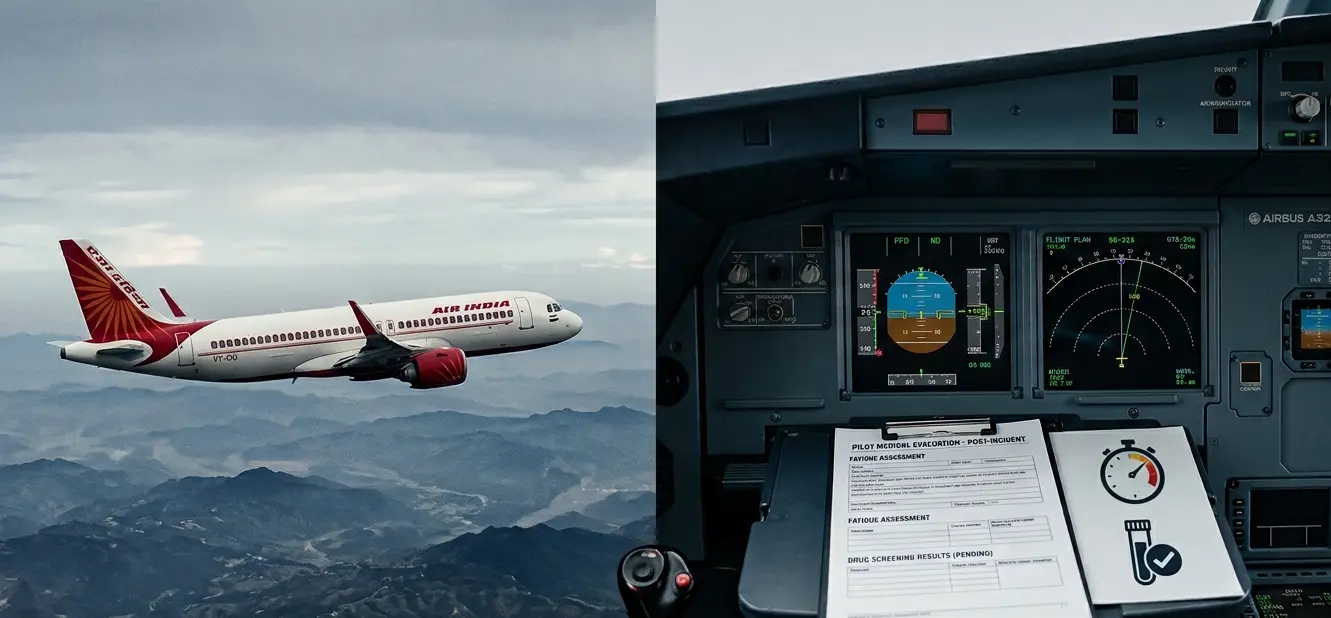
The Air India AI 2379 incident has raised a familiar set of questions: Was it turbulence? Was it pilot error? Or did something go wrong with the aircraft itself? The Phuket–New Delhi flight suddenly dropped around 300 feet on August 4, triggering an investigation and putting the focus on the pilot, the aircraft and what happened inside the cockpit.
In an interview with Mathrubhumi on August 3, about a week after the incident, Captain Sam Thomas, president of the Airline Pilots’ Association of India (ALPA India), discussed the drug-test result, possible hydraulic and autopilot issues, pilot fatigue and the need to examine both human and technical factors before drawing conclusions.
Q: The pilot has reportedly tested positive for cannabis metabolites in both the initial and confirmatory tests. What does that establish, what does it not establish, and what options does the pilot have to challenge or independently verify the result?
“The confirmatory test, which is a little bit more stringent than the primary one, has established that there is marijuana in the system. Now, I have not seen the report and I have not met or talked to anybody who has seen the report. But, for the time being, let's assume that that's what it is.
Now, he will have to go back to the company doctor. The company doctor will examine him and examine the report to find out whether this is recreational use or whether it is from some other source. That is the call of the medical specialist.
Thereafter, he will be sent for rehab. Now, there are two sets of rules. One is the DGCA rule and the other is the company rule. The company rule can be anything that they deem fit.
Whereas the DGCA rule, which is the law, is that he would have to be consulted, then sent for rehab, rechecked and then brought back into the system in a calibrated manner.”
Q: Is this a new situation for Indian pilots?
“This is the first time in Indian history that it is happening, and this is new. We, as a pilot community, have never heard of anybody testing positive for drugs. So we are also in the learning process.”
Q: Do pilots have enough support if they face mental-health problems or extreme stress?
“There is no support. First thing, there is absolutely no support, and it's a very bad thing.
Even if they try to take this up and say, ‘We have a problem with mental health,’ the moment you talk about mental health, you're not treated as an ordinary person. It is an issue we have as a community and as a nation. The mindset around this factor is changing, but we are still not there.
The situation is so bad that the moment you talk about mental health, your chances of even your children getting married can also be affected. That is our culture. It's improving, and there is a lot more to be done.
Because pilots are under extreme stress. We have highlighted the points of fear, fines and fatigue. But it will always be considered secondary. These are the things that make it stressful for pilots. And there is no provision.”
Q: Why do you think there is an immediate focus on pilot error after an aviation incident?
“That is the most wrong thing you can do. Most of the pilot errors which have come out have turned out to be wrong later.
But with the enthusiasm with which the media reports, the public consumes it and the country also goes with it because it is safer for them to accept it at the moment.
Now it's sensational to say that the pilot was tested positive or that he was not paying attention.
The PF, who was controlling the aircraft at the moment, did a brilliant job. And you say it was turbulence? There was absolutely no weather condition as such that day. What are you trying to cover up? How did three hydraulic systems fail?
There was no turbulence whatsoever for three days. You confused the entire country by saying it was turbulence. So now, where is the turbulence? Will you apologise for that now, as it will be proved that it was not what you said? No.
There's a technical issue.
Why is Airbus coming from France to join the investigation? Yesterday, the AEB, which is their accident investigation body, came here. Why would they come for a normal drug-induced issue? They won't.
So obviously, there's something more.
Now, the aircraft has recorded all these incidents in the DFDR as well as something called a PFR, the Pilot Fault Report. It is clearly indicating there is a hydraulic issue.
So it could be momentary. Nobody is saying it's permanent. It happened, disconnected the autopilot, and the crew recovered it.”
Q: What does the aircraft data need to establish?
“First, the DFDR — the Digital Flight Data Recorder and the cockpit voice recorder will have to be decoded.
Then the statements of the crew are taken and all are matched.
Then it goes into the technical evaluation as to why this happened — not whether it happened or not. It happened. It's recorded already.”
Q: What happened in the cockpit when the sudden event occurred?
“Firstly, you have, in a group of two, a pilot monitoring and a pilot flying.
In this flight, the pilot flying was the co-pilot, and the pilot monitoring was the captain.
Now, at this particular time, it was the captain's rest time. The captain slept. You are allowed to sleep up to 40 minutes on a flight, followed by a 20-minute break to stretch or use the washroom, because otherwise you can't open your eyes and make it through early morning and things like that.
So you have to keep a cabin crew member in the cockpit and observe.
The co-pilot and the captain can sleep up to 40 minutes.
The captain at this particular time was woken up after 40 minutes and during his 20-minute break.
And so he was stretching when, standing behind the co-pilot, this incident happened. He was also thrown off.”
Q: What should investigators examine if the reported autopilot or hydraulic issues are confirmed?
“The DFDR and the cockpit voice recorder will be decoded.
Then the statements of the crew are taken and all are matched.
Then it goes into the technical evaluation as to why this happened — not whether it happened or not. It happened. It's recorded already.”
Q: How long could such an investigation take?
“It can be done in 48 hours to extract the data and recordings. Then they submit it to the AAIB. They have a pending backlog of around 60 to 70 cases, so the case will be examined according to its priority and the depth of investigation required. The timeline will therefore depend on the investigation department.
It will come at the bottom of the list, and then it can sit for six months.”
See, in Indian bureaucracy, there is one thing: you keep quiet for two weeks, everybody will forget. Because by then some other news focus will come, or something, some fire will happen, some party or Gen Z awakening will come. And nobody will care about it anymore. So now that has become so normalised.”
Q: What are the biggest unanswered questions in the AI 2379 case?
“More importantly, what is this technical glitch that you said would never happen? How did it happen? Do the other aircraft need to be checked? If it happens again, what is the corrective measure? Is there anything additional that needs to be done beyond what the pilot has already done? These are the questions that need to be answered to ensure overall safety and provide a lesson for all passengers.”
Q: What about the reported drug test?
“Has there been any previous incident where a pilot was found with marijuana in their system? Now they say this has happened for the first time — how many more pilots could there be who are using it but have not been detected? That is also a concern.
Let everybody go through testing, but it should be done scientifically and in a systematic, structured and practical manner. It should not be done for everyone at the same time, because then you could end up grounding the entire airline.
Find out how many more people are in this situation and take corrective action.”
Q: How important are pilot fatigue and rest requirements?
“Very important. It depends on how much attention you give to it. Duty-time limitations are different from prescribed rest periods.
See, we cannot make it like a mathematical equation. Suppose I tell you today, ‘Go to sleep now and get up at 1 o’clock. We have to go for a flight.’ Will you be able to sleep immediately? Nobody works like that. You cannot force yourself to sleep.
Suppose you fly three consecutive nights, the fourth night you may not be able to sleep properly even if you are resting. Your body is like that. No matter how much you sleep during the day, it does not make up for your night sleep.
So you have to compensate for that somewhere. In our time, you could do a maximum of two night flights.
Similarly, when you go westwards, it’s okay. Go to London, no problem. You go to Hong Kong — it’s eastwards. There you get more jet lag.
When you travel abroad, you get jet lag for two or three days. You don’t know what you’re doing. So we are doing it day in and day out. The body will take a toll.
Experts need to come in and formulate this.”
Q: What do you believe needs to change in aviation regulation?
“New, root-level, systematic changes are required if you want to improve the situation.
On top of that, why are we appointing IAS officers to aviation? Do they know the subject in depth? No. They cover general subjects and they study, yes, but do they have deep knowledge of the particular industry they are working in?
Today they are in aviation, tomorrow they are in agriculture. The system keeps shifting them between departments, and the departments and their operations get stuck.
Then there are other UPSC-type officers working in the DGCA. Many of them have no practical knowledge of aircraft, yet they are involved in making aviation rules.
When you don't have that expertise, you go to the Air Force and pick up its systems and practices. But what is the Air Force flying? Is it the same as civil aviation? There is nothing equal between the two.
We need people with specialised knowledge and experience in the aviation industry to make aviation rules.”
Q: What is the wider lesson from the AI 2379 incident?
“So the transparency part, on both the regulator and company side, needs to come out.
As much as it is a technical issue, it is also a cultural issue. Technical issues will happen, and they have technical solutions. Experts need to look into them and find the right solutions. Similarly, bureaucratic issues need to be handled by the people responsible for them.
But for an ordinary passenger, there is one simple thing you can do: when you are seated, you have to have your seatbelt fastened, irrespective of whether the seatbelt sign is on or not. Because it is an ego issue with Indian passengers. They don't wear the seatbelts.
If everybody was wearing a seatbelt that day, then not one injury would have happened.”