'The Odyssey' review: A visually staggering epic that proves Nolan remains in a league of his own
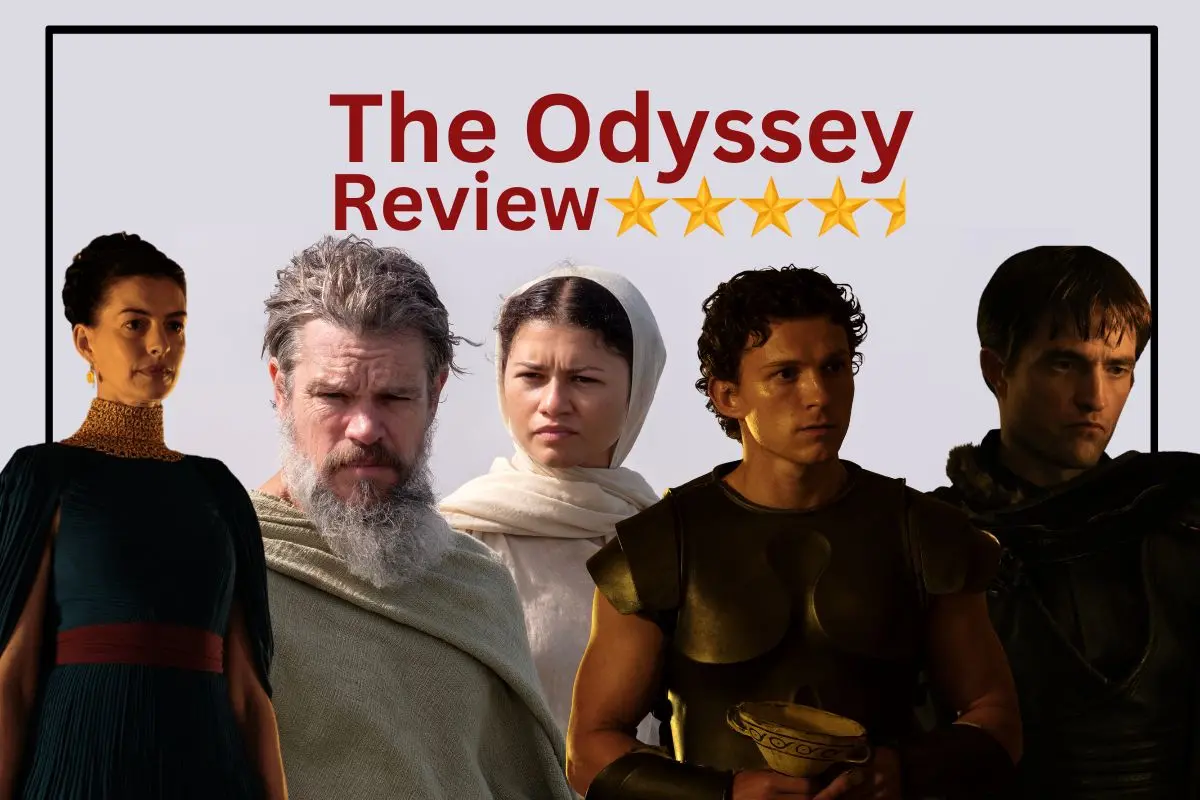
The Odyssey Review: Some filmmakers make movies, and there is Christomer Nolan who creates an experience that stays with you beyond the credits roll. ‘The Odyssey’ is one such film with which the filmmaker has given us not another film, but an event to celebrate. Adapted from the Greek poet Homer’s ‘Odyssey’, the film was shot entirely on IMAX cameras. It’s a movie that’s mounted on a huge scale but never loses its emotional depth. ‘The Odyssey’ isn’t just another adaptation of the Greek epic, but it’s another film that proves why Nolan is considered among the greatest filmmakers in the world.
Also Read: ‘I was left speechless on first day’: Tom Holland on scale of Christopher Nolan’s ‘The Odyssey’
From its breathtaking visuals and performances to its storytelling and technical brilliance, here's our detailed review of 'The Odyssey' and why it deserves to be experienced on the biggest screen possible.
The Odyssey Review: A retelling of a timeless epic
'The Odyssey' picks up in the aftermath of the Trojan War. Even after a decade since the Trojan War, Ithacan awaits the return of its king, Odysseus. Back home, Queen Penelope is hounded by suitors eager to claim Odysseus ’ throne, but she, her son Telemachus, and a handful of Odysseus' loyalists refuse to give up on the hope of his return. Meanwhile, Odysseus, who seems to have forgotten his memory and is stranded on the island of Ogygia for seven years, sets out on a journey back home. The film follows the perilous journey of Odysseus to Ithaca with his men, before he was stranded on the island. ‘The Odyssey’ is a story of mythical creatures, resilience, fate, and tests of courage.
Christopher Nolan’s vision of Homer’s ‘Odyssey’:
Adapting an ancient mythological tale that has been around for nearly 3,000 years is a mammoth task in itself. But when Nolan takes up the challenge, the result becomes an ode to the source material and one that every cinema enthusiast must watch. ‘The Odyssey’ originally is Homer’s work, but with his own touches of grand scale and emotional depths, Nolan makes it truly his film.
Also Read: From 'The Odyssey' to 'Saving Private Ryan': Hollywood's costly missions to rescue Matt Damon
One of the factors that makes it ‘a Christopher Nolan film’ is how the Academy Award-winning director has dealt with gods. Without having to show the gods on screen, Nolan has shown the wrath of the gods that drives Odysseus’ journey. Their presence is shown through the raging sea storms and the sound of silence, yet Nolan never moves from his focus on the people facing the wrath.
One of the crucial reasons why ‘The Odyssey’ deserves to be watched on the biggest screen possible is that Nolan has used IMAX cameras, making ‘The Odyssey’ an immersive experience rather than just a visual spectacle. Point in case is how Odysseus’ men appear to be toy-like little humans when Polyphemus, the monstrous child of Poseidon, known as one-eyed Cyclops, eats them like little bites of food.
Adding to this his Nolan’s choice of once again opting for practical filmmaking that depends heavily on CGI. He built massive sets and shot at real locations across countries and continents to bring the story alive. Even the Trojan War felt real in the film because of Nolan’s approach. Matt Damon had also recently revealed that the fire seen during the battle was real and not created using visual effects. It's this attention to detail that gives the film its scale.
Matt Damon is the backbone of Nolan's 'The Odyssey':
'The Odyssey' boasts an impressive ensemble led by Matt Damon as King Odysseus, Anne Hathaway as Queen Penelope, and Tom Holland as their son Telemachus, among others.
Damon delivers one of the strongest performances of his career as Odysseus. He perfectly balances the strength and awareness of a warrior king with the emotions of a man desperate to return to his family. As a leader, he is determined to protect his men, but also carries the guilt of not being able to bury some of the men he lost along the way. In his character representation of Odysseus, Damon has brought both strength and vulnerability, which helps the audience empathize with the character, but also never forgets the wrongs he may have done in his journey to upset the gods.
Anne Hathaway is much more than just the beautiful Queen of Ithaca. While Odysseus is far away from home, with many even contemplating if he’s truly alive, she shoulders the responsibility of protecting her home and family despite being surrounded by suitors eager to claim the throne. Hathaway beautifully portrays Penelope's unwavering faith in her husband's return while also wanting to keep her son safe from the suitors.
Tom Holland brings sincerity and innocence to Telemachus, a young man who has grown up hearing stories about his father, whom he never met, yet is certain of his return. While he delivers a good performance, he doesn't leave the same impact as Damon. In fact, it isn’t the best performance that Holland delivered, and it appears to be a missed opportunity for him to portray his versatility.
Also Read: Christopher Nolan reveals 'The Odyssey' isn't the first film he planned to premiere in India
The supporting cast, including Zendaya, Robert Pattinson, Lupita Nyong'o, Himesh Patel, James Remar, and others, all do justice to their respective roles. Some have limited screen time, but each leaves an impression.
The Odyssey Review: Technical brilliance
A film mounted on such a huge scale would not have been possible without the efforts of Nolan’s technical team working behind the scenes. Cinematographer Hoyte van Hoytema once again delivers visuals that deserve to be seen on the biggest screen possible. His IMAX frames make the sea look endless, while the battle scenes leave you awestruck with their scale.
But it's not just the grand visuals that stay with you. Hoytema is equally good at capturing the film's emotional moments. There's one scene where Penelope questions a beggar claiming to have crossed paths with Odysseus. As the conversation takes place between the two, the camera moves closer to Penelope’s face, letting her expressions do the talking. Another scene that works beautifully with the emotional core of the film is of the dog lying at the entrance and counting its last breaths, awaiting its king's return.
The visual effects are another big highlight. The whirlpool sequence is easily among the best in the film, alongside the numerous storms at sea that Odysseus and his men face. It’s these visuals that make you feel as if you’re caught in action with Odysseus and his men.
Also Read: Can't wait for ‘The Odyssey’? Stream this behind-the-scenes documentary before release day
Ludwig Goransson's background score complements every scene beautifully, be it the chaos of the Trojan War, Odysseus' battles at sea, the quieter emotional moments, or the crucial climax fight scene. It never tries to overpower the visuals, instead adding to the mood of every scene.
The same goes for the production design, costumes, and sound design. Every department has played its part in bringing Homer’s world to life.
Where the film stumbles:
At 173 minutes, 'The Odyssey' is a long watch, not too far behind Nolan's last theatrical release, 'Oppenheimer'. While the runtime doesn't feel unnecessary, the film does take its own time to settle into the story.
The first half, which largely unfolds through flashbacks, moves at a slower pace. This is where you tend to lose your attention a little, until it eventually picks up. However, once the narrative gathers momentum, 'The Odyssey' rarely lets go. From that point onwards, the film keeps you invested till the very end.
The Odyssey Review: The verdict
Whether you're a Christopher Nolan fan or not, 'The Odyssey' is a film that deserves to be experienced on the big screen. While it is best enjoyed on an IMAX screen, it's equally worth a trip to the cinema halls.
'The Odyssey' may be touted to be a retelling of Homer's epic, but it’s actually Nolan’s masterful storytelling, which is backed by strong performances and breathtaking visuals.
Stars: 4.5 out of 5