Gaya Act and Waqf Act on the occasion of Buddha Purnima: Fundamental rights, minority rights and secularism in peril
The full moon of Vysak is on, the compassionate one annihilating all suffering…
Sahodaran Ayyappan, “Vysakha Paurnami”
Ambedkar, your name would be chanted as a Sarana mantra of Buddhism by future India…
Sahodaran Ayyappan, “Jati Bharatam”
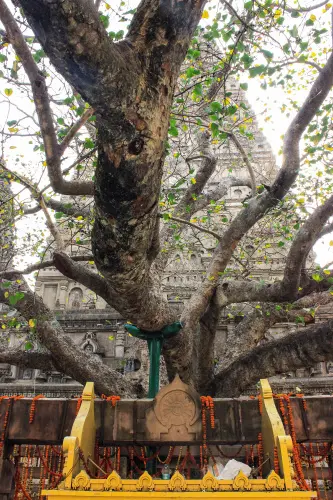
As Buddha Purnima is nearing on 12 May 2025 the world is looking towards Bodhgaya in Bihar. Buddha Purnima is the full moon of the month of Vysak, the day the Buddha was born, achieved enlightenment and passed away. Bodhgaya is one of the oldest pilgrim centres of the world. Sidhartha Gautama achieved enlightenment here under the Bodhi tree in 6th century BC and became known as the Buddha. The peepal tree was revered by the Buddhists as Mahabodhi. In 3rd century BC Mauryan emperor Asoka the Great visited the place and created the diamond seat of the Buddha beneath the Mahabodhi tree and the Mahabodhi Mahavihara at Gaya. Asokan rock edict 13 mentions it as Sambodhi. Ever since it has become the foremost pilgrim centre of Buddhism in the whole world.
When the Sungas came to power after the assassination by cheat of the last Mauryan Buddhist emperor Brihadratha the grandson of Asoka, the Brahmanical militiaman Pushyamitra Sunga cutdown the Bodhi tree and tried to burn it down to ashes. But it came back to life from the roots buried deep in the soil like water and life. It was under attack for centuries under Brahmanical and pagan rulers like Sasanka. By 15th century Gaya fell into the hands of Saivites completely. In modern times it was the British archaeologists and conservationists like Sir Alexander Cunnigham who recovered it back to its glory. It was the British poet and intellectual Edwin Arnold who visited Gaya and many other historical sites of Buddhism in India and wrote about it to bring it to the attention of the world. Arnold also published his English modern epic like poem The Light of Asia in 1879 on the life of the compassionate one that influenced poets like Asan to compose Chandala Bhikshuki, Karuna and Sree Buddha Charitam in early 1920s. Tagore published his Chandalika in 1933. Mooloor’s verse translation of the Dhammapada was done in 1925 at the behest of Sahodaran. Sahodaran’s Buddha Kandam poems appeared in his 1934 Verses. The modern Buddhist movement in Kerala was inaugurated by Narayanaguru by visiting Sri Lanka twice and declaring in 1918, citing the Amarakosa of Amarasimha that ours is also Buddhism.
Anagarika Dhammapala the modern Buddhist monk from Sri Lanka was instrumental in liberating the Mahabodhi Mahavihara from the clutches of Brahmanical Hindu forces who have illegally occupied it from the Middle Ages as in many other ancient shrines in India. He fought the long legal battle successfully to evict the Saivite forces from at least half of the shrine. Anagarika Dhamampala was also instrumental in the conversion of Pandit Ayyothee Thasar the dalit leader of Tamilakam who composed Indirar Desa Saritram the Buddhist History of South India and Dravida Pandian the pioneering work in the Dravidian movement. From late 19th century onwards, Buddhists have been demanding the eviction of Hindu occupiers from their foremost shrine.
There is a greater demand to repeal the Gaya Act of 1949 through which the Bihar State has created a BodhGaya Temple Management Committee in which four Hindu members were placed along with four Buddhists. The ex-officio Chairman is the district magistrate, who must also be a Hindu according to the act. A Hindu majority committee is controlling the Buddhist organisation and properties. The Buddhists are demanding autonomy and full religious freedom as per the Constitution in functioning and managing their shrine. The infiltration of non-Buddhists in the management committee is a clear violation of freedom of religion and minority rights that are fundamental rights guaranteed by the Constitution of India. From February 2025 Buddhist monks and nuns from all over the world are in hunger strike at Bodhgaya for these just legal, secular demands.
The Gaya Act 1949 is a clear violation of the Right to Religious Freedom (Article 25 & 26 of the Indian Constitution). Article 25 of the Indian Constitution guarantees the freedom of religion to all citizens. Article 26 gives religious communities the right to manage their own religious institutions. The Bodh Gaya Temple Act contradicts these provisions by denying Buddhists exclusive control over their own sacred shrine. It is also a clear discrimination against Buddhists in India. The Act does not treat Buddhism equally to other religions in India, especially in relation to Hinduism that is given undue weightage. Hindu temples are protected from outside interference but the Mahabodhi Temple remains under Hindu influence and majoritarian control.
Buddhist groups argue that this amounts to religious discrimination and violates the secular principles of the Indian Constitution. There are also International Human Rights Concerns against the Act. The United Nations (UN) and international Buddhist organizations have raised concerns over India’s handling of the Mahabodhi Temple’s administration. Buddhist-majority countries like Sri Lanka, Thailand, and Myanmar have repeatedly urged the Indian government to return full control of the temple to Buddhists. The failure to address these concerns affects India’s image as a secular nation and could impact diplomatic relations with Buddhist-majority countries. The pilgrims from Japan, Korea, China, Singapore, Malaysia, Indonesia, Vietnam, Cambodia, Laos and many other Buddhist countries are also involved in these just global demands. Further it also affects the minority institutions and rights within India more crucially creating a Constitutional crisis.
In April 2025 the union regime passed the Waqf Act that is a direct attack on the religious freedom and minority rights of Muslims as it enforces non-Muslims in the Waqfs. What has been done to the Buddhist micro minority is done to the largest minority of India now. Muslims have been enjoying the full control and management of their religious institutions and properties for more than a thousand years in India from the time of the Delhi Sultanate, the Mogul Empire and the Carnatic Sultans. Even the British colonial regime acknowledged it in 1863 Religious Endowment Act. In Kerala Muslim mosques called Pallys in the ancient Pali and Tamil traditions of Buddhism, were here from the legendary Cheraman Pally of Kodungallur from the time of the prophet. Infiltration of Hindus into their religious property managing Waqfs would be an absolute denial of their religious autonomy and fundamental rights.
Moreover, a communal split is also caused between Christians and Muslims, two major minority religious groups in Kerala through the Munambam issue and the leverage is taken by the majoritarian Union regime and its Hindutva agendas and outfits. Thus the repealing of Gaya Act is also becoming crucial in protecting the minority rights and fundamental rights of all citizens and the secular credentials of the country. Otherwise, the Muslim claim for community autonomy would not stand if it is denied to Buddhists a micro minority in India. It is more crucial for Muslims as it will create a legal precedence for Waqf Amendment Act. The Christian clergy who are coopted against the Muslims by CASA and Chrisanghis must remember the fact that the Church Act is next in the pipeline. People must develop greater human fraternity and Constitutional solidarity to fight the divide and rule policies and stratagems of the hegemonic regime working against Constitutional values of representative democracy and secularism. EWS amendment was a fatal blow to representative democracy the foundation of the Constitution and the modern republic. Gaya Act and Waqf Act are against fundamental rights and secularism. People are trying to legally and politically fight it and save the fundamental rights and religious rights in the light of the Constitution of India as envisioned by Ambedkar and other pioneers of the democratic republic. Sri Narayana Manavadharmam under Dr Mohan Gopal has also moved the Supreme Court challenging it along with many minority organs. Let this Buddha Purnima 2025 become a moment of awakening and collective resistance to rights violations by the majoritarian regime. Let the flowers bloom… as Amedkar the neo-Buddha has articulated, as imagined by Sahodaran as a future mantra of India in 1940s itself in a poem saluting Ambedkar titled “Jati Bharatam.”
(The author is Associate Professor of English and Founder Coordinator of Centre for Buddhist Studies, SSUS Kalady, Kerala. The author can be reached at ajaysekher@ssus.ac.in)