How a Keralite biz strategist is fighting to save her son from a rare disease in US
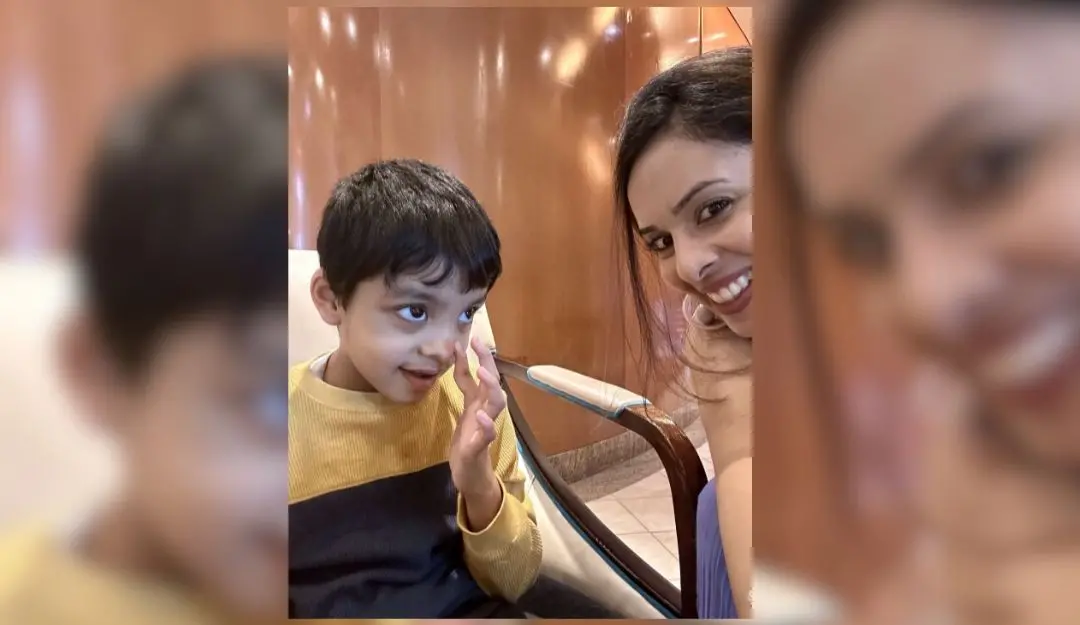
Swapna Sasidharan is not the kind of mom who has endless energy for trips or someone who spends her day at ease after a long, exhausting shift. She is not the mom who dreams of escaping on a vacation for a breather or who can relax whenever she pleases. No, Swapna is a mom who is ready to fight -- and refuses to give up. For the sake of her 8-year-old son, Ved Nambiar, she will read every research paper, ask every possible question, and explore every new path, clinging to the hope that tomorrow might bring just a little less pain than today.
This is the story of Ved Nambiar, a Malayali boy living in Chicago, battling a rare condition known as POGZ disorder -- a disease so rare that it affects only about 500 children across the world. "I was living in the best city, with access to the best medical care. I had the best therapists and wonderful doctors," Swapna recalls, "yet no one had answers to my son’s illness."
"Something just didn’t feel right. Ved didn’t start crawling until he was 3 years, and he didn’t walk until he was 5. He faced a lot of developmental challenges -- he wasn’t talking, couldn’t understand much, he struggled to follow even simple instructions. He had severe cognitive impairment. We ran test after test, but every result came back with no clear answers," Swapna said through phone from the US.
"It was devastating," she admits.
Kannur native Swapna and her engineer husband Sandeep shuttled between doctors, yet the answers remained elusive. A gene test was conducted, and it came out with inconclusive data. Then, in early 2024, a RNA sequencing test revealed the truth. Ved had a rare and harmful genetic disorder. For Swapna and Sandeep, it was a heartbreaking news -- a long-awaited answer, but one that came with its own set of challenges.
“Ved has a de novo mutation in his Pogz gene. This means this mutation is new in a child's DNA and is NOT inherited from parents. It is something that arises spontaneously in the egg, sperm or early embryo due to a random typo error. Ved got a "G" nucleotide replaced by a "C" in his Pogz gene (out of the 3.2 billion nucleotides). That one typo is what is causing the disease,” says Swapna.
Swapna, who is into business operations and digital transformation, was determined to speak the language of doctors and researchers. She enrolled in a certificate course on drug discovery and development at Harvard Medical School. Equipped with new knowledge, she prepared to go to any length to help her son lead a life just like any other child. Swapna launched the Cure POGZ Disorder Foundation in March 2024 to generate the funds for the gene therapy.
With a small, passionate team of 10 with doctors, researchers and volunteers, her mission is clear: to raise the funds -- at least 5 million dollars -- a massive amount that is essential for pioneering research into drug and gene therapies. “I am doing everything I can through social media and NGOs to garner funds, because every dollar brings us closer to a breakthrough that could change Ved’s life,” she said.
Swapna says it's a long way ahead -- for gene therapy first we have to go for clinical trials, toxicology studies and the lengthy FDA approval process. But she hopes in another 5 years, a breakthrough treatment will emerge, one that offers Ved the chance to live a fuller life.
Ved can't attend schools daily but his schedule is filled with therapy sessions -- physical, occupational, and behavioural -- from morning until evening. Amid juggling with work, home, and medical appointments, the family hopes for Ved’s progress, however, gradual.
Hailing from Thalassery in Kannur district, Swapna and her husband Sandeep -- a software engineer -- face the challenge of managing family ties and travel. With Ved suffering from cyclical vomiting, decisions like travelling together to India becomes impossible. They have been settled in Schaumburg in Chicago for 20 years.
Ved’s 11-year-old sister, Sloka, plays with him, unaware of the seriousness of his illness, yet holding on to hope that one day everything will be okay.
To donate visit (https://www.curepogzdisorders.org/)