The sinking of IRIS Dena: How Mk-48 Torpedo delivers a ‘quiet death’
Something shocking happened in the waters near Sri Lanka recently, and the whole world is talking about it. The United States destroyed an Iranian warship called IRIS Dena in the Indian Ocean, just 40 kilometres off the Sri Lankan coast. The ship was returning home after visiting India as a guest of the Indian Navy. At least 87 sailors lost their lives. Around 61 are still missing. And all of this happened without any warning.
US Defence Secretary Pete Hegseth did not hide what happened. He confirmed that an American submarine quietly followed the Iranian ship and fired a torpedo at it. He called it a "quiet death." Iran's Foreign Minister was furious. He called it "an atrocity at sea" and warned that America would "bitterly regret" this attack. The Iranian warship had nearly 130 sailors on board, real people, with families waiting at home.
Now, many are asking, what exactly was fired? What kind of weapon does this silently, underwater, without any warning?
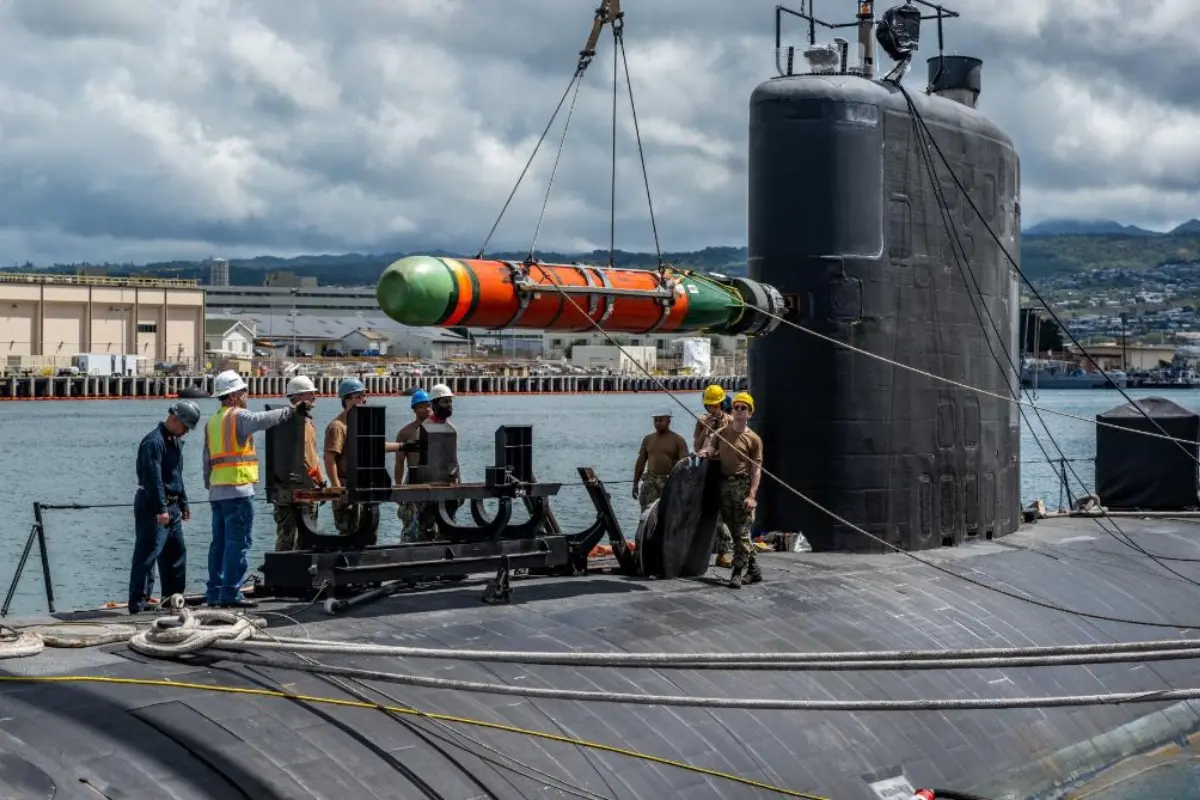
The answer is the Mark-48 torpedo. Think of a torpedo as an underwater missile. While normal missiles fly through the air and hit targets on land or in the sky, a torpedo travels deep inside the sea and hits ships or submarines beneath the water surface. You cannot see it coming. You cannot hear it until it is too late.
The Mark-48 is not a small weapon. It weighs about 1,700 kilograms, heavier than most cars. It is nearly 19 feet long, almost the size of a small room. It has been used by the US Navy since 1972 and has been upgraded many times since then. The latest version is called the Mk-48 ADCAP, which stands for Advanced Capability. The name itself says what it does, it is built to be better, faster and smarter than older versions.
How does it find its target underwater? It uses sonar, a system that works with sound waves, similar to how a bat finds its way in the dark. The torpedo sends out sound signals into the water. When those signals bounce back after hitting a ship, the torpedo knows exactly where the target is. This is called active sonar. It also has passive sonar, which means it quietly listens to the sounds that enemy ships or submarines make, like their engines running. So even if the ship tries to run away or suddenly change direction, this torpedo keeps chasing it.
The speed of this torpedo is more than 55 knots, which is around 100 kilometres per hour, underwater. It can travel hundreds of kilometres before hitting its target. And each one costs around $4.2 million, which is roughly ₹38 crore. One torpedo. ₹38 crore. Gone in seconds.
The most frightening part is how it destroys a ship. Most weapons explode on direct contact. But the Mark-48 is designed to explode underneath the ship, right below its bottom. This targets the keel, which is the long, strong beam running along the bottom of every ship, like the backbone of the human body. When the explosion hits the keel from below, it snaps it. The ship literally breaks into two pieces and sinks very fast. Naval experts call this the "keel-breaking effect." Once this happens, there is almost no chance for the ship to survive.
The torpedo can also be controlled in real time. The submarine operator guides it through a thin wire connection even after it is fired. If needed, the direction can be changed mid-way. And if the wire breaks? The torpedo does not stop. It switches to automatic mode and continues chasing the target on its own, using smart digital systems to make decisions. It does not need a human to hold its hand.
After the attack, Sri Lanka's Navy rushed to help. They rescued 32 injured sailors and recovered 87 bodies from the sea. Search operations are still going on for the 61 who remain missing.
India also has powerful underwater weapons. The Varunastra, developed by DRDO, is India's own anti-submarine torpedo. The Indian Navy also uses imported torpedoes. While the technology differs, the purpose is the same: to track and destroy enemy ships beneath the surface.
This incident has reminded the world of a hard truth. Wars are no longer only fought on land or in the air. Deep beneath the sea, invisible weapons are silently doing their job. And once fired, there is very little anyone can do.
(Girish Linganna is an award-winning science communicator and a Defence, Aerospace & Geopolitical Analyst. He is the Managing Director of ADD Engineering Components India Pvt. Ltd., a subsidiary of ADD Engineering GmbH, Germany.)