The battle over Katchatheevu resurfaces; Solution is in cooperation
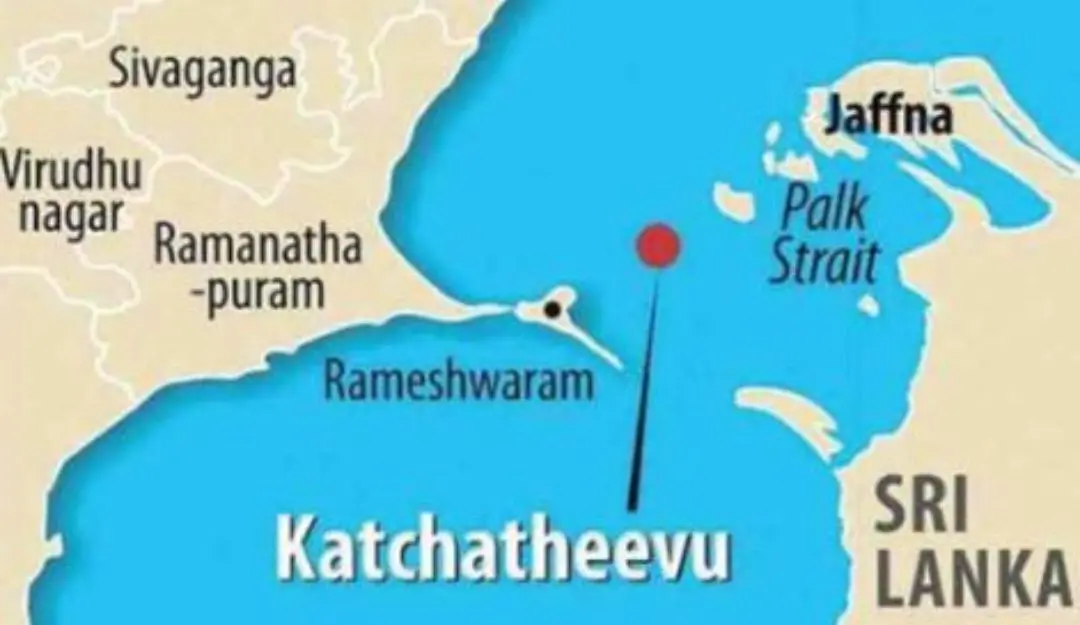
With the Tamil Nadu Legislative Assembly unanimously adopting the resolution asking the Union Govt to reclaim Katchatheevu from Sri Lanka, the highly sensitive and sentimental issue is back on the burners. The resolution says that the retrieval of the tiny islet is the only solution to protect the fishing rights of the Tamil fishers in the Palk Strait. Katchatheevu is a small patch of land comprising 285 acres in between Sri Lanka and India. It is 33 kilometers off the coast of Rameswaram and 62 kilometers away from Jaffna , the northernmost tip of Sri Lanka.
Jawaharlal Nehru , the first PM of India, famously remarked in 1961 that he attached no significance to this little island and that he would have no hesitation in giving up India's claim to it. India accepted Sri Lanka's ownership of Katchatheevu in 1974 when the then Indira Gandhi government signed the maritime agreement with the island nation. The pact formed part of an exercise that aimed at assuaging the feelings of the neighboring country in the wake of the Bangladesh war in 1971. India felt that it would be in the interests of the nation if it took into consideration the sentiments of the neighbors a little more empathetically.
The official records of the agreement don't show that India ceded the territory to Sri Lanka. This is because of the fact that Katchatheevu has been a bone of contention between the two nations even from the pre-independent era. And the fact remains that it couldn't be resolved even during colonial rule when both Ceylon and Madras were under the British administration. The understanding was that the fishermen from Tamil Nadu could use the islet to rest and dry their nets. They are also allowed to participate in the feast of St. Antony, the patron saint of the sole church in the islet. Otherwise the area remains uninhabited since it doesn't have any source of drinking water.
But it became a serious trope of conflict when the Sri Lankan fishermen began asserting their rights to fish in and around Katchatheevu after the civil war ignited by the LTTE came to an end. By then the Indian fishermen had started exploring the waters using bottom trawlers, which resulted in the depletion of marine life. The Sri Lankan fishermen feel that there is no level playing field since bottom trawling is banned in their nation. This forms the crux of the issue.
Prime Minister Modi raised this issue last year when BJP planned a massive campaign to spread its roots in Tamil Nadu. He alleged that the Congress government led by Indira Gandhi callously gave away Katchatheevu to Sri Lanka. The DMK too was accused of giving in to the pressures of the Congress Govt. But the records show that the DMK government under M. Karunanidhi convened an all-party meeting to protest against the agreement between the two nations.
Despite all the hue and cry, the fact remains that Katchatheevu is not an easy nut to crack. Mukul Rohtagi, the former Attorney General of India, gave an insightful assessment when the issue reached the Supreme Court. He informed the apex court in unambiguous terms that India can retrieve the islet only if the nation goes to war with Sri Lanka. The bilateral agreement falls under the UN Convention on the Law of the Sea, and until and unless Sri Lanka gives it back willingly, the islet will remain a part of our neighboring nation. And it will be too naive on our part to expect such a magnanimous offer from the Lankan Govt.
So , is there a way out? According to V. Suryanarayanan, the founding director of the Centre for South and Southeast Asian Studies at the University of Madras, the solution lies not in retrieval but in cooperation: '' Let a Palk Bay Authority be formed, consisting of fisheries experts, fishermen representatives, the navy and the coast guard, and representatives of the two governments.'' Let the two countries make joint efforts to enrich the marine endowments. Let the Sri Lankan fishermen fish in Palk Bay for three days, let the Indian fishermen fish for three days, and let one day be a holiday.'' Of course, it's easier said than done!