I am not a hypocrite; Constitution doesn't prevent me from pronouncing my faith: DY Chandrachud
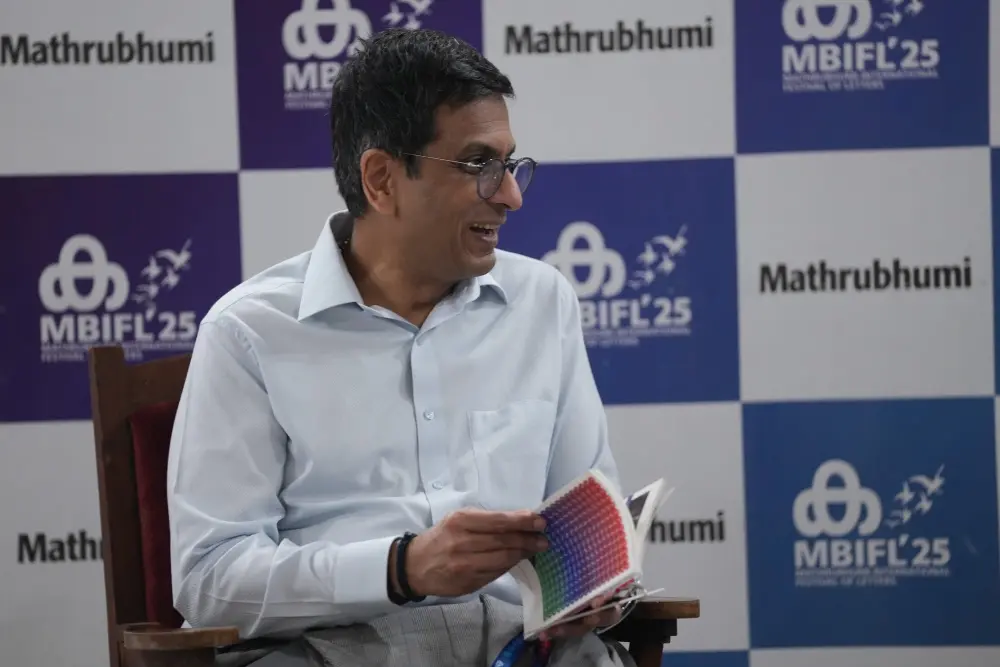
Justice D Y Chandrachud, former CJI says that his revelation about the Ayodhya judgement was never in conflict with the constitution. ''Our constitution does not require judges to be agnostic or atheist to be independent. Our judges can be religious in their inclinations and yet do justice to people who belong to all faiths.'' Excerpts from the exclusive interview.
It has been pointed out that the constitution has been a site of struggles- constant conversation with power. How have been your experiences, vis- a- vis the Indian constitution?
When it was framed and adopted the constitution represented two distinct strands. First was the transfer of political power from the colonial regime to the home grown regime. But equally important was the process of social transformation. So, the constitution was conceived as an instrument for the evolution of India as a democratic nation. That resulted in social movements for dignity, equality and social justice. The decentralisation of ownership of the material resources, mainly the land has been an important element in this evolution (the final verdict by the SC in the Keshavananda Bharati case- 1973.) There have been many struggles in terms of enhancing social welfare, asserting the identity of marginalised sections, and protecting personal liberty as happened in the years after the emergency which saw excesses like the denial of the rights to personal liberty. That way it has been the site of a dialogue between the citizens and the government and between the different levels of governance.
The constitution faces a critical juncture right now. The judiciary has an important role in protecting the constitution. Do you think that the courts have risen up to the occasion?
The constitution has been facing critical phases from the very birth itself. The nature of the challenges may change. The courts are called upon to create a solution to the problems in the context of personal liberty, equality, and contemporary issues like climate change or the growth of the internet and social media. The fundamental principles the courts have to apply are rooted in the constitution. I believe the higher courts particularly the SC have been at the forefront in developing new doctrines such as the doctrine of due process connected to article 14 and article 21 that any law which deprives the citizens of their personal liberty must meet the requirements of fair and reasonable principles of proportionality framed by the SC. We applied this method in the case of the electoral bonds . The higher courts have applied new methods of jurisprudence in cases related to climate change.
Are the courts delivering even during the times of majoritarian rule?
Well, it has always been majoritarian rule. Any government to survive Parliament must enjoy the confidence of the majority on the floor of the house. In that sense the existence of a majoritarian rule does not alter the status of the courts. The courts are constantly reminded of the fact that when they test the validity of the law that law has been enacted by the representatives of the people who have the authority to create the law. So you do not approach the law from the lens of the law being necessarily unconstitutional. But once a party which comes to court questions the constitutionality of the law the government has the responsibility to explain the validity of the law. So, I believe contrary to what many commentators would say that irrespective of the nature of government formation there are some fundamental principles emerging even in the context of what you describe as 'majoritarian' rule. I can give you examples of that happening throughout history particularly in the recent past.
You spoke of societal transformation. The architects of the constitution imagined that the republic would travel forward there by broadening the horizons of democracy. The chief architect of the constitution Dr BR Ambedkar emphasised the point that there must be due representation across the corridors of power. But the sad fact is that the major institutions including the SC don't have the proper representation of diversity. What is your take?
I will speak about the judiciary. I will speak about the Supreme Court. As far as the Supreme Court is concerned a concerted effort is made to ensure that the court reflects a sense of diversity. And to my mind the Supreme Court does reflect a sense of diversity. Until the retirement of my colleague justice CT Ravikumar the SC had three representatives from the Scheduled Castes They were not appointed because they belonged to the Scheduled Castes. They were appointed because they were good judges in terms of what they delivered in the high courts. But since they belonged to that community they brought in a sense of diversity. There is an active effort by the SC to give due representation to different religions without having specific quotas. Therefore we have judges from various communities including christianity, Islam and the Parsi. There is also great focus in terms of regional diversity. The Collegium sees to it that different states and high courts have adequate representation in the apex court. Adequate representation in terms of gender is also taken into consideration. We should also think of the pool from where the appointments take place. The pool for the SC comes from the high courts or the members of the bar. So, in order for the SC to reflect a true sense of diversity the high courts must reflect that sense of diversity. And what is the pool for the high courts? It is drawn from the members of the bar and judges from the district judiciary. So, if you want to bring in diversity to the judiciary in future we have to begin at the base of the pyramid that is the district judiciary. A very encouraging fact is that more than 50% of recruitments to the district judiciary are from women. This provides the necessary gender balance to the judiciary.
The point is taken but there have been observations that there should be more affirmative action on the side of the apex judiciary. It is pointed out that when a vacancy arose in the Supreme Court of the United States of America the stakeholders decided to have representatives of the Black, female community. Wouldn't it be great if the Supreme Court of India acted in a similar way?
You spoke of the US Supreme Court. The Power to appoint judges to the SC there in the US is entirely with the President. The appointments to the US Supreme Court are political appointments. In contrast the appointments to the Indian Supreme Court are not political. We have affirmative action at the level at the district judiciary. The recruitment to the district judiciary is made by the state governments in consultation with the Chief Justices of the High Courts. Every state applies its own policies of affirmative action in this process. These are the very judges who eventually come to the High Courts. And the judges from the High Courts will eventually come to the SC. If you look into the website of the collegium of the Supreme Court you can see the elaborate discussions in this regard.
One of your major judgments was in the Sabarimala case. It was hailed as a much needed progressive judgement. But it also met with protests from various quarters and is presently taken up for a judicial review. What are your reflections on it?
One thing I have learnt in the last 25 years as a judge is that you should do the best you can in a case. Once you deliver the judgement your part is over. I may sound a little bit philosophical but the fact is that I am not attached to the consequences of my judgement. Sometimes those consequences may emerge in future. That is the process of the evolution of society. The quest for equality, the quest for dignity to every segment of the society is part and parcel of the judicial decisions. It is a work in progress and we do hope that society will eventually accept these changes.
You have delivered some remarkable judgements including the one in Puttaswamy case where you held that the right to privacy is a fundamental right and you formally overruled your father's judgement in the ADM Jabalpur case which had held that rights to liberty and life could be suspended during the emergency. What did you really feel while penning this verdict?
When I penned the judgement in the Puttaswamy case the judgement in the ADM Jabalpur case was just another judgement. For that matter I also overruled my father's judgement which had upheld the provisions of Indian Penal code which dealt with the punishment for adultery. When you deal with judgements you are not particularly dealing with the personalities who write the judgement. Sometimes the judgement you deal with might have been delivered by a judge whom you deeply respect in this case my own father. But ultimately that doesn't matter.
Were there any inner conflicts?
Not at all. When you look at the case and the validity of the case in future you are deciding upon the correctness of a view which was taken in the past . We are delivering the judgments in the context of the present day society which has undergone changes in many realms. The Challenges faced by society today are different. What the SC lays down today is in the context of contemporary society. Who knows what the future holds? That's part of the churning of judicial decisions over a period of time.
Your dissenting note in the Romila Thapar case that dissent is the safety valve of democracy was remarkable indeed! It raised the hopes of the Indian republic. You were speaking truth to power, you were holding power to account. Looking back, how do you reflect on those moments?
Festival of Letters (MBIFL) 2025 at Kanakakkunnu, Thiruvananthapuram | Mathrubhumi
That reflects my basic approach to decision making.That dissent is the safety valve of democracy has been my guiding principle over a period of time. There must be space for all kinds of view points in democracy. I was the sole dissenter in the adhar case. Four of my colleagues felt that the project was constitutional. For me the project did not contain sufficient safeguards for the protection of privacy which is a fundamental right.
And it was passed as a money bill?
Absolutely. I dealt with the different aspects of the money bill which is now referred to a larger bench. Dissent in that sense speaks to the future. When you deliver dissent you know that it is not going to be the law. But it reflects a deep seated conviction of what should be a just society. And across the world the dissents have become future laws. For instance , my dissent in Aadhar is not part of law at present. But my dissent in adhar was used in another jurisprudence internationally as the more preferable view in striking off the bio metric scheme .
But here the trend has been to criminalise dissent. Those registered voices of protest against the establishment are arrested and put behind bars and are not even getting bail. We know that many people are languishing in jails without getting bail. How do you look at this development?
Our law contains the presumption of innocence. Whether bail should be granted or bail should be refused depends on the facts of the particular case and the principles are well settled. First and foremost the seriousness of the alleged offence. The judge examines if there is a chance whether the person who is released on bail may commit the same offence or a similar offence. Then the judge verifies how long the trial is going to take place. This is very important from the view of personal liberty. If the trial is not going to conclude in the immediate future that would provide sufficient reason for granting bail apart from the presumption of innocence. You mentioned that there is a tendency to criminalise dissent. I can only tell you that last year in the SC over 21,000 bail petitions were filed. The SC disposed of 21,300 bail applications which is an indicator that the court as the epic judicial institution does value personal liberty. Unfortunately this message does not percolate down to the district courts and that causes a lot of concern for me as the former Chief Justice of India. The reason for it is that we live in an era of public distrust for institutions. District judges are sometimes fearful of how they would be regarded if they were to grant bail. Would the high courts come down very heavily if they find the granting of bails was not justified. There is a great deal of responsibility weighing with the high courts in ensuring that deserving people are granted bail on time. One should not put the career of a district judge in doubt unless there are grounds which reflect on the lack of morality, particularly corruption . Otherwise just because that you are reversing a view should not be a reason to compleely demoralise the district judges.
The principle is that bail is the rule and jail is the exception. Has the SC failed to pass on this message to the other courts?
Not at all. Every bail case which is decided by the SC is a message to the other courts to implement this rule. The SC constantly tells the high courts and the district judiciary ''please grant bail'. I think that it is important that the message is conveyed. The SC when it grants bail does two things. It does justice to the facts of that particular case. it is also sending a message to the future how the cases should be decided. I hope that it is taken up in the right spirit.
There have been some criticisms in the context of some of your judgements. Legal luminaries like Dushyant Dave and Indira Jaisingh have pointed out that when you came face to face with political power you didn't live up to the promises that were there when you took charge as the CJI. For example the reopening of the Gyanvapi mosque case. It is felt that you really opened up Pandora's box. And we have seen the tragedy that occured in places like Sambhal where innocent people got killed. How do you respond to this criticism?
Thank you very much for asking this question. In fact I do really value this question. Because I find that so much criticism that is levelled not against me personally only but against the SC is completely contrary to the facts.It is very easy to sit back on a television camera on the evening news channels and start criticising the judiciary. The SC in the course of its order specifically directed that the worship at the Gyanvapi mosque by Muslims must be protected and that it must be allowed to go on unabated. We directed that worship at the Gyanvapi mosque must be protected. We directed that not only worship in terms of namas to continue but at the same time the places antecedent to the worship should not be allowed to be destroyed or be subjected to new constructions. Yes,by the time the matter came up before the SC, the district court had ordered the survey and the high court had affirmed it. A survey has taken place. Whether the survey has any
evidential value is something now which will be decided by the SC. So, to the contrary to what is being said, obviously you mentioned two names, a segment of lawyers is countering the reality in the Gyanvapi mosque case.
One more thing I would like to state in this context. The Places of Worship Act contains a provision that says that the position of the religious character of a place of worship as on the 15th of August, 1947 shall be maintained. It makes one exception in the Ayodhya case because of the suits pending. That provision in the Places of Worship Act contains an exception that nothing in this shall apply to a place of archaeological or historical significance . Now the moot question which will be before the SC is whether a place of historical or archaeological significance does require a survey to take place. This is exactly what the statute says. Therefore there is a small part of a cellar in the Gyanvapi mosque where worship by the Hindus was permitted. But you must be conscious of the fact that the order of the SC does not stop the worship by the Muslims in the Gyanvapi mosque. In fact to the contrary, a direction was issued to the district magistrate and the collector to ensure that our directions are complied with.
The question is that if we can't change the fundamental character of a place of worship then why should we go to ascertain the character because it will lead to unnecessary and unfortunate incidents?
As I told you there is a provision in that statute that allows an exception in the case of a place of archaeological or historical significance. So, you have a statute in that sense which has balanced both aspects and that exactly is the point pending before the SC. And the most important thing is the worship by the Muslims has been protected just as the worship by the Hindus has been going on. The SC has brought about a degree of balance in its interim order, it is not a final judgement. There was a part of the order by the trial court which required carbon dating at the behest of the plaintiffs in the suit. We stayed the order of the trial court in so far as it directed carbon dating. So, if people were just to look at facts they will realise that the reality is very different from what they want to portray to the public. If you start with the assumption that you want to criticise or target a judge then you will say things which are contrary to the reality and use social media to target the judges. If someone were to open the orders they will find the reality is contrary to what is being portrayed.
The Ayodhya case judgement delivered by the SC which included you made it crystal clear that the exception was made only to the Ayodhya case?
Yes, that is right. That case dealt with Ayodhya. That case dealt with the evidential dispute in Ayodhya. I am not into the merits of our judgement, because I was a party to the judgement. The critique or defence of the judgement has to rest with the wider society. But having made that point I told you that The SC has to take the final call in the GYanvapi case. Let us wait for that.
You made a revelation with regards to the judgement in the Ayodhya case. You thought it fit to share with the public how you tackled that moment of crisis and how you arrived at the decision in the case. Many people felt that you replaced your trust in the constitution with your trust in the divine spirit. What could be your response?
Again thank you very much for raising this question. I think here again I think it is important that people should know the facts before they jump to conclusions. The judgement pans over a thousand pages. Every one of those pages is replete with the analysis of the evidence in the case. So, let us look at the judgement. Is the judgement purely on faith? Or is it on the basis of evidence which was presented in the course of the trial. We will find that every one of that thousand one pages in a judgement which was unanimous consists of evidential evaluation of the case. Now the second part. I was asked during the course of my visit to my own village which is a small agricultural community two hours from Pune how do we maintain our sense of calm , equilibrium in the face of conflict in deciding court cases. I answered that different human beings , different judges have different paths to maintain the sense of equanimity, balance in the face of intense conflicts. For me, faith, meditation and reflection for which I carve out time every morning have been a very important source for maintaining calm which was necessary in my work as a judge. And faith for me is not just faith. What faith teaches individuals is that universal humanity is within all of us. Our faith not only teaches to protect our own religious beliefs but to have respect for other religious beliefs as well. Our constitution does not require judges to be agnostic or atheist to be independent. Our judges can be religious in their inclinations and yet do justice to people who belong to all faiths. If you were to step into the SC every day then you will find that the judges are delivering justice to people cutting across religious, caste or gender lines. Now people expect that I should be hypocritical enough to deny the value which my own faith has in my evolution as a person.
Well, I am not a hypocrite. Second, I don't believe the constitution requires me to suppress the knowledge of my faith amongst others. When I spoke of my faith, let it be very clear that I spoke of what faith teaches us, namely the sense of universal compassion and humanity towards every citizen whomes seeks justice.
Were you pained by the criticisms? Do you regret the decision to share with the public your inner feelings?
No, not at all. I don't regret for a moment that I was not a hypocrite. I spoke the truth and a segment of the society felt pained by what I said. For me I have never been pained by criticisms so long as the criticism is based on facts. But sometimes it pains me that so much of the criticism is based on illusory or assumed facts which are contrary to what is actually the truth. But these are the times that we live in and there are people who think that they can target judges to carry their own status to a higher level. But our shoulders are broad enough to bear that.