Counting votes, shifting power; The politics behind Modi’s delimitation pitch
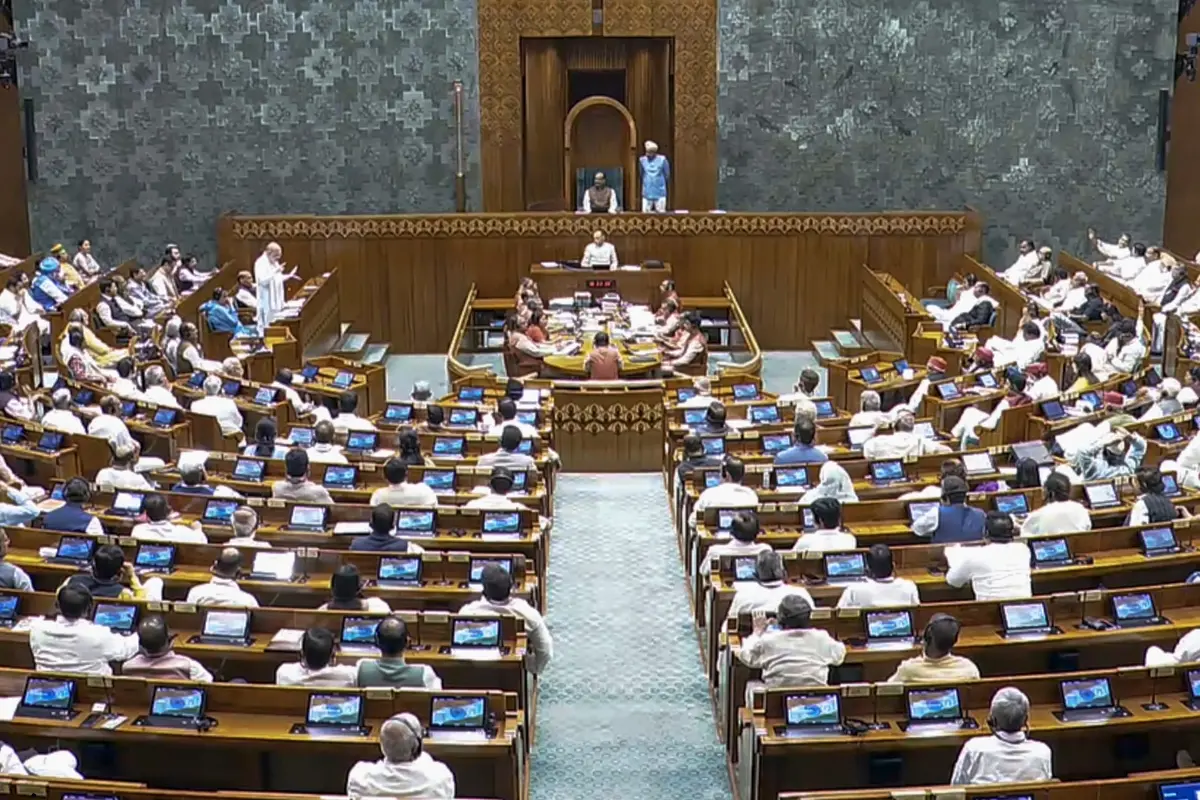
There are moments in politics when an argument does not evolve, but it simply reveals itself. The Prime Minister’s address to the nation at 8:30 PM on Saturday, April 18, 2026, supposedly on women’s representation, is one such moment. What was previously implied by legislative design is now stated explicitly through political messaging. The fusion is complete. Women’s reservation and delimitation are no longer parallel questions; they have been collapsed into a single moral proposition. Support one, or be seen as opposing both. That is not a clarification, but a construction. His speech began with a familiar opening move, a declaration of commitment to women’s empowerment. No serious political actor in India would contest that principle; precisely why it was invoked first. It establishes a deliberately uncontested moral ground, creating a baseline against which all disagreement can then be measured and, well, mischaracterised.
The next step is more consequential. Mr Modi framed the failure of the recent legislative effort as an obstruction, not of a procedural mechanism, but of women’s rights themselves. This is where the argument departs from accuracy and enters strategy. The opposition’s position has been consistent: implement the women’s reservation framework passed in 2023, without tethering it to a future delimitation exercise. That is not a rejection of representation but a rejection of sequencing. But sequencing is difficult to communicate, and intent is not. By recasting a disagreement over “when and how” into a question of “whether,” the speech achieved a crucial simplification. It transformed a conditional argument into an apparent contradiction. In doing so, it placed the opposition in a structurally weaker communicative position. Nuance must now compete with accusation.
His speech then pivoted, subtly but decisively, to the question of numbers. Delimitation was presented as an inevitability, as an exercise in democratic correction, grounded in the principle of equal representation. One person, one vote. That’s an elegant formulation, and like all elegant formulations, it conceals as much as it reveals. Because delimitation, in this context, is not merely arithmetic, but it is a redistribution. Population-based seat allocation does not operate in a vacuum; it operates within a federation of unequal demographic trajectories. States that have stabilised population growth through sustained investment in health and education face the prospect of diminished representation. States with higher population growth stand to gain proportionally greater political weight. And that would not be an incidental outcome; that would be the outcome. And to present that as neutral is to mistake the language of democracy for its mechanics. Representation in a federal system is as much about individuals as it is about units. States are not just containers of population. They are political entities with distinct developmental histories and policy choices. To privilege population above all else is to privilege one vision of the Union over another. That choice may be defensible, but it is not neutral.
And Mr Modi’s speech did not engage with this tension. Instead, it returned to the moral frame, reiterating that those who resisted the legislative formulation have, in effect, resisted women’s participation in governance. This was the final consolidation of the argument, with the technical getting absorbed into the ethical, the procedural becoming the moral, and dissent becoming suspect. None of this was surprising, as it followed a trajectory already visible when the legislation was first structured to link reservation to a future delimitation exercise. What did change was not the logic, but its articulation. The argument had moved from the fine print to the foreground.
There is also a forward strategy embedded in this moment. Having failed to secure passage in its earlier form, the government now has multiple pathways. It can introduce a standalone reservation measure, decoupled from delimitation, thereby appropriating the opposition’s stated demand while retaining the larger project for later reintroduction. It can defer the exercise while continuing to build a narrative of inevitability around it. Or it can take the argument directly to the electorate, framed in its simplest form: a government that sought to expand women’s representation, and an opposition that stood in the way. The speech suggests that the third path is already underway.
What remains conspicuously absent, across both sides of the debate, is a serious engagement with alternatives. If population alone cannot determine representation, what should? Economic contribution, human development indicators, or fiscal equity? Each offers a partial answer, and each introduces its own distortions. There is no perfect metric, but the absence of a perfect metric does not justify the uncritical acceptance of a consequential one. The point is not to reject numbers; it is to interrogate them. To ask what they prioritise, what they ignore, and who benefits from their application. Numbers do not end arguments, but they do structure them.
The Prime Minister’s speech does not resolve the debate over delimitation and women’s representation. It, in fact, sharpens it. Bringing the underlying political logic into the open makes the stakes harder to obscure. The question is no longer whether women should have greater representation. That question was settled long ago. The question now is whether that representation should be contingent on a reordering of political power whose consequences are presented as technical, but are, in fact, deeply political. The earlier comfort in numbers is gone. And what remains is their use.
(The author is a National Award winner for Best Narration and an independent political analyst. Views expressed are personal.)