SPECIALSChina's C919 takes off beyond its borders; What does this mean for India?
For decades, anyone boarding a commercial flight anywhere in the world has most likely travelled on an aircraft made by either Boeing or Airbus. These two companies have dominated the global passenger aircraft market for years, supplying thousands of aircraft to airlines across continents. Now, China has taken another step towards changing that story.
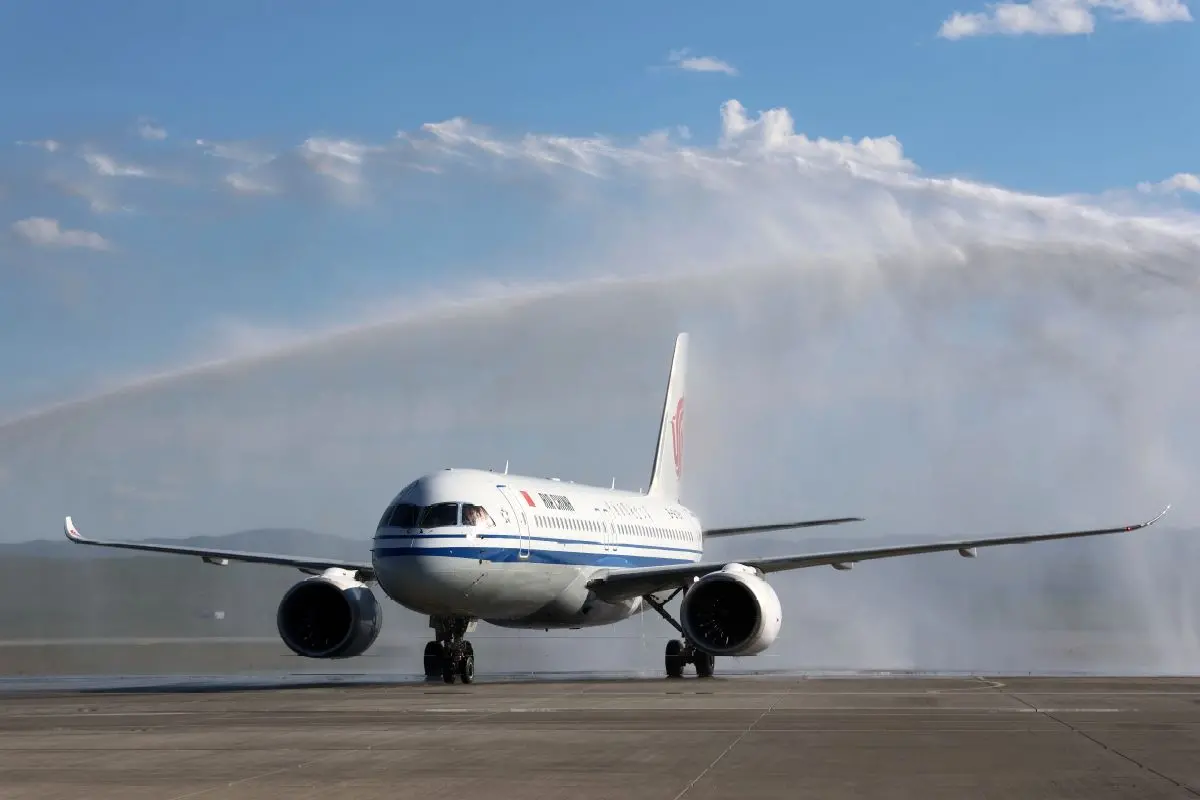
On August 12, China's homegrown COMAC C919 completed its first scheduled international commercial passenger flight, flying from Beijing to Ulaanbaatar in Mongolia. While the two-hour journey may seem ordinary, it marks an important moment for China's aviation industry and its long-term ambition to become a serious competitor to Boeing and Airbus.
The flight is more than a new international route. It is a symbol of China's determination to build its own large passenger aircraft industry from the ground up.
A milestone year in the making
The aircraft was operated by Air China, departing Beijing Capital International Airport and landing safely in Mongolia's capital, where it received a traditional water salute. The Beijing-Ulaanbaatar service will now operate every day, making it the first regular international route served by the C919 since the aircraft entered commercial service in 2023. Until now, the C919 had flown only on domestic routes within China.
Also Read: COMAC’s global push signals a new chapter in commercial aviation
Crossing an international border on a scheduled passenger service is therefore an important milestone because it demonstrates that the aircraft has met the operational requirements needed for regular commercial flights between China and Mongolia.
What exactly is the C919?
The C919 is a single-aisle passenger aircraft built by the Commercial Aircraft Corporation of China (COMAC), a state-owned aerospace company created to reduce China's dependence on foreign aircraft manufacturers.
It belongs to the same aircraft category as the Boeing 737 MAX and Airbus A320neo -- the workhorses of global aviation. These aircraft typically carry between 150 and 180 passengers and operate short- and medium-haul routes, making them the backbone of airlines around the world.
The C919 can accommodate up to 174 passengers, placing it directly in competition with its Western rivals.
Why is this important for China?
Building a passenger aircraft is one of the most difficult engineering challenges in the world.
Unlike manufacturing cars or trains, a commercial aircraft combines millions of parts, complex software, advanced materials, powerful engines and strict safety standards.
Only a handful of companies have successfully mastered this process. China recognised that relying entirely on imported aircraft would leave one of the world's fastest-growing aviation markets dependent on foreign manufacturers.
That led Beijing to invest heavily in COMAC as part of its broader strategy to strengthen domestic manufacturing and high-technology industries.
The goal was not simply to build an aircraft but to build an entire aviation ecosystem.
How China built its own aircraft programme
China's approach has been different from many other countries. Instead of expecting private companies to lead the project alone, the government provided long-term financial backing while bringing together state-owned enterprises, research institutions and domestic suppliers.
Engineers worked alongside global suppliers to develop systems ranging from avionics to aircraft structures. Over time, China used its enormous domestic aviation market to give COMAC an initial customer base.
Also Read: China’s giant flying taxi? 10-passenger ‘Matrix’ eVTOL gives a glimpse of the future
Major Chinese airlines including Air China, China Eastern Airlines and China Southern Airlines became early operators of the aircraft, helping the manufacturer gain real-world operational experience.
This strategy gave COMAC something many new aircraft manufacturers struggle to achieve: guaranteed early customers.
Can it really rival Boeing and Airbus?
The answer is both yes and not yet. On paper, the C919 competes directly with Boeing's 737 MAX and Airbus' A320neo. In reality, Boeing and Airbus still remain far ahead in almost every major area. One of the biggest differences is production.
By the end of 2025, COMAC had delivered only about 32 C919 aircraft, with another handful added during 2026. During the same period, Airbus delivered roughly 100 narrow-body aircraft to China alone in a single year. The gap is enormous.
Even though COMAC has built a large order book, mostly from Chinese airlines and leasing companies, turning those orders into delivered aircraft remains a much bigger challenge.
The engine is still foreign
One surprising fact about China's "homegrown" aircraft is that some of its most important components still come from overseas. The C919 is powered by CFM International LEAP engines, built by a joint venture between GE Aerospace in the United States and Safran Aircraft Engines in France.
Several other critical aircraft systems also rely on international suppliers. This means COMAC cannot yet claim complete technological independence. Industry analysts say reducing reliance on foreign components remains one of the company's biggest long-term challenges.
Winning trust is about more than building aircraft
Manufacturing an aircraft is only half the battle. Airlines also need confidence that the manufacturer can keep those aircraft flying every day. That means providing spare parts, maintenance support, software updates and technical assistance around the clock.
This global support network is one of Boeing's and Airbus' greatest strengths. Their aircraft are backed by decades of maintenance experience, worldwide service centres and established supply chains. COMAC still has to build that same level of global confidence.
As aviation experts often point out, passengers rarely think about the manufacturer until something goes wrong but airlines think about reliability every single day.
Why production is so difficult
Aircraft manufacturing depends on thousands of specialised suppliers. A shortage of something as small as a fastener can delay an entire aircraft delivery. Industry experts often say that building an aircraft requires every single part to arrive on time.
Engines, fuselage sections, electronic systems, forged metal components and even tiny connectors must all come together perfectly. For COMAC, expanding production while maintaining quality will be one of the biggest tests over the next few years.
The company hopes to significantly increase annual production before the end of the decade, but analysts believe reaching those targets will require major improvements across the supply chain.
The next chapter has already begun
Even as the C919 enters international service, COMAC is continuing to develop new versions of the aircraft. Recently, the company completed the maiden flight of a high-altitude C919 variant, designed to operate in more challenging environments such as Tibet.
The new version can carry between 140 and 160 passengers and is being developed with Tibet Airlines, showing that COMAC is already expanding its product family.
What does this mean for India?
For India, the C919's journey offers an interesting lesson rather than an immediate competitive threat. India has become one of the world's fastest-growing aviation markets, with airlines placing record-breaking aircraft orders from Boeing and Airbus.
However, India still does not have its own large commercial passenger aircraft programme comparable to the C919. China's experience shows that building such an industry requires years of investment, not only in aircraft manufacturing, but also in engines, components, certification systems, skilled engineers and maintenance infrastructure.
It also highlights the importance of creating a complete aviation ecosystem instead of focusing only on assembling aircraft.
A long runway ahead
The C919's first international commercial flight will not suddenly change the balance of global aviation. Boeing and Airbus continue to dominate aircraft deliveries, production capacity and worldwide customer support. Yet China's achievement should not be underestimated.
Building a modern passenger aircraft capable of carrying hundreds of people safely is something only a handful of countries have managed.
The C919's flight from Beijing to Ulaanbaatar is therefore more than another international service. It is a statement of intent.
China has shown that it can design, build and operate a modern passenger aircraft. The next challenge is proving that it can produce it at scale, support it worldwide and earn the confidence of airlines beyond its own borders.
That journey may take years, but with every take-off, COMAC moves one step closer to becoming a name that travellers around the world may hear alongside Boeing and Airbus.