Can India afford to wait for its homegrown stealth fighter?
India’s air force is at a crossroads. With neighbours China and Pakistan racing ahead to bolster their air forces with advanced stealth fighter jets, India’s current fleet of 4.5-generation warplanes -- like the French Rafale and Russian Su-30MKI -- risks falling behind.
The government’s plan to build the Advanced Medium Combat Aircraft (AMCA), India’s first homegrown stealth fighter, is a bold leap toward self-reliance under ‘Make in India’ and ‘Atmanirbhar Bharat’. But with production not expected until 2034, can India wait that long? Or does it need a quicker solution to keep its skies safe?
Growing threat across the border
China, India’s northern neighbor, is rapidly expanding its air power. It operates two fifth-generation stealth fighters: the Chengdu J-20 and the Shenyang J-35. The J-20, nicknamed the ‘Mighty Dragon’, is a single-seat, twin-engine jet designed for air superiority and precision strikes. It boasts advanced stealth to evade radar, cutting-edge sensors for detecting enemies, and the ability to engage targets from long distances.
China already has around 300 J-20s and is adding 60–100 annually, aiming for 1,000 by 2030. The J-35, unveiled in November 2024, is a lighter, multirole stealth fighter, ideal for both air combat and ground attacks. Its introduction made China the second country after the US (with its F-35 and F-22 Raptor) to field two fifth-generation jets.
Meanwhile, Pakistan, India’s western rival, is reportedly close to buying China’s J-35 at a steep discount. It’s also gaining expertise by sending 200 personnel to assist Turkey’s KAAN stealth fighter project, set for production by 2028. These developments shift the regional power balance, especially after the 2025 India-Pakistan conflict exposed how fast threats can escalate.
What makes a fighter fifth-generation?
So, what does “fifth-generation” mean? Unlike older jets, fifth-generation fighters combine several game-changing features:
- Stealth: Their design and materials make them nearly invisible to radar, allowing them to strike without being detected.
- Advanced Sensors: They use sensor fusion, where radar, infrared, and other systems work together to give pilots a complete battlefield picture.
- Network Warfare: These jets share real-time data with other forces, enhancing coordination.
- Supercruise: They can fly at supersonic speeds without burning extra fuel, unlike older jets.
- Beyond-Visual-Range Combat: They can engage enemies from far away, reducing exposure to danger.
These capabilities make fifth-generation jets like the J-20 and J-35 far superior to India’s current 4.5-generation fleet, which, despite upgrades, struggles against modern air defenses and stealth technology.
Why India can’t wait
The AMCA is India’s answer to this challenge. The government recently allowed private companies to join the project, boosting innovation. But the timeline – serial production starting in 2034 – leaves a dangerous gap.
Aviation expert Harpreet Sidhu told Sputnik that over the next decade, China’s J-20 and J-35 deployments in Tibet and Xinjiang will give it a clear edge in contested airspace. If Pakistan acquires J-35s, its air force could leapfrog India’s capabilities, upsetting the regional balance.
The 2025 conflict showed that air superiority is critical in modern warfare. Stealth jets can evade defenses and launch precision strikes, while older jets are vulnerable to advanced systems. India’s current fleet can’t fully counter these threats. Waiting for the AMCA risks leaving India exposed in a region where technological superiority is everything.
A stopgap solution: The Su-57
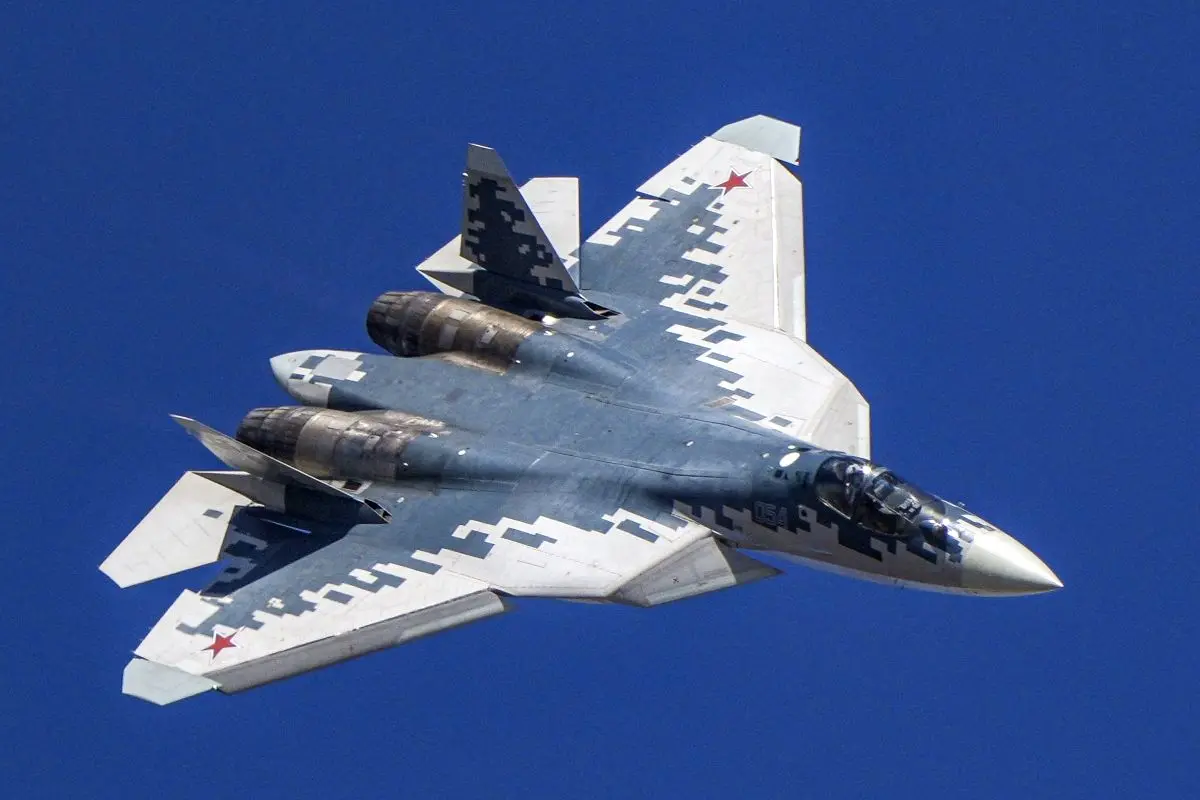
Many experts urge India to buy a fifth-generation fighter now to bridge the gap. Russia’s Sukhoi Su-57 is a strong contender. This twin-engine stealth jet offers advanced radar, supercruise, and multirole capabilities for air and ground combat. Here’s why it makes sense:
- Technology Transfer: Russia is open to sharing tech, allowing local production and customization, aligning with India’s self-reliance goals.
- Familiarity: The Su-57 shares design roots with India’s Su-30MKIs, easing training, maintenance, and logistics.
- Affordability: It’s likely cheaper than Western options like the F-35, especially with local manufacturing.
- Strategic Freedom: Unlike US deals, which come with restrictive agreements (like End Use Monitoring or COMCASA), Russia offers more autonomy.
But the Su-57 has drawbacks. Its deployment is limited, and its new Izdeliye 30 engine (Saturn AL-51) and full sensor suite are still in development. Russia’s logistical issues in the Ukraine conflict raise concerns about long-term support.
India’s earlier attempt at a joint Su-57-based program, the Fifth Generation Fighter Aircraft (FGFA), collapsed in 2018, highlighting risks that need careful evaluation.
The way forward
The AMCA is India’s long-term dream, but dreams won’t secure the skies today. A stopgap like the Su-57 could maintain deterrence, build expertise, and buy time until the AMCA is ready. The government must act fast – conduct a thorough technical review, negotiate a robust deal with Russia, and perhaps revive a restructured FGFA-like program.
China and Pakistan aren’t slowing down, and India can’t afford to either. By balancing urgency with caution, India can ensure its air force remains a powerful shield in an increasingly tense neighbourhood.
The author is a Defence, Aerospace & Geopolitical Analyst.