From Ivory Coast to literary fame: Gauz’s inspiring story
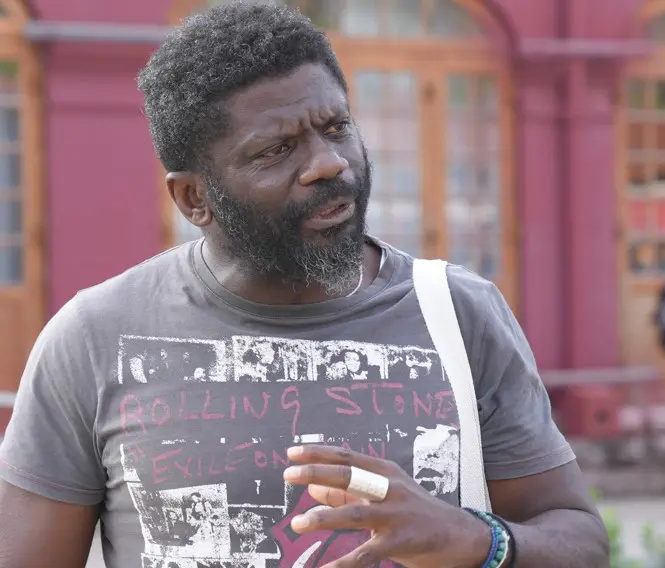
Gauz is the pen name of Ivorian-born Patrick Armand-Gbaka Brede. Côte d'Ivoire or Ivory Coast, a small West African nation, may not have a highly developed literary scene, but from this very place, 53-year-old writer Armand Gauz has shown the world that a man from a very poor country, marginalised in many ways, can rise to success through sheer grit and determination. Gauz’s debut novel, Standing Heavy, originally published in 2014, was later translated into English and went on to be shortlisted for the prestigious International Booker Prize in 2023. The satirical mode is one of Gauz’s greatest strengths. Beyond writing he takes on multiple roles as a photographer, screenwriter, and actor. For a brief period, he also served as the editor of a political magazine.
In an exclusive conversation with Mathrubhumi English, Gauz talks about his journey as a writer, the hurdles he faced, and how he managed to keep his head held high despite the challenges.
What inspired you to launch the satirical newspaper Newseco, and what ultimately led to its closure?
Newseco was a monthly satirical economic newspaper that my friend and I started after the end of the civil war in Ivory Coast. We wanted to shed light on the economy and the inequalities in a way that was both thought-provoking and entertaining. Our idea was to bring to light how power and economy often dictate the narrative -- take Donald Trump, for instance, leading one of the world’s strongest economies while being a figure of controversy. But power is with him. African nations struggle under the weight of huge debts.
We began with a small team of six people, and as a photographer, I ensured the paper featured stunning visuals that resonated with our readers. People truly appreciated it -- many even kept copies for future reference. But sadly,, after three years, due to lack of funds we were forced to shut it down. Despite the love it received, keeping it afloat without sufficient funds became impossible.
Can you talk about your early life and education? What led you to embark on your journey as a writer?
I was born in Côte d'Ivoire, where my father was a teacher. After my schooling, at 27, I received a scholarship to visit Canada. However, fate had other plans -- I fell in love with a beautiful French woman and decided to follow her to France in 1999. I ended up staying in France for 11 years, during which time I had two children and completed my biochemistry studies. However, I realised that working in the scientific field wasn’t for me.
Instead, I found my own path, taking on various jobs to make a living -- gardening, working as an analyst, and doing other small gigs. I also worked as a documentary critic and provided desk support before returning to Côte d'Ivoire.
Can you share your experience working as a security guard in France? How did that role shape your observations in Standing Heavy, the satirical novel?
Things went wrong between my wife and me, and I decided to return to my home country, Côte d'Ivoire. It was during that time that the civil war broke out, and I felt a strong desire to be part of history. To leave France and to buy a plane ticket, I needed a quick job. The best option for a man like me was becoming a security guard -- if you’re dark-skinned, you can get the job almost instantly, sometimes within an hour. The only qualification required was your skin colour.
I worked as a security guard for six weeks, and I have to admit, it was an incredibly boring job. But the one advantage was the plenty of time -- time to think, to observe. I made the most of that time, studying people and their behaviours. Six months later, my debut novel, Standing Heavy, was born.
What was the central theme of your first book Standing Heavy? Did it capture everything a security guard observes on the job?
Standing Heavy is a novel about security guards, spanning three timelines and following three generations of Ivorian immigrants in Paris. It draws heavily from my personal experiences, exploring why Ivorian immigrants were often sought after for security jobs in the city. Through the eyes of these "men in black," the book paints a picture of Paris as seen from their perspective.
I wrote about my time as a security guard and how I observed fellow immigrants being hired for menial jobs. The novel also has a strong satire, filled with moments of silly humor. One of my favorite passages features a security guard thinking who comes up with names for new dresses and perfumes—eventually concluding that capitalism must have designated official “namers” for this very purpose. The book is divided into two parts, each offering a different perspective on the world of security work.
How did you feel when you learned that your book was translated into Malayalam and found an audience in Kerala?
I felt so proud when, out of the blue, a publisher called me one day and said my book would be translated into Malayalam, an Indian language I had never even heard of at the time. Surprised, I jokingly asked, Malayalam? Really? I immediately started researching the language and the place. I learned that Kerala is a state with a strong communist history, it made the news even more exciting for me. The translation was completed in 2024, and now, I’m planning to spend a month in India to know about the culture and understand my new readers better. I’m looking forward to meet both my publisher and translator in person so I can thank them for bringing my words to an entirely new audience.
How would you describe the literary scene in Côte d'Ivoire? Do you have a strong readership there?
The audience for literature in Côte d'Ivoire is quite small. Unfortunately, reading is often seen as too complex for many people, which is a real shame. Education levels vary, and this impacts literary engagement. However, as writers, part of our mission is to encourage more people to read and write, making literature more accessible.
What future books are in the pipeline? What stories are you working on next?
I consider myself a prolific writer with countless ideas constantly running through my mind. While in Kerala, I plan to finish two books. For me, the challenge isn’t generating book ideas -- it’s finding the right publisher. One of my upcoming works is a photography book exploring the concept of aging in Africa. Through a combination of photographs and text, I reflect on what it means to grow old, drawing inspiration from my own bond with my grandmother, who was like a mentor to me. The book features encounters with elderly people in Côte d'Ivoire and has the feel of a coffee table book, blending visuals with storytelling.
The other project is a novel about twin sisters -- one completely white, the other entirely black -- who come together to save the world from catastrophe. It’s an ambitious story, and I’m excited to bring it to life.