'What does God look like?’
‘What does God look like to a man who has seen more of the earth than almost anyone else?’ For Santhosh George Kulangara, the answer to this is not found in the frescoes of ancient cathedrals or printed calendars of deities.
"God is not a figure with a long beard and hair painted on church walls or depicted in Sivakasi prints," he told a packed audience at the 7th edition of the Mathrubhumi International Festival of Letters (MBIFL) in Thiruvananthapuram. "To me, God is the Universe. The positive energy of the people sitting here -- that is God," he declared.
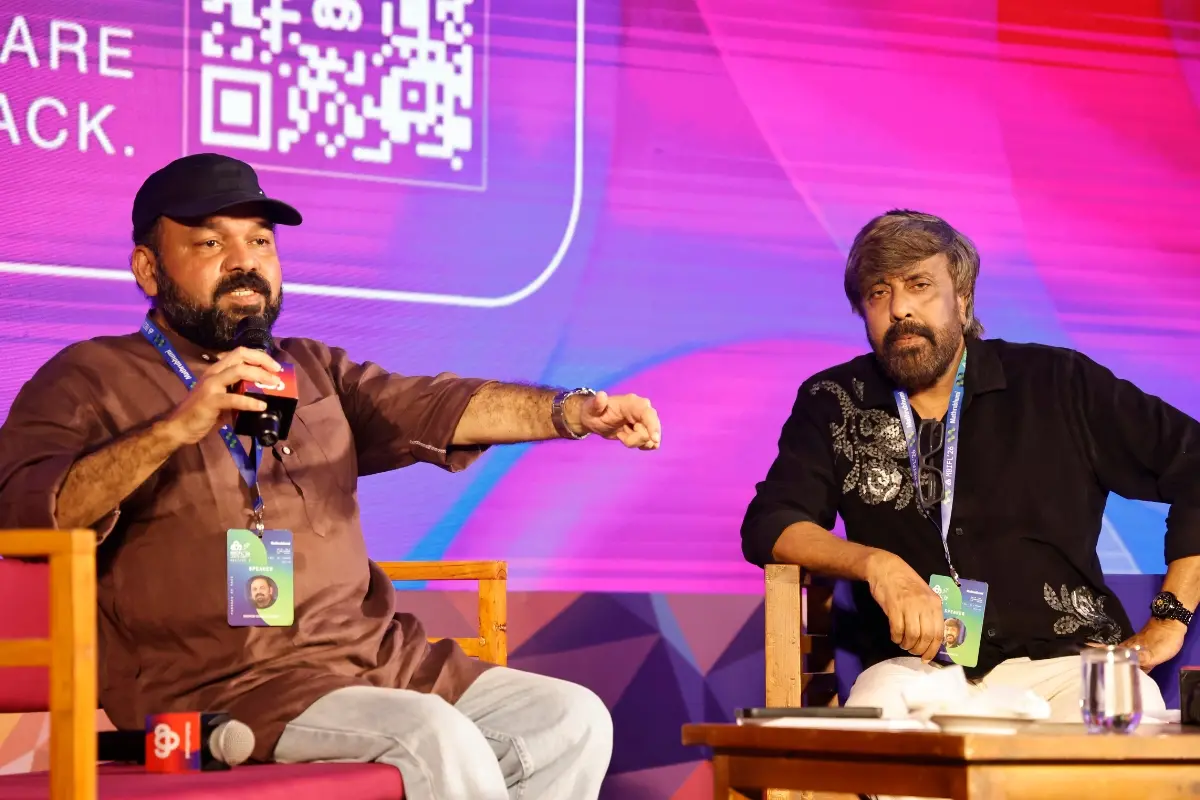
Taking part in a session titled 'Charithram Enniloode', moderated by legendary traveler and media entrepreneur Abraham Mathew, the author-traveller dismantled the conventional image of a celebrity explorer, revealing instead a solitary philosopher who prefers the shadows to the spotlight.
For a man whose face is recognized in every Malayali household, Santhosh's confession about his travel habits came as a surprise. He is not the traveler who seeks to conquer or announce his arrival. "I love to be alone. Even at airports, I find a corner where no one is likely to come, just to sit and think or read," he admitted.
He views travel not as a hunt for selfies or autographs, which he dismisses as ultimately useless, but as a deep research project into the human condition. He likened his approach to the title of MT Vasudevan Nair’s 'Alkoottathil Thaniye' (alone in the crowd), preferring to observe the world rather than intrude upon it.
The conversation naturally drifted from the spiritual to the political, a realm where Santhosh is often branded as ‘apolitical’ by critics. He met this accusation with characteristic sharpness, redefining the very concept of political engagement.
"If I say I disagree with the ideas of the parties currently ruling or not ruling, it does not mean I am apolitical. It means I dream of better politics," he asserted. His vision of politics is one where the system creates circumstances that make a citizen feel proud, respected, and loved by their nation, rather than remaining stuck in the ideologies of 1947.
Addressing the anxieties of modern Kerala, particularly the mass migration of youth, he offered a grounded perspective. He noted that the streets of his native Marangattupilly are emptying of young people, who are now building lives in the UK, Germany, and Canada.
While he doesn't foresee an immediate reverse migration, he believes the pull of the homeland remains inevitable for the older generation who dream of returning to their roots in their twilight years.
Yet, despite having traversed the globe and witnessed the grandeur of foreign cities, Santhosh’s anchor remains surprisingly local. When asked to name the best place he has ever seen, he didn't name a European capital or an exotic island. "It is Marangattupilly," he said without hesitation. He argued that with a satellite above his head and ideas in his mind, he could reach the world just as effectively from his village as from a metropolis.
The session also peeled back the layers of his professional success with Safari TV, a channel that defied industry logic by surviving without commercials. He hinted, however, that the medium itself is facing an existential crisis.
"Television is running its final lap," he observed, predicting a complete shift to mobile screens and Artificial Intelligence, where future content might not even require a camera crew to travel, but could be synthesized from existing global footage.
Behind the calm demeanor of the traveler lies a perfectionist who battles bouts of "depression" when reality falls short of his vision. He confessed to getting angry when his team fails to meet the rigorous standards he sets, a discipline perhaps inherited from a strict father who once believed in corporal punishment but later evolved to support his son’s unconventional path into mass communication when traditional academics failed him.
As the discussion wound down, Santhosh left the audience with a profound reflection on his own identity. He doesn't see himself as a separate entity, but rather as a reflection of the people who watch him. "I live as a thought of my audience," he concluded, adding, "My responsibility is to make them think beyond where they are today."