The Dawn in Jantar Mantar
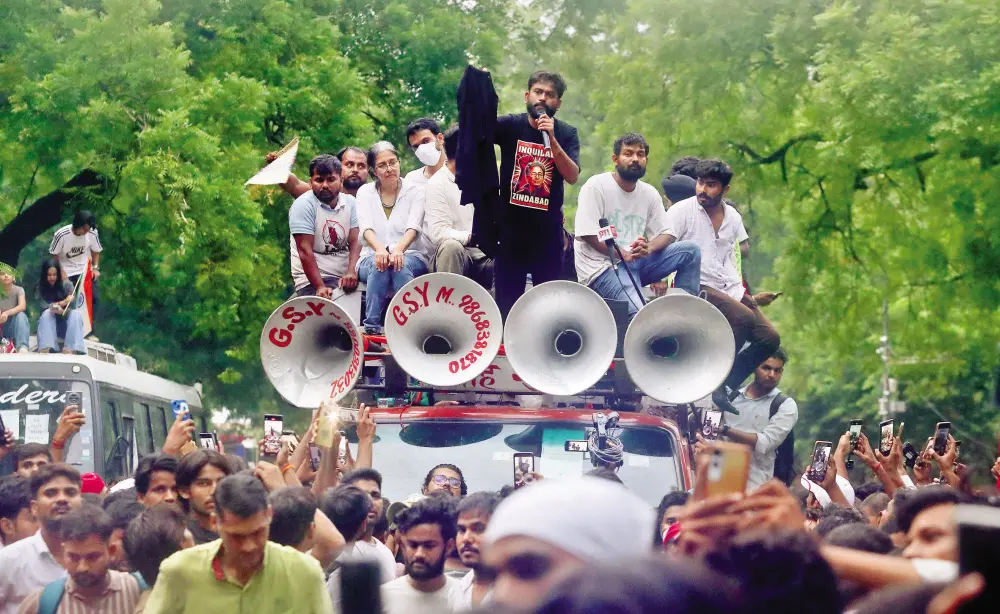
Bliss was it to be alive in that dawn
And to be young was pure heaven
William Wordsworth penned these immortal lines to convey the hope, exhilaration and excitement unleashed by the French Revolution. Since then, they have resonated across history at every moment of profound transformation, serving as an “everlasting anthem for radical hope and youthful rebellion”.
Rarely have such moments been witnessed in independent India's history. What unfolded at Jantar Mantar this July was one of them. Wordsworth himself was disillusioned later with the extreme violence, reign of terror and bloodshed that followed the revolution. Nevertheless, that the “dawn” symbolised a monumental new political and social rebirth in human history is undeniable. Indian youth’s July Revolution also may or may not prove a false dawn later. Yet, undeniable is the spark it ignited in a nation that had long appeared entrapped in an atmosphere of fear, hatred and communal hegemony.
The Jantar Mantar of July 2026 has entered the pantheon of those recent historic moments that witnessed the young rising to dare the might of a monstrous establishment. Almost every decade since the 1960s has seen students and other young people rise in revolt in different countries against authoritarianism and injustice, demanding democracy, civil rights and dignity. Recall Atlanta 1960, Paris 1968, Bihar 1974, Assam 1979, Beijing 1989, Tunisia and Cairo 2011, New York 2011, Hong Kong 2014, Bangladesh 2022, and Nepal 2025.
To this author, the most reassuring takeaway from the Jantar Mantar uprising is this: the devious exploitation of religion may not work forever, particularly with India’s young generation. At first glance, this may seem hardly surprising, for the young, throughout history, have repeatedly risen above the narrow walls of religion, caste, language, gender and region. Yet such an opportunity had rarely presented itself in India over the past decade—until now.
As Wordsworth wrote in the same autobiographical poem, the young revolutionaries did not stand alone in that dawn. They were backed by such “mighty and invisible auxiliars” as hope, love and reason, enabling them to break free from all the “forbidding ways of custom, law and statute”. The cockroaches at Jantar Mantar had another mighty auxiliar, too- social media.
There was much more for us elders to learn from the children of Jantar Mantar. They unambiguously proclaimed in July that, for them, the real issues were livelihood, jobs, quality education and a decent future—not sectarian religious frenzy, hatred of other faiths, or the blind worship of false icons that has intoxicated their elders. In doing so, they made us, the elders, recall the true spirit of the idea of India, something many of us seem to have forgotten in recent times: an India that ended two centuries of colonial rule by holding hands and fighting together, rising above the divisions of religion, caste, gender and region.
Gen Z taught us something else too that we forgot to practice in recent times: looking fear in the eye. They boldly called the bluff of a repressive state and its brutal forces, exposed its nefarious ways of surveillance, isolation and othering. They couldn't care less for a criminal state’s machinations to buy them over as it did with Opposition politicians. As the firebrand student leader, Neha Bora, the national president of the AISA who observed fast for 23 days alongside Sonam Wangchuk, wrote, this government has “used fear as a weapon against the Opposition, campuses and communities through arrests, the CBI, ED, surveillance, vilification and force. We looked fear in the eye”.
Arundhati Roy quipped that the cockroaches movement was the progeny of the unholy union of a judge and a joke! The cockroaches and their comrades have proved that humour, satire and even expletives could be the most potent and creative weapons against bigotry. The cockroaches rediscovered with stinging effect, India's long tradition of using humour to poke fun at the ruler, beginning from the days of the Vidushaks and Chakyars to the modern age of cartoonists, satirists and stand-up comedians, who have often been targeted by contemporary governments.
“Power is always ridiculous; and humour is the best way to expose it”, wrote Margaret Atwood. For Orwell, every joke was a tiny revolution. Jantar Mantar proved the true worth of the demographic dividend of one of the world’s oldest civilisations, which is currently one of the youngest nations with more than 65% of its population in the working age group.
Yet, was it only the ruling BJP which lay vanquished at the Jantar Mantar? They are the first, for sure. But there are more. Not just the ruling party but the entire political class was rendered irrelevant by the cockroaches. While the government unleashed violence on them, the Opposition, at best, remained either passive spectators or mere cheerleaders of the historic moment. Some even conspired to steal the thunder from the cockroaches by putting together an alternate show which, however, failed to take off. Perhaps, this made them realise their sheer stupidity in competing with the cockroaches and stood beside them in support. It was fun to see the ardent bhakts of Rahul Gandhi using this too as another opportunity to praise him. For what? For doing nothing!
However, the growing irrelevance of conventional politics is not merely an Indian story. It is as much a universal phenomenon which certainly doesn't augur well for democracy. We can only hope that our political parties learn from the cockroaches to reinvent themselves as early as possible.
Last but not least is the third pillar that lies broken and beaten by the July Revolution. The so-called mainstream media. This was the latest nail in its coffin as it has been losing trust at the fastest pace ever. The loss of legacy media’s relevance is as much self-inflicted as it is the result of the emergence of social media as the primary source for news.
According to the 2026 Reuters Digital News Report published in June, trust in news has fallen to an all-time low - 37% - globally, three points lower than last year. More than half of the respondents get their news from third-party platforms like social media and video networks, although their trust in them is even worse- 22%.
In India, only 38% have confidence in their mainstream media, placing the country eighteenth among 48 markets in the survey. While social media and video platforms have overtaken both TV and news websites in India too, it has among the highest YouTube users globally. India’s AI Chatbox news consumption is about double the global average.
The reasons for the universal phenomenon are many: growing news avoidance, plummeting credibility of most social institutions, competition with social media, which privileged sensationalism over substance, and the massive concentration of ownership that led to corporate capture, etc.
But India’s mainstream media has another reason too for its growing irrelevance. It has fine-tuned a unique form of harakiri: a voluntary capitulation to the state. This marks the emergence of the Godi Media. Except during the Emergency, the media of the world’s largest democracy has never served as the megaphone of the ruling establishment as it does now. It was sheer fear that had made the media crawl when asked to bend during those 21 dark months of Emergency when democracy was eclipsed in the country. Today, it is voluntary service. Never before has India’s mainstream media, which claims to be free and privately owned, happily become not just the lapdogs but the hitmen and women of the central government and also its politics of majoritarianism.
Their worst face was all on display in their coverage or lack of it of the Jantar Mantar agitation. Initially, the media tried to ignore it and when the police violence on the protestors caught global attention through the social media, India's English media began blaming them for crimes such as stone pelting the police.
Imagine a national TV channel which looked the other way when the student agitators were being attacked with pellet guns and nailed lathis, making a teenager tearfully apologise on screen for the Instagram reels she did making fun of the RAF! The most loyal Godi Media Mughal took this to its most comic extreme by discovering mysterious American and Chinese hands behind the Cockroach Spring. His evidence? 1. An American Consulate advisory which was put out on the Cockroach march in Delhi. 2. A CPI(M) delegation’s visit to the Chinese Embassy of Delhi. No wonder the cockroaches chased some of the Godi Media goons out of Jantar Mantar. Like in the case of political parties, it will not just be at its own peril, but democracy’s too, if the media doesn't reinvent itself. Thanks to its legacy of the renaissance, the Kerala media has proudly proved a glorious exception to this national trend.
New Delhi’s Jantar Mantar, is an observatory built by Jaipur’s Sawai Jai Singh II in 1723. Its purpose was to astronomically predict the times and movements of the Sun, Moon, and other planets. Only time will tell whether the historic moments that Jantar Mantar witnessed will be predictive of the way our nation moves in the coming days.