OPINIONThe curious case of 'The Gaumutra expert'
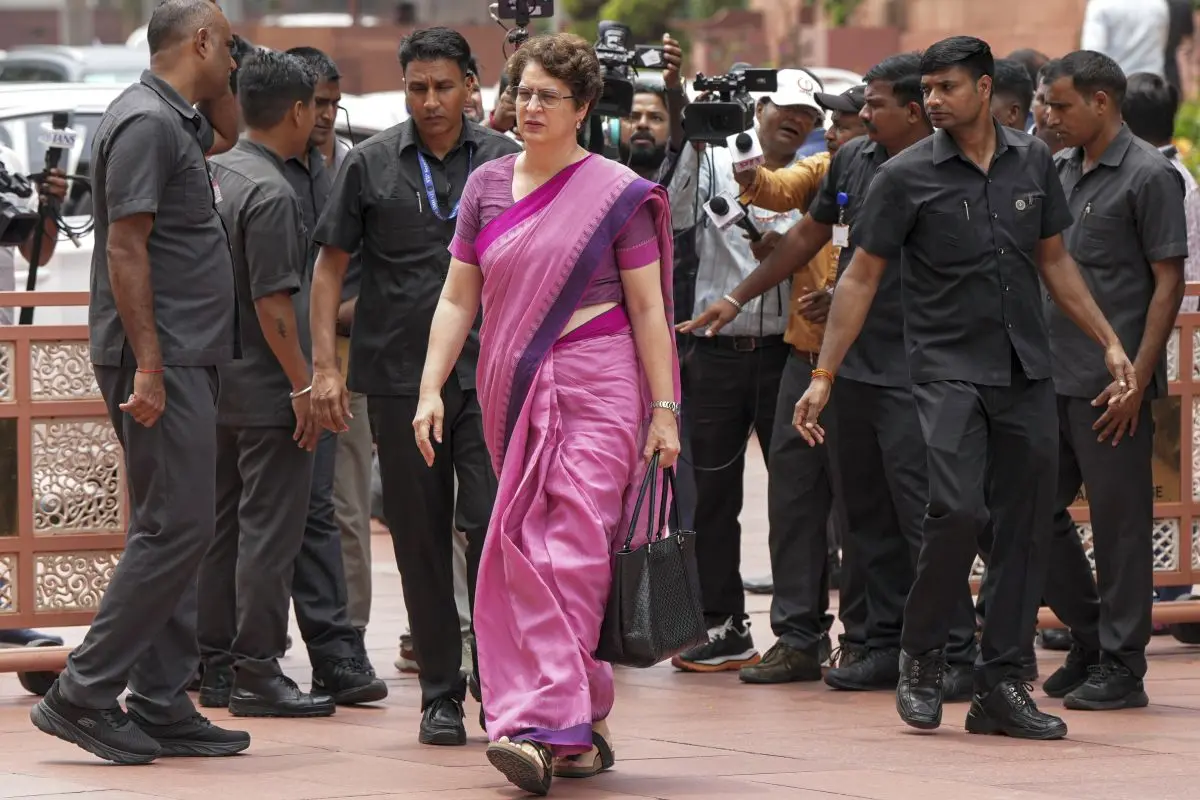
There is something peculiarly revealing about the latest controversy over the now-infamous "gaumutra expert." Member of Parliament from Wayanad, Priyanka Gandhi never identified anyone by name. Yet, within minutes of her remark in Parliament, an astonishing number of ministers, party spokespersons, television panellists and right-wing social media warriors seemed to know precisely who she had meant.
Scotland Yard has spent decades searching for criminals with less enthusiasm than the ruling ecosystem has displayed in identifying unnamed individuals. If nothing else, it was an extraordinary demonstration of collective intuition. And once the identity had been enthusiastically supplied by her critics themselves, the operation shifted into its second, more familiar phase.
Also Read: The slow death of scientific temper
The discussion has ceased to be about whether the public promotion of medically unsupported claims by the head of one of India's premier scientific institutions was appropriate. Instead, it has become an elaborate exercise in advertising his academic credentials while simultaneously ridiculing Priyanka Gandhi's educational qualifications.
The argument, apparently, is that degrees constitute scientific evidence. It is an odd line of attack. Priyanka Gandhi possesses perfectly legitimate academic qualifications, and the same cannot always be said of everyone occupying high political office in contemporary India, where questions about mysterious degrees, inaccessible university records, and even an unheard-of discipline and its “entirety” continue to linger in public memory.
One might have expected a little caution before transforming academic credentials into a political weapon. But intellectual consistency has never been an abundant natural resource in ecosystems where ad hominem attacks routinely substitute for reasoned argument.
The truly interesting question disappeared beneath the noise almost as soon as it was asked. It was never whether the individual concerned is academically accomplished. By all accounts, he is.
The real question is whether occupying one of the highest scientific offices in the country entitles anyone to publicly legitimise claims that have not survived even the ordinary tests of scientific evidence. Those are entirely different propositions. While the first deserves admiration, the second demands scrutiny. That scrutiny became even more necessary when Sudhanshu Trivedi rose in Parliament armed with American patent numbers, presenting them almost as though they constituted divine certification of the medicinal virtues of cow urine. The performance was enthusiastic. It was also profoundly misleading.
A patent does not establish scientific truth. It merely recognises a claim that satisfies legal standards relating to novelty and utility. More importantly, the patents repeatedly cited in these debates do not declare cow urine to be an antibacterial or antifungal medicine. They concern formulations in which distilled cow urine is claimed to enhance the activity of certain compounds.
Whether those claims withstand rigorous clinical evaluation is an entirely different matter. Confusing a patent with scientific consensus is rather like confusing the registration of a company with proof that it has ever made a profit. One suspects that many celebrating these patents have never actually read them. Reading, after all, has become something of an endangered activity in an age where screenshots enjoy greater authority than scientific journals.
Ordinarily, such claims would not deserve sustained attention. Every society has its enthusiasts who believe they have discovered perpetual motion, miraculous cures or messages hidden in sacred texts. Liberal democracies survive because they permit harmless eccentricity.
Also Read: Who really won the exam protest?
The difficulty begins when those advancing such claims occupy positions whose authority derives entirely from science. When the Director of IIT Madras publicly lends credibility to medically unsupported claims or when the Chairman of ISRO confidently suggests that modern scientific knowledge merely rediscovers what ancient India had already mastered, they are not speaking merely as private citizens exercising personal faith. Scientists are perfectly entitled to private beliefs. The moment they invoke the prestige of the institutions they head to legitimise claims unsupported by evidence, those beliefs cease to be private. They become public interventions carrying the imprimatur of the Republic itself.
Science is gloriously indifferent to nationalism, and there is no patriotic exemption from peer review. Yet contemporary India increasingly appears determined to negotiate with evidence itself. This tendency acquired official respectability when mythology began receiving treatment usually reserved for scientific literature.
We have been told that Karna's birth demonstrates ancient genetic engineering, and that Lord Ganesha has become retrospective evidence of plastic surgery (not even a head transplant!) Ancient India apparently possessed aircraft, advanced reproductive technologies, sophisticated nuclear weapons and, given sufficient time, may yet be credited with inventing quantum computing, artificial intelligence and perhaps the internet itself, though mercifully not social media.
The inevitable defence invokes the Sushruta Samhita. Sushruta unquestionably occupies a distinguished place in the history of medicine. His surgical observations were remarkable for their time and deserve admiration precisely because they represented genuine inquiry rather than inherited dogma. But mere historical importance is not scientific validation.
Every ancient medical tradition, whether Indian, Greek, Chinese or Arabic, combined profound insight with spectacular error. Medicine advanced because later generations retained what worked and discarded what did not. Nobody proposes treating coronary artery disease exclusively with Hippocrates. Yet in India, every demand for evidence somehow ends with someone producing a two-thousand-year-old manuscript as though antiquity itself were a substitute for clinical trials.
Nearly a century ago, in 1926, in his travel book, Jesting Pilate: An Intellectual Holiday, Aldous Huxley recognised this curious national habit. With characteristic irony, he observed that one repeatedly encountered the assertion that virtually every modern discovery had already been anticipated by the ancient Hindus. His satire was not directed against Indian civilisation, but against a civilisation insufficiently confident to celebrate its genuine achievements without inventing imaginary ones.
He said, 'In the course of the last thirty or forty years a huge pseudo-historical literature has sprung up in India, the melancholy product of a subject people’s inferiority complex. Industrious and intelligent men have wasted their time and their abilities in trying to prove that the ancient Hindus were superior to every other people in every activity of life. Thus, each time the West has announced a new scientific discovery, misguided scholars have ransacked Sanskrit literature to find a phrase that might be interpreted as a Hindu anticipation of it.'
He goes on to say, 'A sentence of a dozen words, obscure even to the most accomplished Sanskrit scholars, is triumphantly quoted to prove that the ancient Hindus were familiar with the chemical constitution of water. Another, no less brief, is held up as the proof that they anticipated Pasteur in the discovery of the microbic origin of disease. A passage from the mythological poem of the Mahabharata proves that they had invented the Zeppelin.'
The sad part is that what Huxley regarded as an amusing eccentricity he encountered during his travels in India in 1925 has, in twenty-first-century India, acquired the status of public policy.
Perhaps no episode better illustrates this than the extraordinary spectacle of September 1995, when millions believed that Ganesha idols were drinking milk. Queues formed outside temples across the country. Television channels breathlessly documented the miracle. Physicists demonstrated within hours that ordinary capillary action and surface tension explained the phenomenon completely. The explanation was elegant, repeatable and experimentally verifiable, but it scarcely mattered. Belief had become entirely independent of evidence. And that, ultimately, is the danger before us.
Also Read: The new burden of being a public figure
It is not that individuals believe improbable things. Every free society accommodates eccentric beliefs. The danger arises when institutions established to defend rational inquiry begin legitimising those beliefs themselves. Once scientific authority abandons scientific standards, superstition acquires official sponsorship.
Article 51A(h) of our Constitution imposes upon every citizen the duty to develop scientific temper, humanism and the spirit of inquiry and reform. Those words reflect an understanding that democracy depends upon citizens capable of distinguishing evidence from assertion, scholarship from sentiment and science from mythology.
India does not diminish itself by acknowledging that our ancestors, brilliant though many of them were, did not discover everything. In fact, it diminishes itself by pretending that they did. The true heirs of Aryabhata, Sushruta, Panini and Raman are not those desperately searching ancient scriptures for antibiotics or genetics. They are the scientists quietly working in laboratories today, submitting hypotheses to experiment, accepting failure with humility and allowing evidence, rather than ideology, to determine what is true.
A civilisation secure in its greatness does not need to manufacture miracles. It produces discoveries instead. That, once upon a time, was precisely India's greatest strength, and it would be a profound tragedy if we surrendered it in exchange for the comforting fantasy that we had already invented everything worth discovering, and surrendered ourselves to pseudoscientific nonsense.
Pseudoscience deserves neither reverence nor accommodation. It deserves exactly what science has always reserved for unsupported claims: scepticism, scrutiny and, when they collapse under evidence, ridicule.
The author is a National Award winner for Best Narration and an independent political analyst. Views expressed are personal.