OPINIONDefiance in Bengal, suspense in Tamil Nadu, Shakespeare in Kerala
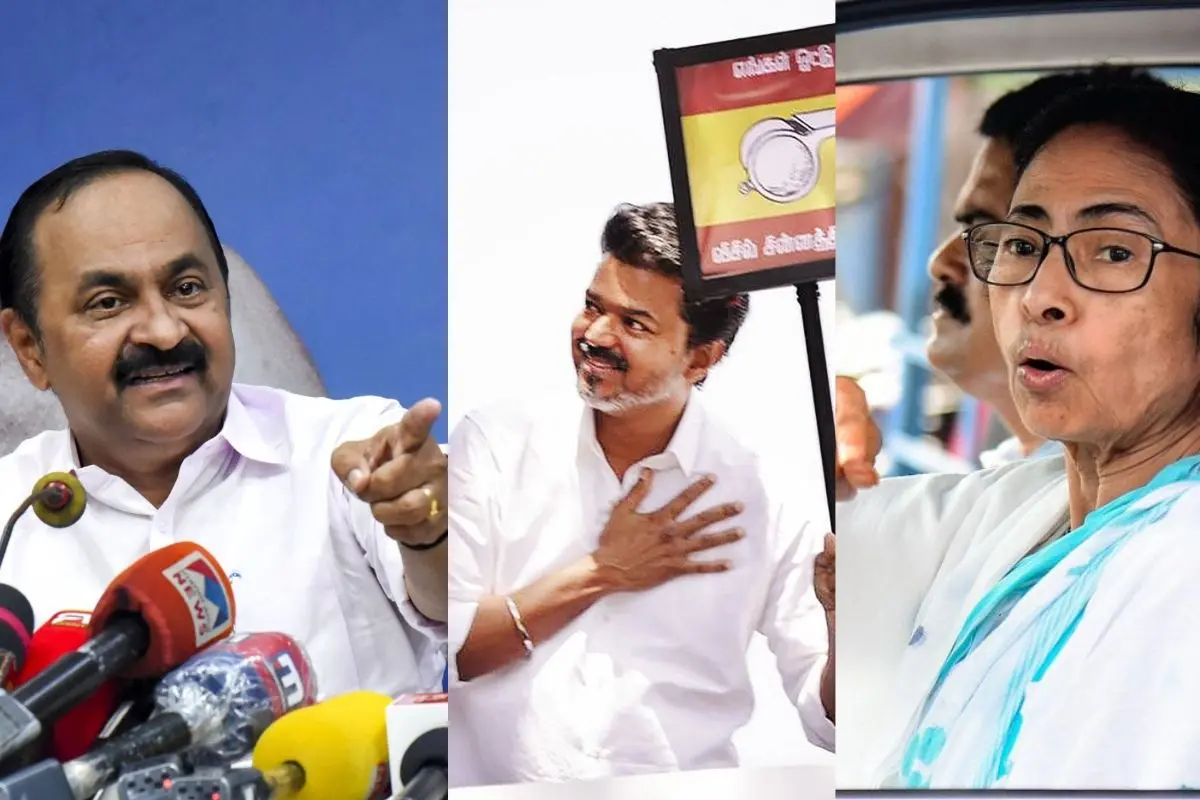
India's political theatre has always had a flair for melodrama. But what is unfolding across the country now is no longer politics that occasionally resembles theatre. It is like theatre accidentally stumbling into politics between costume changes.
West Bengal is staging a tragicomedy in which Mamata Banerjee, after being electorally battered, appears determined to treat democracy as a mere technical inconvenience. In her script, defeat is apparently not a verdict but a misunderstanding that requires prolonged clarification. One half expects a courtroom monologue, thunder in the background and a violin score swelling, while constitutional propriety quietly jumps out of the nearest window.
Tamil Nadu, meanwhile, has decided to produce a different genre altogether. There, MK Stalin exits with the solemnity of a statesman while actor Vijay's TVK storms the stage like a political blockbuster with a first weekend collection nobody anticipated. TVK emerges as the single largest party, falls short by a handful of seats and then encounters the Governor performing interpretative constitutional dance to avoid inviting the obvious claimant to form the government.
Also Read: Kerala votes for a political reboot
And somewhere in the middle of this national carnival stands the Congress party, wandering from tent to tent like a confused stage actor who has forgotten which play he was originally hired for.
In West Bengal, Rahul Gandhi spent considerable time accusing Mamata Banerjee of enabling the BJP. Fair enough, one might say, until one notices the Congress contesting nearly 270 seats despite possessing the electoral muscle of an underfed harmonium in the state. The result was not the Congress rising heroically from the ashes. The result was anti-BJP votes being sliced as thin as a cucumber at a five-star buffet. What makes this deliciously absurd is that the TMC is supposedly a partner in the INDIA alliance. Which means the Congress now belongs to that rare political species capable of fighting an ally with greater enthusiasm than it fights the actual opponent. One almost admires the consistency of the confusion.
Also Read: 5 big reasons why voters chose Vijay as their new 'Nayagan'
Then comes Tamil Nadu. Where, without the DMK, Congress would struggle to win a spirited argument at a tea shop, let alone win parliamentary seats. The DMK practically oxygenates the Congress presence in the state. Yet the moment Vijay's TVK emerges as a serious force, Congress suddenly develops ideological flexibility bordering on some yogic transcendence. Overnight, the party appears willing to support TVK and even negotiate for ministerial berths. Imagine the spectacle.
A party sustained electorally by one ally is now enthusiastically flirting with the rival claimant to power because the electoral winds have shifted direction. At this point, one suspects the Congress high command views ideology the way people view gym memberships. Wonderful to possess, but rarely used consistently.
But in Kerala, the subplot overtakes the main feature. Elsewhere in India, politics is descending into farce. In Kerala, however, the Congress has elevated farce into fine art. The UDF secures a massive victory. The LDF is handed a humiliating defeat. And the man widely seen as the principal architect of that victory, VD Satheesan, suddenly finds himself in danger of being politely escorted away from the throne room while Delhi searches for a more obedient occupant. Enter KC Venugopal.
Like a character introduced in the third act by a screenwriter who has run out of coherent ideas, Venugopal appears from Delhi with sudden chief ministerial aspirations. And then, as though the plot required additional comic layering, Ramesh Chennithala too enters the frame, ensuring that the audience loses track of whether this is a political transition or the casting call for a sequel nobody requested. The message from the Congress high command could not be clearer if delivered through a neon billboard.
* You may build the campaign.
* You may energise the cadre.
* You may dismantle the ruling front.
* You may engineer the victory.
But succession shall still be decided in Delhi drawing rooms by individuals who treat state units the way medieval monarchs treated distant provinces.
Rahul Gandhi's speeches frequently invoke internal democracy with the devotional sincerity of a man reading poetry under moonlight. Unfortunately, the party's operational structure often resembles a Mughal court, with better media management. And therein lies the real satire.
The Congress today wishes to function simultaneously as a decentralised democratic movement, a family enterprise, an ideological resistance platform, and a coalition-dependent electoral machine. This is rather like attempting to be Marx, Gandhi, Machiavelli and a district-level broker at the same time. The resulting spectacle is magnificent in its confusion.
Also Read: Did SIR really bring down Mamata Banerjee in West Bengal election 2026?
In Bengal, they weaken an ally while warning about the BJP. In Tamil Nadu, they survive because of one ally while negotiating with another emerging rival. In Kerala, they risk alienating the very leader who delivered them political resurrection because the high command's instinct for loyalism remains stronger than its instinct for political gratitude. And throughout this entire travelling circus, Rahul Gandhi wanders through the narrative like a well-meaning but chronically bewildered intellectual who arrived at a knife fight carrying lecture notes on constitutional morality.
The tragedy for the Congress is that some of Rahul Gandhi's criticisms of the BJP are not even wrong. But a party cannot sermonise endlessly about democracy while internally operating through intrigue, reeking of entitlement and durbar calculations. Voters eventually notice the contradiction.
What we are witnessing now is not merely electoral confusion. It is the slow fragmentation of authority within opposition politics itself. Regional satraps possess actual vote banks, organisational depth and political instincts sharpened by survival. The national leadership often relies on rhetoric, press conferences, and nostalgia. And Indian voters, whatever else may be said about them, can smell political insincerity from astonishing distances.
Perhaps that is why this entire national tableau feels less like democratic politics and more like an overextended political satire written by somebody with a savage sense of humour and absolutely no respect left for institutional dignity. Every state has become its own theatre company. West Bengal performs defiance. Tamil Nadu performs constitutional suspense. Kerala performs factional Shakespeare.
And the Congress party, magnificently and repeatedly, performs self sabotage with the confidence of an artist convinced it is unveiling genius.
The author is a National Award winner for Best Narration and an independent political analyst. Views expressed are personal